



The Hay Wain 1821 By John Constable

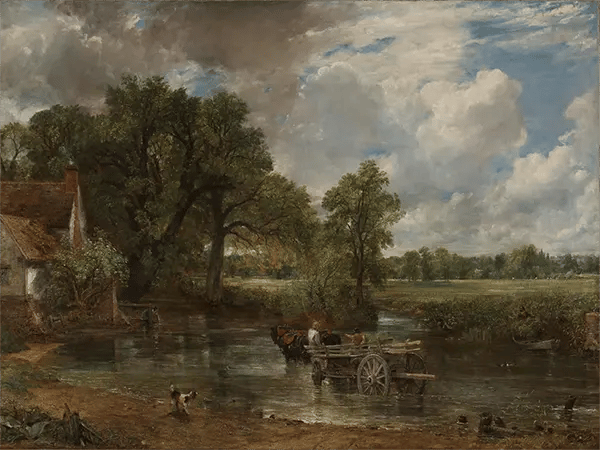

What Is The Hay Wain by John Constable?
The Hay Wain is an oil landscape painting by John Constable depicting rural life on the River Stour in Suffolk and is considered a masterpiece of the British Romanticism art movement.
Representing everyday life with a tranquil vision of agricultural England, it was first exhibited at the Royal Academy. It was the third of Constable’s celebrated “six-foot” landscapes, painted at the peak of his artistic maturity.
Among Constable’s landscapes, The Hay Wain is especially personal. He lived, walked, and worked within this landscape from childhood.
When Did John Constable Paint The Hay Wain?
It was painted in 1821 and depicts the River Stour in Suffolk, near the artist’s childhood home, and reflects the countryside he knew.
The tranquil composition centers on the millpond at Flatford, once part of a working watermill leased and operated by the Constable family for grinding corn. The mill survives today and remains a popular historical site. This region is now widely known as Constable Country and is inseparable from the artist’s legacy.
Although the mill itself is not visible in the painting, the building on the left is Willy Lott’s Cottage, which still stands. During Constable’s youth, the cottage was leased by a local woman named Willy Lott, whose home appears repeatedly throughout his work.
Why Did John Constable Choose This Composition?
Constable chose this composition to portray a deeply familiar landscape, using everyday rural life to express the connection between people and the natural world.
The hay wagon, river crossing, and working figures reflect everyday agricultural life.
The title refers to a wain, a wooden wagon used to transport hay for winter feed. Carefully observed details reveal Constable’s emotional bond with the area:
- The wagon’s front wheel is already turning, ready to cross the shallow ford
- Haymakers at work with one sharpening his scythe, another loading hay in the distance
- A calm rhythm of labor that reflects harmony between people and nature
Although the scene feels rooted in direct observation, Constable completed much of the painting in his London studio. He relied on memory, oil sketches, and drawings made outdoors, adjusting elements, such as the small boat on the right, for compositional balance rather than strict topographical accuracy.
Why is The Hay Wain Important?
- One of Constable’s six-foot landscapes
- A defining work of British Romanticism art
- A landmark of naturalistic landscape painting
- A lasting symbol of England’s rural heritage
What is the Historical and Artistic Context of The Hay Wain?
Painted during the early Industrial Revolution, it reflects a rural life undergoing rapid social and economic change.
How Does the Painting Reflect a Vanishing Rural World?
The Hay Wain preserves an idealized vision of traditional agricultural life at a moment when industrialization was beginning to transform Britain.
While factories, steam power, and mechanized transport reshaped British life, developments famously explored by J. M. W. Turner, Constable turned instead to the quiet continuity of the countryside he knew firsthand. Raised in rural Suffolk, Constable witnessed these social and economic shifts.
The painting can therefore be read as a quiet yet poignant farewell to an England already beginning to disappear.
Which Artists Influenced Constable’s Style?
Constable was influenced by Dutch Golden Age landscape painters, particularly Jan van Goyen, as well as the dynamic compositions of Peter Paul Rubens.
The low horizons and expansive skies in van Goyen's oil paintings shaped Constable’s approach to atmosphere and space.
Where Is The Hay Wain Located Today?
Today, The Hay Wain is held in the collection of the National Gallery in London.
Constable's most iconic painting forms part of the Museum's main collection, where it is one of its most popular paintings, seen by more than 3 million visitors a year. The painting is signed and dated. When it was cleaned in 1942 and discolored varnish removed, further details of the original painting emerged.
Despite strong critical praise when first exhibited, the painting failed to sell during Constable’s lifetime. This was a lingering disappointment for Constable. However, the painting was later sold as part of a group of works to a dealer for £250. Alongside The Hay Wain were Stour Valley and Dedham Church, and Yarmouth Pier.
Constable's paintings were sent to Paris and exhibited at the 1824 Salon, where they caused a sensation. Reflecting on this success, Constable wryly remarked that the “peaceful farmhouses of Suffolk” had stirred the emotions of the “gay and frivolous” Parisians.
What Does The Hay Wain Represent?
The Hay Wain represents an idealized vision of rural England, celebrating continuity, tradition, and the value of agricultural labor. It conveys Constable’s emotional attachment to the countryside and his belief in nature as a source of truth and meaning.
Why Does The Hay Wain Still Matter Today?
More than two centuries later, The Hay Wain endures as a defining image of English landscape painting and Constable’s most celebrated work.
The Hay Wain represents the continuity and tradition of agricultural labor. Although initially better received in France than in Britain, Constable's painting is world-renowned as one of the defining images of rural England.
Its lasting importance lies in:
- Authentic observation grounded in lived experience
- Masterful handling of light, sky, and natural color
- Emotional honesty and respect for everyday rural labor
The Hay Wain endures as a symbol of England’s pastoral heritage and as John Constable’s most beloved masterpiece.
Because of its central place in British art history and continued study by museums and scholars, The Hay Wain is among our most requested museum-quality oil reproductions. Each piece is hand-painted by academically trained artists using traditional oil techniques, ensuring authenticity to Constable’s original brushwork and tonal structure.
We have been creating museum-quality fine art oil reproductions since 1996, working from high-resolution archival references and curatorial documentation to ensure historical accuracy.
We offer a 100% money back guarantee or replacement service. If for any reason you are dissatisfied with your painting please contact us within 7 days of receipt, advising the reason you are unhappy and we will provide you with all the information you need for its return or replacement.
We ship free to anywhere in the world via FedEx or DHL expedited service with online tracking.
Your painting will be shipped rolled in strong plastic tubing, ready for stretching and/or framing locally. This is the conventional method of transporting hand-painted oil on canvas. Learn more about how your painting is shipped.
We are able to offer a framing service intercontinental U.S. Please contact us if you would like a quotation. Alternatively, should you prefer, we can recommend a framer in your area.
Your painting will be shipped directly from our Studio in Thailand.
Notes About Your Painting
All of our paintings come with a 7.5cm (just under 3") clean surplus canvas so the framer can achieve good leverage and easy stretching.


Cannot Find What You Are Looking For?
Reproduction Gallery Information
Customer Service

(Send Us A Message)

Tel: (302) 513 3464