



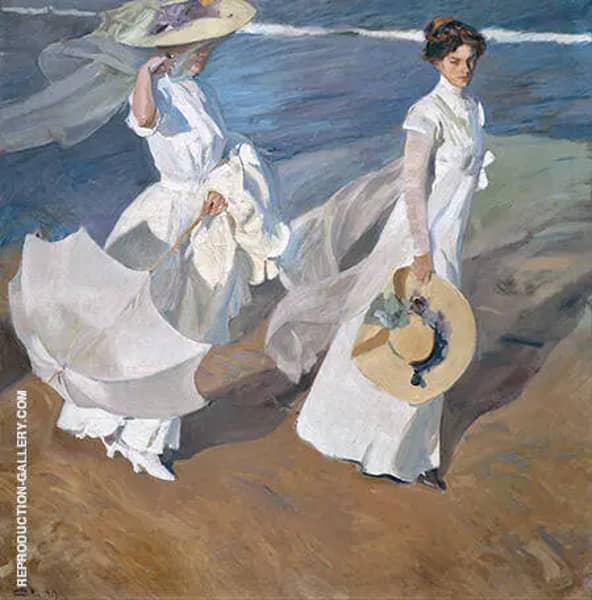
Strolling along the Seashore 1909 By Joaquin Sorolla


What Is Strolling Along the Seashore (1909) by Joaquín Sorolla?
Strolling Along the Seashore (1909) is a celebrated oil-on-canvas painting by Joaquín Sorolla, widely known as the Spanish Master of Light, created at the height of his international success. The composition depicts two elegantly dressed figures walking along the Mediterranean shoreline, their white garments animated by sunlight, sea reflections, and coastal wind.
Widely regarded as a masterwork of Sorolla’s mature career, the painting exemplifies his ability to combine observational realism with the fleeting effects of Mediterranean light, securing its place among the most internationally recognized of his beach scenes. The painting is held in Spain’s national collections and is closely associated with the Museo Sorolla in Madrid.
Why Is Strolling Along the Seashore One of Joaquín Sorolla’s Most Famous Paintings?
Strolling Along the Seashore is best known for its extraordinary depiction of natural light interacting with movement. The figures appear to progress through the sea breeze, while the water surface flickers with layered blues, greens, and silvery highlights that suggest continuous motion.
Art historians frequently identify the painting as a defining example of Sorolla’s combination of Impressionist light effects with Spanish realist traditions.
Curatorial scholarship from Spanish museums, including the Museo del Prado, describes Sorolla’s mature beach paintings as achieving a balance between modern perceptions of light and established realist technique at the turn of the 20th century.
Who Are the Figures in Strolling Along the Seashore?
The figures are widely believed to represent Sorolla’s wife, Clotilde García del Castillo, and their daughter María. Their presence transforms the scene from a generalized beach view into a personal depiction of family life captured in motion.
This blending of intimate subject matter with technical precision is characteristic of Sorolla’s mature work, contributing to the emotional warmth that distinguishes his coastal paintings from those of many contemporaries.
What Themes Appear in Strolling Along the Seashore?
Central themes include leisure, modern family life, and the lived Mediterranean environment. As in many of Sorolla’s coastal works, everyday moments are elevated through careful attention to atmosphere and spatial rhythm.
These themes reflect Sorolla’s broader artistic objective of depicting Spain through direct observation and lived experience rather than historical narrative, emphasizing how contemporary life is shaped by place and climate.
Why Is Light Central to Strolling Along the Seashore by Joaquín Sorolla?
Light operates as the unifying force in Strolling Along the Seashore. Sorolla carefully observes how sunlight interacts with fabric, skin, sand, and water, creating a dynamic surface in which forms appear to shift and dissolve.
This technical mastery of light is a defining characteristic of Sorolla’s painting practice and a key reason his works continue to be studied, collected, and widely reproduced.
Where Does Strolling Along the Seashore (1909) Fit Within Joaquín Sorolla’s Career?
Painted in 1909, the work dates from a period of exceptional visibility in Sorolla’s career, marked by major international exhibitions and critical success. During these years, he produced many of his most celebrated beach scenes.
Within Sorolla’s broader body of work, Strolling Along the Seashore serves as a benchmark for the visual language that would come to define his international reputation.
Why Does Strolling Along the Seashore Remain Important Today?
Today, Strolling Along the Seashore is valued for its timeless subject matter and technical refinement, continuing to influence painters and remaining among Sorolla’s most frequently reproduced works.
Its enduring popularity underscores Sorolla’s lasting international significance and the continued relevance of his vision across generations and cultures.
Why Does Strolling Along the Seashore Work So Well in Interior Décor and Art Collections?
Beyond its art-historical importance, Strolling Along the Seashore is particularly well suited to curated collections and interior spaces due to its luminous palette, refined subject matter, and timeless Mediterranean atmosphere.
Sorolla’s use of light-filled whites, soft coastal blues, and flowing movement allows the composition to brighten interiors while maintaining a balanced, museum-quality presence.
As one of Sorolla’s most famous paintings, the painting complements a wide range of interiors, from classic and coastal settings to contemporary minimalist spaces. A hand-painted oil-on-canvas reproduction offers collectors a faithful representation of this celebrated work while preserving its visual impact.
We offer a 100% money back guarantee or replacement service. If for any reason you are dissatisfied with your painting please contact us within 7 days of receipt, advising the reason you are unhappy and we will provide you with all the information you need for its return or replacement.
We ship free to anywhere in the world via FedEx or DHL expedited service with online tracking.
Your painting will be shipped rolled in strong plastic tubing, ready for stretching and/or framing locally. This is the conventional method of transporting hand-painted oil on canvas. Learn more about how your painting is shipped.
We are able to offer a framing service intercontinental U.S. Please contact us if you would like a quotation. Alternatively, should you prefer, we can recommend a framer in your area.
Your painting will be shipped directly from our Studio in Thailand.
Notes About Your Painting
All of our paintings come with a 7.5cm (just under 3") clean surplus canvas so the framer can achieve good leverage and easy stretching.
Recently Viewed:


Cannot Find What You Are Looking For?
Reproduction Gallery Information
Customer Service

(Send Us A Message)

Tel: (302) 513 3464