



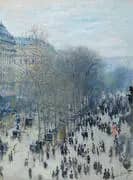
Boulevard des Capucines 1873 By Claude Monet



What Is Boulevard des Capucines by Claude Monet?
Boulevard des Capucines (1873–1874) is an Impressionist oil painting by Claude Monet depicting a snowy winter day on a Parisian boulevard. Exhibited at the First Impressionist Exhibition in 1874, it is considered one of the earliest masterpieces of modern urban painting.
This Impressionist oil painting captures the rhythm, movement, and atmosphere of modern Paris in the late 19th century. Frequently listed among Claude Monet's famous paintings, it remains one of the most studied and collected works associated with the birth of the Impressionist art movement.
When Did Claude Monet Paint Boulevard des Capucines?
Painted between 1873 and 1874, Monet's Boulevard des Capucines is an oil-on-canvas painting measuring approximately 80 x 60 cm (31.5 × 23.6 inches). It depicts one of Paris’s most important Grand Boulevards during a snowy winter day and reflects Monet’s fascination with modern urban life.
How Did the First Impressionist Exhibition Influence This Painting?
In late 1873, Monet and fellow artists rejected by the official Salon de Paris formed the independent Société Anonyme des Artistes Peintres, Sculpteurs et Graveurs. Their revolutionary exhibition, now known as the First Impressionist Exhibition, opened in April 1874.
The show was held at the former studio of photographer Nadar (Gaspard-Félix Tournachon) on the Boulevard des Capucines itself. Exhibitors included Camille Pissarro, Alfred Sisley, and Pierre-Auguste Renoir.
Monet presented several oil paintings, including Impression Sunrise 1873, the most famous Impressionist painting that gave the art movement its name.
Monet Boulevard des Capucines was among the key cityscapes shown, directly connecting the artwork to the historical birth of Impressionism.
Why Did Claude Monet Paint This Street Scene?
Monet painted Boulevard des Capucines to capture the energy of modern Paris, an essential theme across many of Claude Monet's popular paintings. Rather than detailed realism, he used loose, rapid brushstrokes to convey atmosphere, motion, and fleeting light.
Individual figures appear as dark, vibrating shapes against the snow-covered boulevard. From a distance, the composition feels alive with movement; up close, the brushwork dissolves into expressive strokes of gray, blue, and black.
The elevated viewpoint from Nadar’s window creates dramatic perspective lines formed by trees, carriages, and Haussmann-era buildings. This angled composition enhances the sense of dynamism and reflects Monet’s exploration of modern urban experience.
How Was the Painting Received by Critics in 1874?
The critic Ernest Chesneau offered a mixed review. From afar, he praised the painting as a “masterpiece” showing a flowing “stream of life.” Yet up close, he criticized what he perceived as unfinished brushwork.
His reaction reflects the broader controversy surrounding early Impressionist paintings. Many critics initially viewed Monet’s technique as sketch-like rather than complete. However, even skeptics acknowledged the painting’s innovation and its potential influence on the future of modern art.
Where Is the Location Depicted in Monet Boulevard des Capucines?
The painting depicts the Boulevard des Capucines in Paris, one of the city's historic Grand Boulevards redesigned during the modernization of the city in the 19th century.
The street spans the 2nd and 9th arrondissements and was a vibrant cultural center. Its name derives from a former Capuchin convent located nearby before the French Revolution.
Monet painted the scene from the elevated window of Nadar’s studio at No. 35. From this vantage point, he observed the winter crowd, carriages, and tree-lined boulevard below, transforming an everyday Parisian street into one of the most iconic subjects in Impressionist art.
Where Is the Original Monet Boulevard des Capucines Today?
One version of Monet Boulevard des Capucines is housed at the Nelson-Atkins Museum of Art in Kansas City, Missouri. Another version is located at the Pushkin State Museum of Fine Arts in Moscow.
Art historians continue to debate which version was exhibited in 1874. Many scholars believe the Moscow painting may have been the canvas displayed at the First Impressionist Exhibition, though documentation remains inconclusive.
Why Is Monet Boulevard des Capucines Important in Art History?
Monet Boulevard des Capucines represents a pivotal turning point in Modern Art. It embodies the radical shift away from academic finish toward atmospheric perception, an approach that defined Impressionism.
Today, the painting is consistently ranked among Claude Monet's famous paintings and remains one of the most recognizable Impressionist cityscapes ever created. Its innovative brushwork and urban subject matter helped redefine what could be considered a finished painting.
For collectors seeking Claude Monet paintings for sale, it is essential to choose reproductions that honor the integrity of the original masterpiece.
At Reproduction-Gallery.com, every Monet painting is 100% hand-painted in oil on canvas by professional fine-art artists; it is never printed, giclée transferred, or machine produced.
Using museum-quality materials and carefully studied historical color accuracy, each reproduction reflects the brushwork, atmosphere, and tonal balance that define Monet’s Impressionist technique. A museum-quality hand-painted reproduction of Boulevard des Capucines offers collectors the opportunity to own a work connected to the very birth of Impressionism.
We offer a 100% money back guarantee or replacement service. If for any reason you are dissatisfied with your painting please contact us within 7 days of receipt, advising the reason you are unhappy and we will provide you with all the information you need for its return or replacement.
We ship free to anywhere in the world via FedEx or DHL expedited service with online tracking.
Your painting will be shipped rolled in strong plastic tubing, ready for stretching and/or framing locally. This is the conventional method of transporting hand-painted oil on canvas. Learn more about how your painting is shipped.
We are able to offer a framing service intercontinental U.S. Please contact us if you would like a quotation. Alternatively, should you prefer, we can recommend a framer in your area.
Your painting will be shipped directly from our Studio in Thailand.
Notes About Your Painting
All of our paintings come with a 7.5cm (just under 3") clean surplus canvas so the framer can achieve good leverage and easy stretching.



Cannot Find What You Are Looking For?
Reproduction Gallery Information
Customer Service

(Send Us A Message)

Tel: (302) 513 3464