



Liberty Leading the People 1830 By Eugene Delacroix

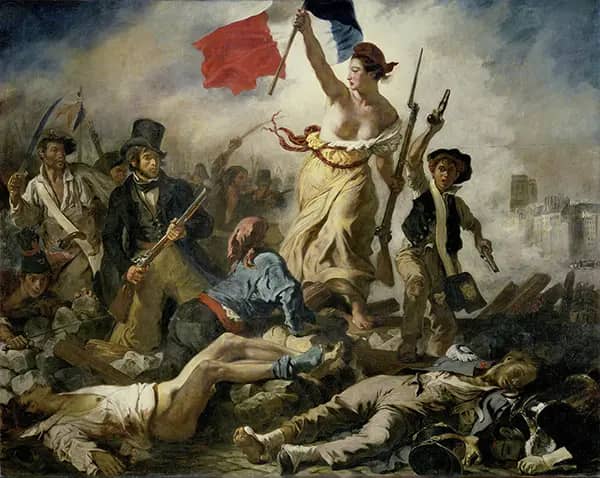

Liberty Leading the People by Eugene Delacroix
Liberty Leading the People represents the July Revolution that swept across France in 1830. It’s one of art history’s most recognizable and radical images, cementing Delacroix’s reputation as a painter of the people.
What does Liberty Leading the People tell us?
Otherwise known as the “three glorious days,” this transformative uprising overthrew King Charles X. The revolution represented the shift from the House of Bourbon to the House of Orléans. It consequently marked the start of popular sovereignty replacing hereditary monarchical rights. Delacroix himself warmly celebrated these developments.
Among Eugene Delacroix's paintings, Liberty Leading the People is unusual for its direct political and patriotic message. The famous woman in the center wears a Phrygian cap, symbolic of freedom for the French people. Waving the French tricolor flag, she stands for the best qualities of liberté, égalité, and fraternité.
However, the tricolor flag, a prominent feature in the painting, only became France’s national emblem after these events. Intriguingly, a second, smaller tricolor is just discernible, fluttering from the towers of Notre-Dame Cathedral in the background.
Is Delacroix's painting patriotic?
Liberty Leading the People is a prime example of a famous patriotic painting. Delacroix enhanced the partisan message by choosing individuals in the crowd below. Comprising workers, children, students, fighters, and even the upper classes, the diverse group represents the universal consequences of the French Revolution.
The upper classes are identifiable through the man in a top hat, the student by a traditional bicorne, and the revolutionary worker recognizable as the young boy holding pistols. What unites all these figures, though, is their fierce determination for freedom. Likely borrowed from a print by Nicolas Charlet, an illustrator particularly admired by Delacroix for his energetic and realistic compositions, their exact identities are topics of lively debate.
With plenty of guns, swords, and corpses scattered amongst the chaotic urban scene, it is no simple, revolutionary celebration. However, on the contrary, the heavy price exacted by the French populace is clear.
Delacroix wrote to his brother about the painting, describing it as a “modern subject.” Although he regretted not personally fighting for his country, he nonetheless said, “At least I shall have painted for her.”
Is Liberty Leading the People an example of Romanticism art?
Liberty Leading the People exemplifies the characteristics of Romanticism paintings. As an art movement that rejects logical details and precise drawing, it focuses on emotional responses to modern events in contrast. In Eugene Delacroix’s most famous painting, the woman symbolizes liberty, individuality, and the French Republic itself. Reflecting Romantic sensibilities, she rises barefoot and bare-chested from the rubble.
Many scholars accordingly identify Delacroix’s work as marking the end of the Age of Enlightenment, characterized by classical art styles and academic certainty. Delacroix instead heralds the beginning of a new era in Romantic painting.
Sympathetic to the ideals of the French Revolution, early Romantics saw themselves as cultural revolutionaries. They fought with their pens and paintbrushes for intuition and emotion over capitalist industrialization. Indeed, the notorious Romantic poet Lord Byron inspired other Eugene Delacroix paintings, including Death of Sardanapalus.
Initially considered a dangerous and incendiary artwork, the French government removed the painting from public view. It was simply too political. Despite this, Delacroix's art masterpiece returned to public display after the subsequent revolution of 188 when Louis Philippe, Duke of Orléans, was deposed. It remains on view at the Louvre museum in Paris to this day.
Eugene Delacroix's famous painting has subsequently inspired great works of literature, such as Victor Hugo’s Les Misérables, published in 1862.
We offer a 100% money back guarantee or replacement service. If for any reason you are dissatisfied with your painting please contact us within 7 days of receipt, advising the reason you are unhappy and we will provide you with all the information you need for its return or replacement.
We ship free to anywhere in the world via FedEx or DHL expedited service with online tracking.
Your painting will be shipped rolled in strong plastic tubing, ready for stretching and/or framing locally. This is the conventional method of transporting hand-painted oil on canvas. Learn more about how your painting is shipped.
We are able to offer a framing service intercontinental U.S. Please contact us if you would like a quotation. Alternatively, should you prefer, we can recommend a framer in your area.
Your painting will be shipped directly from our Studio in Thailand.
Notes About Your Painting
All of our paintings come with a 7.5cm (just under 3") clean surplus canvas so the framer can achieve good leverage and easy stretching.
Recently Viewed:


Cannot Find What You Are Looking For?
Reproduction Gallery Information
Customer Service

(Send Us A Message)

Tel: (302) 513 3464