



The Carpet Merchant c1887 By Jean Leon Gerome

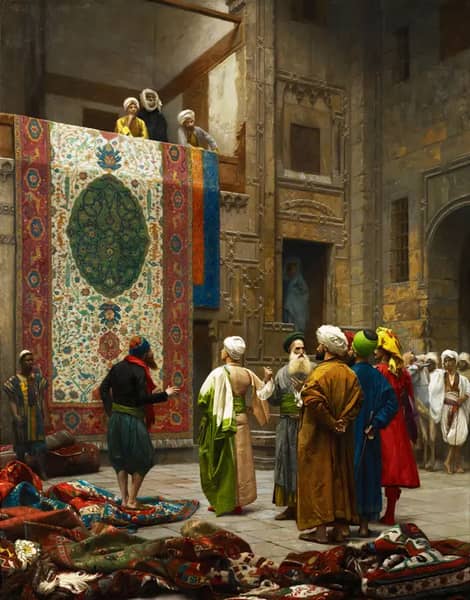

Jean Leon Gerome, The Carpet Merchant, is an outstanding creation of French academic painting.
Completed in 1887, this oil on canvas painting exhibits a strong element of Orientalism and French colonialism.
Jean Leon Gerome's famous paintings include depictions of historical and mythological subjects. His oil paintings reflect his travels in North Africa and the Middle East.
What does The Carpet Merchant painting represent?
In the 1850s, Jean Leon Gerome visited Egypt for the first time. Reflecting the classical "Grand Tour" route, he traveled up the Nile towards Cairo, then proceeded to Jerusalem and Damascus.
This visit shaped his entire artistic creation thereafter. Indeed, the trip marked the beginning of Gerome's Orientalist phase. As a result, many of his paintings depict Arab religious practices and North African landscapes.
Consequently, The Carpet Merchant represents an everyday scene brought to life through the 19th century French imagination.
Gerome's Oriental artworks often blend contemporary stereotyping of the Near East with carefully observed representations of female nudity.
Some of this period's most famous Jean Leon Gerome paintings include "The Slave Market," "Moorish Bath," and "The Black Poet."
While these oil paintings were largely imaginative, they also featured expertly crafted examples of Middle Eastern architecture and idealized academic nude art.
Fascinated by this part of the world, Gerome also collected artifacts and costumes for staging oriental scenes in his studio. Unfortunately, this makes accurately locating the creation of The Carpet Merchant problematic. The painting could have been painted en plein air in Cairo or perhaps in Gerome's Paris atelier.
In 1878, Jean Leon Gerome described how, when exhausted from "long marches under the bright sun," he would paint enthusiastically on location.
He preferred to add just "three touches of color" to paintings of his most vivid memories, sometimes omitting crucial details.
Where is the Carpet Market in Gerome's painting?
The Carpet Merchant painting depicts a scene in Egypt. It reflects a common occurrence in nineteenth-century Egyptian life: the display and bartering of stunning handmade carpets.
Carpets are some of the oldest luxury items purchased as domestic furnishings. They appear in some of the most famous examples of Medieval and Renaissance art, for instance, Hans Holbein's The Ambassadors (1533) and Hans Memling's Virgin with Child (1490).
The carpet market visited by Gerome lay in the capital of Cairo. Visiting the site in 1885, the artist was captivated by the markets, with their luxurious fabrics, bright colors, and distinctive sounds. While the painting depicts several figures, the carpets are the main focal point.
Indeed, draping large rugs from balconies and walls allowed for quick viewing by buyers. The crowd of men possibly debates the merits of the giant carpet towards the left of the composition. The shine of their robes and turbans almost rivals the rugs and carpets in beauty as they all listen intently to the charismatic merchant.
To the right, another group of more modestly dressed men looks on. The woman appearing from a doorway in the background is the only female in the composition.
Similar to other Jean Leon Gerome oil paintings, the architectural patterns of the building are rendered in intricate detail and vivid color.
Why are Jean Leon Gerome's paintings famous?
While Jean Leon Gerome's name is not as well-known today, he was one of the most famous painters of 19th century art. By the end of the 1880s, Gerome's pioneering artwork made him one of the world's most famous living artists.
In addition to the astounding skill of his paintings, Gerome also taught art and ensured the ongoing popularity of the French academic and classical paintings. Already renowned as a leading teacher, The Carpet Merchant painting emerged while Jean-Leon Gerome worked as a Professor at the prestigious Paris École des Beaux-Arts.
Jean Leon Gerome represents a unique historical period through oil paintings such as "The Carpet Merchant" and "The Slave Market." While his paintings reflect entrenched French attitudes towards non-white subjects, they also present unparalleled painterly skill and beauty.
Gerome's Orientalism paintings are instantly recognizable. The Minneapolis Institute of Art owns the original oil-on-canvas painting.
Discover colorful wall art and museum-quality fine art reproductions by French artist Jean-Leon Gerome.
We offer a 100% money back guarantee or replacement service. If for any reason you are dissatisfied with your painting please contact us within 7 days of receipt, advising the reason you are unhappy and we will provide you with all the information you need for its return or replacement.
We ship free to anywhere in the world via FedEx or DHL expedited service with online tracking.
Your painting will be shipped rolled in strong plastic tubing, ready for stretching and/or framing locally. This is the conventional method of transporting hand-painted oil on canvas. Learn more about how your painting is shipped.
We are able to offer a framing service intercontinental U.S. Please contact us if you would like a quotation. Alternatively, should you prefer, we can recommend a framer in your area.
Your painting will be shipped directly from our Studio in Thailand.
Notes About Your Painting
All of our paintings come with a 7.5cm (just under 3") clean surplus canvas so the framer can achieve good leverage and easy stretching.
Recently Viewed:


Cannot Find What You Are Looking For?
Reproduction Gallery Information
Customer Service

(Send Us A Message)

Tel: (302) 513 3464