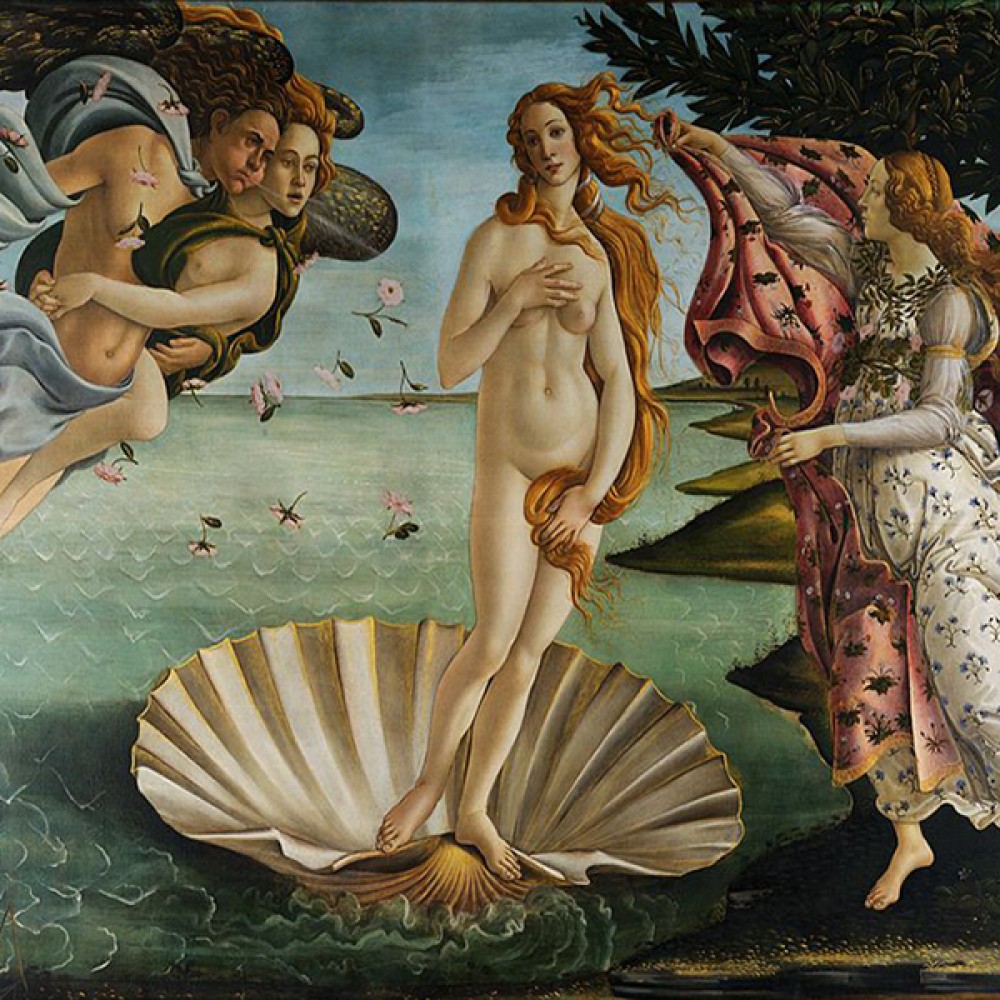




The Birth of Venus c 1483 By Sandro Botticelli

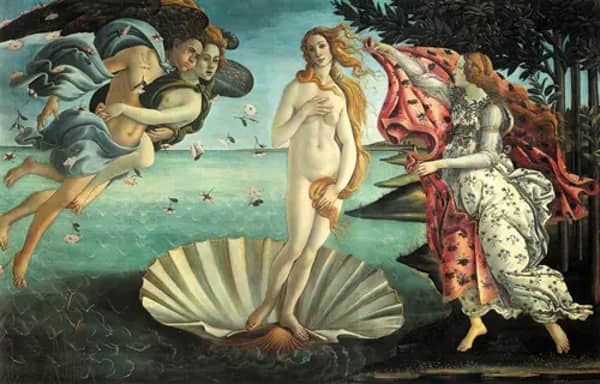

Sandro Botticelli's The Birth of Venus, painted in the mid-1480s, is one of the most recognizable early Renaissance paintings.
Although titled The Birth of Venus, it depicts the moment the goddess Venus arrives on the idyllic shores of Cyprus.
What is the theme of Botticelli's Venus painting?
The painting centers on classical Greek and Roman mythology. As the goddess of love, the sea spray itself gave birth to Venus. Blown towards the shores of Cyprus by the winds Aura and Zephyr, she stands atop a giant scallop shell. Her skin is even more pearlescent than the shell, with Venus’s swirling hair covering her modesty.
Borrowed from classical statues and figurines, Venus’s pose and other compositional elements hark back to Hellenistic artworks in the Medici family’s collection.
On the shore, Venus meets a female attendant whom people identify as either Hora of Spring or one of the three Graces. Botticelli depicts the woman wearing a flowing pink shawl adorned with floral motifs. Many scholars believe Hora of Spring is the more likely candidate, referencing the rose petals blowing through the scene.
Indeed, another celebrated work, Botticelli’s Primavera, also references Spring; created in 1482, it was painted on wood panels, whereas the Birth of Venus is tempera on canvas.
Did the Medici family commission Botticelli's painting?
Likely commissioned by an influential member of the Florentine Medici family, the painting is surprisingly mysterious, given its subsequent fame. Although endlessly analyzed by art historians, Sandro Botticelli’s intentions remain elusive.
Some clues do exist, though, and Giorgio Vasari described the painting hanging in the Villa of Castello, owned by the Medici family. The orange trees at the top right of the composition further support the Medici theory.
Known as “mala medica” in Italian, the orange was associated with the Medici family due to the similarity between their names. The laurel trees are a possible reference to Lorenzo Medici, known as "the Magnificent”.
Despite the lack of firm evidence, art historians believe the painting represents Neoplatonic ideals of pure, divine love. Venus’s pose, combined with attendant winged beings and devoted followers, also reflects the iconography of the Baptism of Christ.
Why is the Renaissance Venus painting important?
Among Sandro Botticelli's famous paintings, the Birth of Venus is notable for its fusion of artistic styles. The painting draws inspiration from Greco-Roman styles and popular Gothic aesthetics, which is particularly evident in the woman’s off-center, slightly curved body.
Venus floats above the shell rather than standing firmly on its surface. Her elongated arms, legs, and body follow the swirls of her golden hair, foreshadowing the later Mannerist art movement approach.
The woman’s pose eschews Classical Realism and would be impossible to hold in reality as her weight is shifted too far to the left. Although an insignificant detail at first glance, this is important to the painting.
Sandro Botticelli rejected dominant naturalistic styles exemplified by contemporaries such as Domenico Ghirlandaio, opting instead for mythological symbolism. As a result, the trees and grass are highly stylized, as is the sky.
Comparably, the azure waves form regular, rhythmic patterns. Even the bulrushes on the left-hand side of the painting are incongruent, as they don’t grow in saltwater environments.
Where is Botticelli's The Birth of Venus painting?
Today, this masterpiece of early Renaissance oil paintings hangs in the Uffizi Gallery in Florence, Italy. The Uffizi Gallery has undergone extensive renovation and expansion in recent years, attracting approximately 2 to 3 million visitors annually. With many new works of art on display, the Gallery is one of Italy's most prominent art museums, located in Florence.
Fine art reproductions are available in our extensive catalog of Renaissance oil paintings and our art collection of Venus Paintings.
We offer a 100% money back guarantee or replacement service. If for any reason you are dissatisfied with your painting please contact us within 7 days of receipt, advising the reason you are unhappy and we will provide you with all the information you need for its return or replacement.
We ship free to anywhere in the world via FedEx or DHL expedited service with online tracking.
Your painting will be shipped rolled in strong plastic tubing, ready for stretching and/or framing locally. This is the conventional method of transporting hand-painted oil on canvas. Learn more about how your painting is shipped.
We are able to offer a framing service intercontinental U.S. Please contact us if you would like a quotation. Alternatively, should you prefer, we can recommend a framer in your area.
Your painting will be shipped directly from our Studio in Thailand.
Notes About Your Painting
All of our paintings come with a 7.5cm (just under 3") clean surplus canvas so the framer can achieve good leverage and easy stretching.
Recently Viewed:


Cannot Find What You Are Looking For?
Reproduction Gallery Information
Customer Service

(Send Us A Message)

Tel: (302) 513 3464