




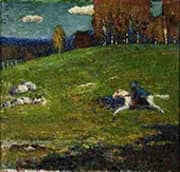
The Blue Rider 1903 By Wassily Kandinsky



What Is The Blue Rider (Der Blaue Reiter) by Wassily Kandinsky?
The Blue Rider (Der Blaue Reiter) is a 1903 painting by Wassily Kandinsky that marks his transition from representational landscape painting to spiritual symbolism and early abstraction, laying the foundation for European Expressionism and modern Abstract Art.
Who Was Wassily Kandinsky?
Wassily Kandinsky (1866–1944) was a Russian painter and art theorist widely regarded as the pioneer of abstract art. His revolutionary approach transformed Modern Art by emphasizing inner experience, spiritual meaning, and emotional resonance rather than faithful depiction of the visible world.
Kandinsky’s Early Life and Artistic Formation
Born in Moscow, Kandinsky spent much of his childhood in Odesa (present-day Ukraine), then a thriving Black Sea port known as the “Pearl by the Sea.” The city’s rich musical and artistic culture shaped his early sensitivity to color, rhythm, and emotional expression.
Although he attended the Grekov Odessa Art School, Kandinsky did not fully commit to painting until his early thirties. A pivotal encounter with Claude Monet’s Haystacks radically altered his understanding of color and form, convincing him that painting could communicate meaning independent of subject matter. Shortly afterward, he moved to Munich, one of Europe’s leading avant-garde centers.
Why Is The Blue Rider Important in Kandinsky’s Career?
Der Blue Rider (1903) is an early Kandinsky painting that synthesizes symbolic color and movement, marking his transition from Impressionism toward abstract art.
How Is the Painting Executed?
Kandinsky applies paint in thick, broken strokes, using stippled brushwork to animate the surface. Green dominates the landscape, while vivid blues and sharp whites punctuate the composition. Autumnal tones of yellow, brown, and auburn suggest seasonal change and emotional transition, reinforcing the painting’s symbolic character.
What Does the Kandinsky's Famous Painting Represent?
On a literal level, the painting depicts a rider in blue galloping across a green meadow on a white horse, passing through a forested landscape. Symbolically, however, the image functions as a metaphor for spiritual passage, movement, and inner transformation rather than narrative storytelling.
Why Is this Painting a Turning Point Toward Abstract Art?
While not academically precise, Der Blue Rider functions as a conceptual bridge between Impressionism and abstraction. Emotional resonance and spiritual intent begin to outweigh faithful representation, anticipating Kandinsky’s later move toward non-objective painting.
What Did the Color Blue Mean to Kandinsky?
Color symbolism was central to Kandinsky’s artistic philosophy. Blue, in particular, represented spiritual depth, intellect, and transcendence. For both Kandinsky and his collaborator, Franz Marc, darker blues were believed to guide the viewer toward the eternal and the unseen.
Kandinsky later expanded these ideas in his influential theoretical writings, including Concerning the Spiritual in Art (1911).
How Does this Painting Express Spiritual Movement?
Through its dynamic composition and symbolic color, Der Blue Rider conveys the idea of spiritual motion rather than physical travel. The rider becomes an emblem of humanity’s inner journey toward higher awareness—a concept that would underpin Kandinsky’s later abstract works.
How Does This Early Work Anticipate Kandinsky’s Later Abstraction?
Although still figurative, Der Blue Rider foreshadows Kandinsky’s fully abstract paintings, such as Several Circles (1926), where recognizable imagery disappears entirely. In these later works, color and form operate independently to create emotional and spiritual harmony.
The Blue Rider (Der Blaue Reiter) and the Art Movement It Inspired
Although painted in 1903, several years before the Der Blaue Reiter movement formally emerged, The Blue Rider established the symbolic imagery and spiritual use of color that later gave the group its name. The blue rider motif became a visual expression of Kandinsky’s belief in art as a vehicle for inner experience and transcendence, principles that would define the Der Blaue Reiter movement founded in 1911 by Kandinsky and Franz Marc.
Which Artists Were Associated with Der Blaue Reiter Group?
Key members included:
Together, they played a defining role in shaping German Expressionism.
Why Did Der Blaue Reiter Movement End?
The movement was tragically short-lived. World War I brought its activities to an abrupt end, with Franz Marc and August Macke killed in combat and Kandinsky returning to Russia.
In 1923, Kandinsky co-founded Die Blaue Vier (The Blue Four), extending the spiritual and abstract ideals of Der Blaue Reiter to international audiences, particularly in the United States.
We offer a 100% money back guarantee or replacement service. If for any reason you are dissatisfied with your painting please contact us within 7 days of receipt, advising the reason you are unhappy and we will provide you with all the information you need for its return or replacement.
We ship free to anywhere in the world via FedEx or DHL expedited service with online tracking.
Your painting will be shipped rolled in strong plastic tubing, ready for stretching and/or framing locally. This is the conventional method of transporting hand-painted oil on canvas. Learn more about how your painting is shipped.
We are able to offer a framing service intercontinental U.S. Please contact us if you would like a quotation. Alternatively, should you prefer, we can recommend a framer in your area.
Your painting will be shipped directly from our Studio in Thailand.
Notes About Your Painting
All of our paintings come with a 7.5cm (just under 3") clean surplus canvas so the framer can achieve good leverage and easy stretching.
Recently Viewed:


Cannot Find What You Are Looking For?
Reproduction Gallery Information
Customer Service

(Send Us A Message)

Tel: (302) 513 3464