




Water Lilies 1916 By Claude Monet

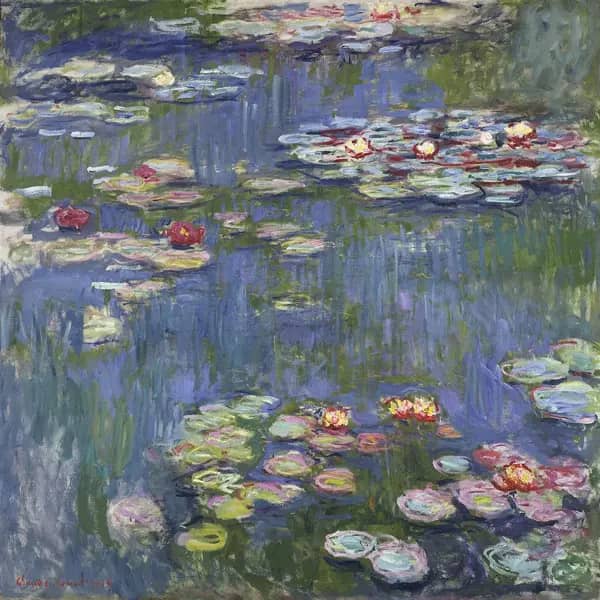

Water Lilies (1916) by Claude Monet is a major late work within his celebrated Water Lilies series. The motif of floating lilies, revisited more than 250 times, is the culmination of Monet’s artistic vision, remaining one of the defining achievements of Impressionism.
How Large Is Claude Monet’s Water Lilies (1916)?
Water Lilies (1916) measures just over 200 by 201 centimeters (78.7 × 79.1 inches), making it smaller than many of Monet’s later panoramic panels. Despite this more contained format, Monet's famous painting conveys remarkable movement and chromatic vitality, distilling the essence of his mature style.
What Does Water Lilies (1916) Depict?
Signed and dated by Claude Monet on the lower left-hand side, the painting depicts the artist’s famed lily-covered pond in the gardens of Giverny, the private landscape that became Monet’s most enduring source of inspiration.
How Many Water Lilies Paintings Did Claude Monet Create?
Claude Monet painted over 250 oil paintings as part of his Water Lilies series, a body of work that dominated the final decades of his life and represents one of the most sustained thematic explorations in European art.
Why Was Monet’s Garden at Giverny So Important?
After settling permanently in Giverny, Monet transformed his property into a living studio, carefully designing the garden to serve as an endless source of motifs. Over time, the lily pond became the dominant subject of his final decades.
How Did Monet Create the Water Lily Pond?
To create the pond, Monet diverted a branch of the Epte River and employed a team of gardeners to cultivate exotic plants, willows, and Japanese-inspired bridges. The project was so central to his life that he later described the garden as his “finest masterpiece.”
What Makes Water Lilies (1916) Artistically Significant?
By 1916, Monet had explored the Water Lilies motif for nearly two decades. In this oil painting, dissolving contours and layered color harmonies move beyond Impressionist description toward a more immersive, atmospheric vision, an approach that would later influence aspects of later Expressionist and Abstract Art painting.
Painted during World War I, the work belongs to a pivotal moment in Monet’s late career, when he was simultaneously developing the monumental Nymphéas panels for the Musée de l’Orangerie. The increasingly expansive surfaces and blurred forms of the 1916 painting anticipate the panoramic environments later installed in Paris.
Unlike his earlier explorations of Haystacks, cathedrals, and poplars, the water lilies offered an endlessly shifting surface of reflection and color. The motif allowed Monet to merge observation with abstraction, sustaining his interest for more than twenty years.
Why Did Monet Remove the Horizon Line?
In Water Lilies (1916), Monet focuses exclusively on the pond’s surface, omitting land and sky entirely. Only fleeting reflections suggest their presence, immersing the viewer in an abstracted world of color, movement, and light.
Why Did Water Lilies Become an Obsession for Monet?
Despite his earlier subjects, the water lilies at Giverny held a unique and lasting allure. While the precise reason for Monet’s obsession remains uncertain, the interplay of natural beauty, color, reflection, and artistic experimentation clearly played a central role.
How Did Personal Loss and Illness Affect Monet’s Water Lilies?
Many of Monet’s later Water Lilies paintings were created after the death of his wife, Alice, in 1911. Following this loss, his compositions grew larger and more immersive, with brighter color accents and increasingly expressive brushwork.
How Did Cataracts Influence Monet’s Style?
During his later years, Monet suffered from advanced cataracts, which altered his perception of color and light. The softened outlines and intensified reds and yellows visible in some late canvases reflect this physiological shift in vision.
Where Is Monet’s Water Lilies (1916) Located Today?
The painting is part of the permanent collection of the National Museum of Western Art in Tokyo, where it remains one of the museum’s most celebrated Impressionist paintings.
Why Is Water Lilies One of Monet’s Most Famous Paintings?
Today, Monet's Water Lilies reproduction is one of our most popular paintings. Its immersive composition, chromatic subtlety, and historical importance continue to attract scholars, museum visitors, and art-lovers worldwide.
We offer a 100% money back guarantee or replacement service. If for any reason you are dissatisfied with your painting please contact us within 7 days of receipt, advising the reason you are unhappy and we will provide you with all the information you need for its return or replacement.
We ship free to anywhere in the world via FedEx or DHL expedited service with online tracking.
Your painting will be shipped rolled in strong plastic tubing, ready for stretching and/or framing locally. This is the conventional method of transporting hand-painted oil on canvas. Learn more about how your painting is shipped.
We are able to offer a framing service intercontinental U.S. Please contact us if you would like a quotation. Alternatively, should you prefer, we can recommend a framer in your area.
Your painting will be shipped directly from our Studio in Thailand.
Notes About Your Painting
All of our paintings come with a 7.5cm (just under 3") clean surplus canvas so the framer can achieve good leverage and easy stretching.
Recently Viewed:


Cannot Find What You Are Looking For?
Reproduction Gallery Information
Customer Service

(Send Us A Message)

Tel: (302) 513 3464