



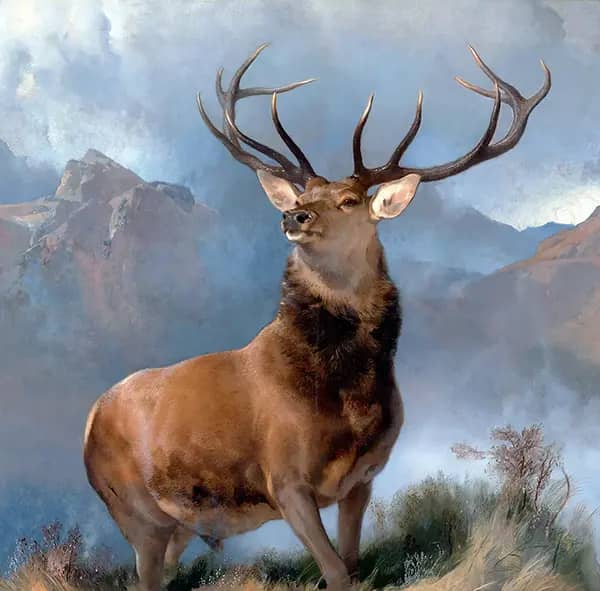
Monarch of The Glen 1851 By Edwin Henry Landseer


Why Is Monarch of the Glen One of the Most Famous Scottish Paintings?
Sir Edwin Landseer’s Monarch of the Glen is one of the most instantly recognizable works of Scottish art and one of the most famous animal paintings of the 19th century. Widely reproduced and embedded in popular culture, the image has become a lasting symbol of the Scottish Highlands.
The painting is widely regarded as iconic because it combines historical significance, powerful symbolism, and exceptional technical skill:
- Painted by Sir Edwin Landseer in 1851
- Iconic depiction of a royal red deer stag with twelve-point antlers
- Enduring symbol of the Scottish Highlands and national identity
- One of the most widely reproduced images in British popular culture
- Frequently cited as a defining example of Victorian animal painting
This monumental depiction of a red deer stag combines technical mastery with powerful symbolism, establishing the work as both a celebrated artistic achievement and a subject of long-standing cultural debate.
Art historians and curators at the National Galleries of Scotland consistently cite Monarch of the Glen as one of the defining animal paintings of Victorian Britain.
When was the Monarch of the Glen painted?
Monarch of the Glen was created as part of a prestigious series commissioned for the Palace of Westminster in London. The painting depicts a powerful red deer stag emerging from mist-covered Highland terrain, emphasizing solitude, dominance, and symbolic authority.
The stag’s twelve-point antlers identify it as a “royal stag,” a detail that made the subject especially appropriate for a building associated with British governance and imperial symbolism. Art historians widely identify the setting as Glen Affric, an area of outstanding natural beauty located approximately fifteen kilometers west of Loch Ness.
Why Did Monarch of the Glen Become Controversial?
Despite its popularity, Monarch of the Glen became increasingly controversial over time. Critics argued that the image helped promote romanticized and clichéd visions of the Scottish Highlands, reinforcing idealized stereotypes of wilderness, masculinity, and dominance.
Commentators have described the painting as a “swirling storm of Victorian melodrama” and, more critically, as an example of cultural colonialism. These interpretations emphasize the tension between the painting’s visual authority and its role in shaping externally imposed narratives of Scottish identity.
Nevertheless, art historians continue to regard Monarch of the Glen as one of the most accomplished animal paintings of the 19th century, noted for its compositional strength, psychological presence, and exceptional technical mastery.
What Makes the Composition of Monarch of the Glen So Powerful?
In the painting, the stag emerges from heather-covered hills, partially veiled by Highland mist. Landseer’s carefully controlled composition directs the viewer’s attention toward the animal, emphasizing its scale, physical power, and commanding presence.
The structured relationship between foreground and background creates subtle movement and visual tension, drawing the viewer toward the proud, solitary figure. This compositional precision is a key reason the painting remains visually compelling more than a century after its creation.
Why Are Edwin Landseer’s Paintings So Famous?
Sir Edwin Landseer was one of the most celebrated British artists of the 19th century. An English painter favored by Queen Victoria, he held a prominent position within the Royal Academy of London and enjoyed extraordinary public recognition during his lifetime.
Landseer achieved international acclaim for his animal paintings, which combined anatomical accuracy with emotional expression. His ability to suggest character and psychology without sacrificing realism made his work highly influential across British and European art.
What Are Edwin Landseer’s Most Famous Animal Paintings?
In addition to Monarch of the Glen, Landseer produced several other iconic animal works, including:
- The stone lions at the base of Nelson’s Column, Trafalgar Square
- The horses in The Arab Tent
- Animal figures in A Midsummer Night’s Dream
From the 1840s onward, Landseer became especially known for his stag paintings, inspired by sporting trips to the Scottish Highlands. Notable examples include The Highland Nurses and Highland Deer.
How Do Landseer’s Stag Paintings Reflect Scottish History?
Landseer’s stag paintings display remarkable observational detail, reflecting firsthand study of animal anatomy and Highland environments. At the same time, they carry significant historical and social implications.
During the period of the Highland Clearances, stag hunting became increasingly associated with English upper-class sporting culture, at a time when many Scottish communities were being displaced.
As a result, Monarch of the Glen has been interpreted as symbolizing the prioritization of elite sporting pursuits over the lived realities of Scottish communities, adding a complex political dimension to the painting.
Was Monarch of the Glen Well Received When It Was First Painted?
Despite its current fame, Monarch of the Glen was not initially well received. The painting was commissioned for the Refreshment Rooms of the House of Lords, but the House of Commons refused to pay for it upon completion.
Although this refusal was related to funding disputes rather than artistic quality, Landseer never received the promised £150 payment. As a result, the series of Westminster paintings, including Monarch of the Glen, entered private ownership.
Who Owns Monarch of the Glen Today?
Monarch of the Glen is now owned by the National Galleries of Scotland in Edinburgh. In 2017, the institution launched a major public fundraising campaign, successfully raising £4 million to secure the painting for the nation.
What Is the Ownership History of Monarch of the Glen?
The painting has a complex and well-documented provenance:
- Exhibited in 1851, 1874, and 1890
- Owned by William Denison, 1st Earl of Londesborough, by 1884
- Later owned by Henry Eaton, 1st Baron Cheylesmore
- Sold at Christie’s in 1892 for £7,245
- Purchased again at Christie’s in 1916 by Pears Soap Company, which used it extensively in advertising
- Later acquired by John Dewar & Sons, where the stag became a whisky trademark
- The stag image remains associated with Glenfiddich whisky branding
In 1997, Diageo acquired Dewar’s distillery and loaned the painting to the National Gallery of Scotland. Although valued at £8 million, Diageo agreed to sell the painting for half that amount, enabling its permanent acquisition through public funding.
Why Does Monarch of the Glen Still Matter Today?
Today, Monarch of the Glen remains one of the most discussed and widely reproduced images in British art history. Its enduring visibility reflects both its artistic impact and its ongoing relevance within debates about nationalism, representation, and cultural ownership.
The painting stands simultaneously as a masterpiece of 19th-century animal painting and as a contested emblem within modern discussions of Scottish identity.
Where Can You Find Reproductions of Edwin Landseer’s Paintings?
Monarch of the Glen forms part of our curated Art Collection of Famous Animal Paintings. High-quality reproductions allow collectors and art lovers to appreciate Landseer’s mastery while engaging with the painting’s rich historical context.
Monarch of the Glen forms part of our curated collection of historically accurate animal paintings. Our hand-painted reproductions of Sir Edwin Landseer’s works allow collectors and art lovers to engage with these iconic images while preserving their artistic and historical integrity.
We offer a 100% money back guarantee or replacement service. If for any reason you are dissatisfied with your painting please contact us within 7 days of receipt, advising the reason you are unhappy and we will provide you with all the information you need for its return or replacement.
We ship free to anywhere in the world via FedEx or DHL expedited service with online tracking.
Your painting will be shipped rolled in strong plastic tubing, ready for stretching and/or framing locally. This is the conventional method of transporting hand-painted oil on canvas. Learn more about how your painting is shipped.
We are able to offer a framing service intercontinental U.S. Please contact us if you would like a quotation. Alternatively, should you prefer, we can recommend a framer in your area.
Your painting will be shipped directly from our Studio in Thailand.
Notes About Your Painting
All of our paintings come with a 7.5cm (just under 3") clean surplus canvas so the framer can achieve good leverage and easy stretching.



Cannot Find What You Are Looking For?
Reproduction Gallery Information
Customer Service

(Send Us A Message)

Tel: (302) 513 3464