



The Last Supper By Leonardo da Vinci

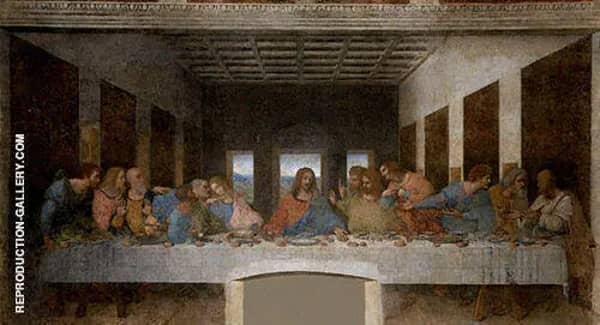

The Last Supper (1495–1498) by Leonardo da Vinci is one of the most famous and influential Renaissance mural painting of all time. Widely regarded as a masterpiece of Western art, the monumental mural has shaped religious imagery, artistic composition, and visual storytelling for over five centuries.
Known in Italian as L’Ultima Cena, the mural measures approximately 460 × 880 cm (15 × 29 feet). Aside from the decorations in the Sala delle Asse in Milan, The Last Supper is Leonardo’s largest surviving painting. Completed between 1495 and 1498 for the Dominican convent of Santa Maria delle Grazie in Milan, the mural depicts the biblical account of Christ’s final meal with his apostles before his crucifixion, as described in the Gospels of Matthew, Mark, Luke, and John.
What Is the Meaning of The Last Supper by Leonardo da Vinci?
Leonardo represents the precise moment immediately after Jesus declares, “One of you will betray me” (John 13:21), capturing the psychological and emotional shock that ripples across the table. Rather than depicting the Eucharist, Leonardo da Vinci focuses on human emotion, portraying each apostle’s distinct psychological reaction to Christ’s announcement.
Some react with anger, sadness, or surprise, yet others attempt to remonstrate or plead with Christ. Due to the complexity of the painting, it is worthwhile examining each member of the group.
Leonardo organizes the apostles into four groups of three, enhancing both compositional balance and symbolic references to the Holy Trinity:
- Far Right: Matthew, Jude Thaddeus, and Simon the Zealot confer urgently.
- Next Group: James the Greater, Philip, and Thomas react with disbelief; Thomas’ raised finger foreshadows later events.
- Center: Jesus forms a stable triangular shape, symbolizing divine harmony.
- Left of Christ: Judas Iscariot, John, and Peter embody tension; Judas withdraws into the shadow, clutching his purse of silver.
- Far Left: Bartholomew, Andrew, and James (son of Alphaeus) recoil in distress.
This grouping system strengthens both narrative clarity and symbolic structure, an innovation that influenced Renaissance religious art for centuries.
Why Is The Last Supper Considered One of the Most Famous Paintings in the World?
The Last Supper is one of Leonardo da Vinci's famous paintings. Da Vinci’s complete proficiency in space and perspective and the presentation of motion and emotion have secured the work’s place in the canon of famous Renaissance art.
Leonardo masterfully employs linear perspective: Christ’s head forms the central vanishing point, anchoring all orthogonal lines and directing the viewer’s gaze toward him. All the angles and lighting draw the viewer’s attention back to Jesus Christ time and time again. Christ’s downward gaze directs the viewer’s sight along his left arm and towards the bread set to identify Judas.
The mural represents a decisive transition into the High Renaissance, uniting mathematical perspective, anatomical precision, psychological realism, and dramatic chiaroscuro.
Da Vinci's art prioritizes the intensity of color and the juxtaposition of light and shade (known as chiaroscuro). This technique is particularly evident in The Last Supper, where dark recesses contrast with the white walls of the foreground and the disciples’ vibrant, jewel-toned robes.
The painting broadly references traditional Last Supper depictions in its composition. For example, all the disciples sit on one side of the table.
Da Vinci places Judas among his fellow disciples. Unlike most famous religious art, Judas would have been the only character sitting alone on the opposite side of the table. Da Vinci’s compositional change allows Judas to reach out for bread simultaneously with Jesus.
Beyond its artistic mastery, The Last Supper has generated centuries of theological debate, artistic analysis, and modern conspiracy theories—cementing its place in global popular culture.
Are There Hidden Messages in The Last Supper?
The Last Supper fresco is one of the most widely debated paintings in the world. Claims about hidden messages and symbolic codes within the painting intensified following the publication of The Da Vinci Code by Dan Brown in 2003.
One popular modern theory suggests that the figure to Christ’s right (viewer’s left) represents Mary Magdalene rather than the Apostle John. This theory further identifies a letter M in the center of the painting, representing “Matrimonio” (marriage) or Mary Magdalene herself.
However, art historians overwhelmingly identify the figure as the Apostle John, whose youthful and delicate appearance reflects Leonardo’s characteristic use of soft modeling and sfumato. Other famous Da Vinci paintings, such as Saint John the Baptist, have similarly feminine features.
The composition contains recurring groupings of three, traditionally interpreted as references to the Holy Trinity, though more speculative claims regarding the Fibonacci sequence remain unproven.
In a similarly controversial manner, Da Vinci’s fresco does not depict Jesus and his disciples with halos. However, this could be a heretical allusion to their status as mere mortals and ordinary people, rather than divinely inspired figures.
While unproven theories surrounding hidden messages continue to this day, what is certain is that Leonardo da Vinci's famous painting continues to captivate and fascinate audiences in equal measure.
Why Is The Last Supper in Poor Condition Today?
Ludovico Sforza, Duke of Milan, commissioned the mural for the refectory of the Dominican convent of Santa Maria delle Grazie. By the mid-1490s, Leonardo Da Vinci was already an acclaimed artist in high demand. However, his busy schedule meant work progressed slowly over several years.
Indeed, one story relates that a Prior complained to Leonardo about the prolonged delays in completing the painting. The remark infuriated Leonardo, who claimed he'd struggled to find a sufficiently villainous face for Judas, sarcastically adding he’d considered using the nagging Prior’s likeness. While the truth of this tale is uncertain.
Instead of the traditional fresco technique, Leonardo experimented with tempera and oil on dry plaster. While this allowed for slower, more detailed work, the unstable mixture caused the paint to deteriorate rapidly.
Sadly, however, these artistic materials, combined with environmental factors and intentional damage, meant the mural disintegrated quickly. As a result, very little of Leonardo’s original work remains. Despite extensive restoration efforts, most recently completed in 1999, the mural remains fragile, with only a portion of Leonardo’s original surface surviving.
Today, the mural is preserved under carefully controlled environmental conditions and remains part of the UNESCO World Heritage site encompassing Santa Maria delle Grazie in Milan.
Frequently Asked Questions About The Last Supper
Where Is The Last Supper Located Today?
The mural remains in its original location at Santa Maria delle Grazie in Milan, Italy.
What Medium Did Leonardo Use for The Last Supper?
Leonardo used tempera and oil on dry plaster rather than traditional fresco, which contributed to its deterioration.
How Long Did Leonardo Take to Paint The Last Supper?
Leonardo worked on the mural between 1495 and 1498.
Why Is The Last Supper So Famous?
The painting revolutionized religious composition through psychological realism, linear perspective, and dynamic grouping.
Museum-quality hand-painted reproductions of The Last Supper and other Renaissance masterpieces by Leonardo da Vinci are available within our curated fine art collection. Each replica is created using professional-grade oil paints on canvas, allowing collectors to experience the scale, composition, and emotional intensity of this iconic religious art.
We offer a 100% money back guarantee or replacement service. If for any reason you are dissatisfied with your painting please contact us within 7 days of receipt, advising the reason you are unhappy and we will provide you with all the information you need for its return or replacement.
We ship free to anywhere in the world via FedEx or DHL expedited service with online tracking.
Your painting will be shipped rolled in strong plastic tubing, ready for stretching and/or framing locally. This is the conventional method of transporting hand-painted oil on canvas. Learn more about how your painting is shipped.
We are able to offer a framing service intercontinental U.S. Please contact us if you would like a quotation. Alternatively, should you prefer, we can recommend a framer in your area.
Your painting will be shipped directly from our Studio in Thailand.
Notes About Your Painting
All of our paintings come with a 7.5cm (just under 3") clean surplus canvas so the framer can achieve good leverage and easy stretching.


Cannot Find What You Are Looking For?
Reproduction Gallery Information
Customer Service

(Send Us A Message)

Tel: (302) 513 3464