



The Sleeping Gypsy 1897 By Henri Rousseau

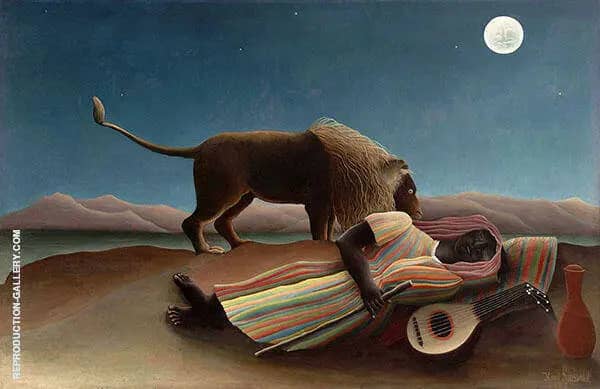

The Sleeping Gypsy by Henri Rousseau is one of the most famous examples of primitive art. His oil on canvas painting reveals a mysterious atmosphere and imaginative subject matter that has captivated art lovers ever since its inception.
When did Henri Rousseau Paint The Sleeping Gypsy?
Painted in 1897, The Sleeping Gypsy is a dream-like depiction of a woman and a lion, illuminated by the light of the moon.
The painting was first shown at the Paris Salon des Indépendants that same year. As a proud resident of Laval, a municipality in western France, Rousseau hoped the town’s Mayor would purchase the work. Sadly, the painting didn’t appeal to mayoral tastes, and a Parisian charcoal merchant purchased it.
In 1924, the painting changed hands again. This time, the famed art dealer Daniel-Henry Kahnweiler bought Rousseau's famous painting and later sold it to Alfred H. Barr, working on behalf of the Museum of Modern Art in New York.
What is the meaning behind Rousseau's Jungle Painting?
The Sleeping Gypsy, like many of Henri Rousseau's paintings, is shrouded in mystery. Despite this, there are certain clues to its meaning.
For instance, he describes the woman as a mandolin player. In addition, he identified the vessel beside her as containing drinking water. The artist goes on to further specify that the woman lay in a deep sleep, overcome by extreme fatigue.
Amidst this unusual subject matter, the artist described how a lion chances upon the scene. However, while the ferocious animal picks up the woman’s scent, it does not attack. He describes the painting as having a “very poetic and moonlight effect.”
Henri Rousseau joined much of the French elite in his fascination with “wandering gypsies.” Referred to as “bohémiens,” Romany people were discussed and fetishized for their position on the fringes of French society. Common contemporary perceptions linked Romany people with Egypt and Bohemia, perhaps explaining the arid landscape of Rousseau’s dream-like world and the woman’s dark-skinned appearance.
Additionally, the painting suggests a longing for a pre-industrial past. At this time, France, and Paris in particular, witnessed massive changes due to the Industrial Revolution. In contrast to the world of capitalist logic, Romantic and Primitive artists sought to reconnect with their emotional selves.
Of course, danger lurks with any attempt to create this deeper level of connection. The lion’s unnerving gaze directly confronts the viewer, challenging our bravery. The woman’s razor-sharp teeth further evoke a sense that this mysterious world is teetering on the edge of dream and nightmare.
How did Rousseau create his oil painting?
His jungle paintings employ a gradual building up of flat planes of color. Henri Rousseau’s Sleeping Gypsy relies on simple geometric forms, contrasted with the mysterious and exotic subject matter.
Largely self-taught, the artist worked as a tax collector by day. However, due to his unusual techniques and subject matter, he was repeatedly denied entry to the highly traditional Académie Française.
Despite, or maybe because of this rejection, the artist was later lauded by 20th-century French avant-garde artists. As a result, Henri Rousseau’s The Dream 1910 is an icon of the Modern Art Movement.
Intriguingly, Rousseau never left Paris. Consequently, the desert landscape depicted is based on observations made within Parisian botanic gardens. He frequently visited the Jardin des Plantes, which contained an astounding array of flora and fauna collected during French colonization.
Henri Rousseau may have also viewed colonized individuals displayed at the 1889 Paris World’s Fair. Sources possibly used by Rousseau in his famous painting, "The Sleeping Gypsy," may include French illustrations and adventure stories that depict images of French imperial conquest.
Explore the remarkable world of Henri Rousseau's jungle paintings by browsing our extensive catalog of famous art reproductions, featuring animal paintings.
We offer a 100% money back guarantee or replacement service. If for any reason you are dissatisfied with your painting please contact us within 7 days of receipt, advising the reason you are unhappy and we will provide you with all the information you need for its return or replacement.
We ship free to anywhere in the world via FedEx or DHL expedited service with online tracking.
Your painting will be shipped rolled in strong plastic tubing, ready for stretching and/or framing locally. This is the conventional method of transporting hand-painted oil on canvas. Learn more about how your painting is shipped.
We are able to offer a framing service intercontinental U.S. Please contact us if you would like a quotation. Alternatively, should you prefer, we can recommend a framer in your area.
Your painting will be shipped directly from our Studio in Thailand.
Notes About Your Painting
All of our paintings come with a 7.5cm (just under 3") clean surplus canvas so the framer can achieve good leverage and easy stretching.


Cannot Find What You Are Looking For?
Reproduction Gallery Information
Customer Service

(Send Us A Message)

Tel: (302) 513 3464