




Alexej von Jawlensky Oil Painting Reproductions
Alexej von Jawlensky replica paintings on Canvas for sale
Who is Alexej von Jawlensky
Alexej von Jawlensky is one of the most famous artists of the Expressionist art movement of the late 19th and early 20th centuries. As a Russian painter working in Germany, he transformed the world of Modern Art paintings.
Where was Jawlensky born?
Georgewitsch von Jawlensky, better known as Alexej von Jawlensky, was born on March 13, 1864, in the town of Torzhok, Russia. He was the fifth son of Georgi von Jawlensky and Alexandra Jawlensky. Torzhok was famous for its folk art goldwork embroidery tradition, and the young Jawlensky absorbed the town’s creative atmosphere.
Alexej von Jawlensky married Hélène Nesnakomoff in 1922, and they had one son, Andreas, born in 1902. Jawlensky often painted Hélène with subtle artworks displaying his deep love for her. They include works such as Helene in Red Waistcoat, Helene in Colored Turban, and Helene with Her Hair Down.
The family moved to Moscow in 1874, and initially, he enrolled in the military academy, but his love of art soon took over. Visiting the Moscow World Exposition in 1880 enthralled the young man. Luckily, the family had friends in high places, and Alexej’s parents subsequently secured introductions in St Petersburg. Jawlensky commenced his studies at the St Petersburg Academy. He did this alongside his military duties, excelling in both.
While studying in St Petersburg, the artist met Ilya Repin, one of the most famous Russian artists of the 19th century. Ilya Repin's paintings are pivotal to the Russian Realism art movement. Alexej von Jawlensky fitted comfortably into Repin’s close artistic circle. Here, he also met Marianne von Werefkin, well-known for her Expressionist paintings. Alexej Jawlensky and his oil paintings impressed her so much that she devoted her energy to promoting his art. Marianne von Werefkin also provided the young artist with living expenses and further social introductions.
Who inspired Alexej von Jawlensky?
In 1894, Jawlensky moved to Munich with Marianne von Werefkin. He continued his studies with Anton Azbe. Azbe was a well-respected realist painter who trained the biggest names in Impressionism art and Expressionist paintings. His students included Wassily Kandinsky, famed for his Der Blaue Reiter oil paintings. Deeply inspired by Wassily Kandinsky and his circle, Jawlensky's artistic career underwent significant changes after this date. Alongside Kandinsky and Marianne von Werefkin, he played a crucial role in forming the Blue Rider group of artists.
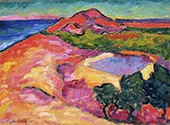
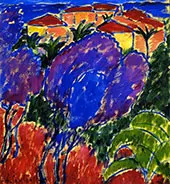
Jawlensky enjoyed spending summers in the Bavarian Alps, and accompanied by Gabriele Munter, they both created colorful landscape paintings of their beautiful surroundings. Munter and Jawlensky artists often discussed techniques and artistic goals, sharing their knowledge and approaches. Alexej von Jawlensky's paintings from this period include the "Yellow Sound" paintings of 1907 and 1908, as well as "The Mountain." From these early paintings, it is possible to see the foundations of the Der Blaue Reiter group of artists. The Blaue Reiter group was short-lived, lasting only from 1911 to 1914. This small artistic community was incredibly influential, however. The Blue Rider oil paintings focus on freedom of expression, with each artist striving to convey spiritual truth. Vivid colors and expressive brushwork are common features.
What is Alexej von Jawlensky’s Art Style?
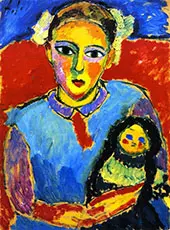
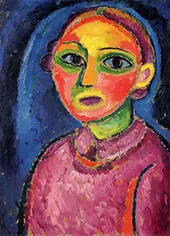
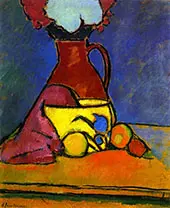
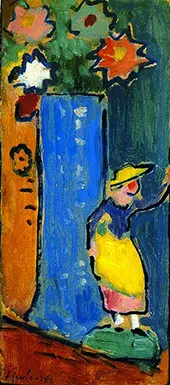
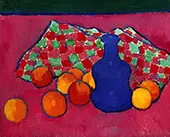
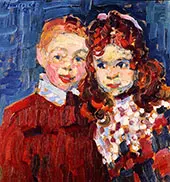
Alexej von Jawlensky primarily employed emotional color usage in his art.. His famous paintings frequently demonstrate loose brushstrokes, piercing figural representations, and flat forms. Alexej von Jawlensky's self-portrait paintings demonstrate this technique.
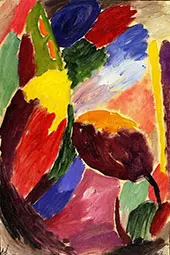
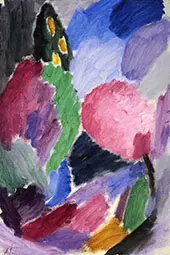
With the outbreak of the First World War, Jawlensky moved back to Russia. Unfortunately, the war signaled the break-up of Der Blaue Reiter group. Franz Marc and Auguste Macke, two leading artists in the group, sadly died in active military service. The other artists in the Group dispersed all over Europe. Jawlensky’s art style developed considerably during the war years. He experimented with Abstract Art in paintings such as Variation When the Lark is Singing. Despite such experiments, Jawlensky returned to his love of depicting the human form, and his expressionist paintings took shape during this period.
In 1916 Jawlensky met Galka Scheyer, the German-American painter, teacher, and art dealer who also championed his colorful paintings.
Alexej von Jawlensky Famous Portrait Paintings
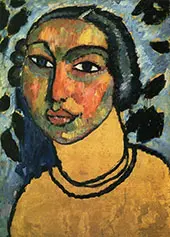
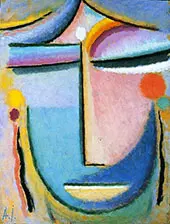
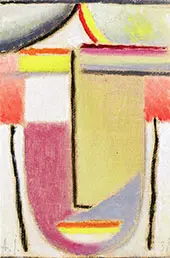
From 1916 onwards, Jawlensky created two of his most colorful paintings: Mystical Heads and Saviour’s Faces. These portrait paintings evoke Alexej von Jawlensky’s upbringing in the town of Torzhok. They reflect the town’s folk-art rituals and, specifically, the traditional Russian Orthodox religious icons familiar to the area.
Alexej von Jawlensky's paintings in the Mystical Heads series include Mystical Head Opal, Mystical Head in Blue, and Mystical Head Dreaming Woman. The later Religious Art series contains masterpieces such as Savior's Face Resurrection, The New Life II, and Savior's Face Head of Christ.
After the First World War ended, Alexej von Jawlensky returned to Germany. He continued his tireless work on modern art oil paintings and later settled in the town of Wiesbaden, Hesse. While living in Germany, Alexej von Jawlensky played a significant role in forming the Blue Rider group, also known as the Blue Four. The group was formed in 1924 and also comprised Wassily Kandinsky, Paul Klee, and Lyonel Feininger. Galka Scheyer was instrumental in bringing the artists together and promoting their work throughout Germany and the United States.
When did Jawlensky die?
From 1929 onwards, Jawlensky struggled with arthritis. As his health deteriorated, he scaled back his Expressionist art movement paintings, and his artistic output sadly came to an end in 1937. Alexej von Jawlensky started dictating his life’s memoirs the following year, remaining in Wiesbaden for the rest of his life. He died on 15 March 1941.
In a fitting tribute to the artist’s life and his famous paintings, the “Jawlensky Award” was established in 1991. This prestigious award is granted to a contemporary artist once every five years. The successful artist enjoys support from Wiesbaden and Hesse, accompanied by an exhibition at the Museum Wiesbaden.
Buy oil painting reproductions from our extensive catalog of vibrant wall art by famous European artists, including Alexej Jawlensky and Wassily Kandinsky.






Enter Your Private Gallery
Log in with your gallery ID here
Track Your Order
Type your order number here




Cannot Find What You Are Looking For?
Reproduction Gallery Information
Customer Service

(Send Us A Message)

Tel: (302) 513 3464