




Claude Monet Oil Painting Reproductions
Hand-Painted Claude Monet Paintings on Canvas for Sale
How Did Claude Monet Change the Way Light Was Painted?
Claude Monet changed how artists painted light by showing how it could transform the color and appearance of a familiar subject. Buildings, water, gardens, and landscapes provided the structure, but sunlight, mist, shadow, and reflection often determined what Monet actually placed on the canvas.
Look closely at many of his paintings, and colors that merge at normal viewing distance separate into individual strokes. Shadows can contain blue and violet beside warmer tones, while water picks up color from the sky, vegetation, and reflected architecture. Rather than defining every edge, Monet used these relationships to create atmosphere and the impression of changing light.
Impression, Sunrise (1872), now in the Musée Marmottan Monet in Paris, is an early example. The harbor at Le Havre dissolves into blue-gray haze, while a small orange sun and its reflection provide the strongest contrast. Exhibited in 1874, its title helped give Impressionism its name.
What Makes Claude Monet Paintings Recognizable?
Claude Monet paintings are recognizable for their visible brushwork, softened edges and distinctive use of color. Up close, individual strokes can appear surprisingly separate. From a normal viewing distance, they combine into water, foliage, clouds, reflections and architecture.
Monet adapted his brushwork to the subject. Water might be constructed from short horizontal strokes, foliage from quicker irregular marks and skies from broader passages of color. Outlines sometimes soften or disappear altogether. The result can appear spontaneous, but Monet repeatedly adjusted his paintings to achieve the balance he wanted.
His technique also evolved throughout his career. Earlier landscapes generally retain clearer depth and structure. At Giverny, water, reflections and increasingly dense areas of color became more prominent, culminating in the late Water Lilies, where the traditional division between foreground, distance and sky can almost disappear.
Why Did Claude Monet Paint the Same Subjects Repeatedly?
Claude Monet painted the same subjects repeatedly to study how changes in light, weather, season, and time of day altered their appearance. Keeping the subject relatively constant let him focus on differences in color and atmosphere from one painting to the next.
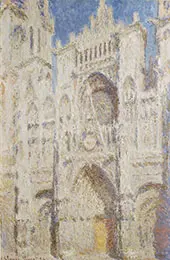
Monet’s series paintings are important to understanding this approach. In his Haystacks series, the same landscape is transformed by conditions ranging from winter frost and mist to warm evening light. At Rouen Cathedral, Monet repeatedly returned to the façade, using its complex stone surface to explore the effects of changing daylight.
His garden at Giverny later provided subjects he could study over much longer periods. Monet painted the Japanese Bridge from different viewpoints, and his Water Lilies developed into an extensive body of paintings rather than a single series. Reflections, vegetation, water and sky shifted from one canvas to another even though the pond itself remained familiar.
Repetition gave Monet a constant point of reference. What changed from canvas to canvas was his perception of the subject and the way he chose to paint it.
What Makes Claude Monet’s Most Popular Paintings So Interesting?
Claude Monet’s most popular paintings show the remarkable range of subjects and techniques he explored. Water Lilies, Woman with a Parasol, The Poppy Field near Argenteuil and his Japanese Bridge paintings span decades of experimentation with movement, depth, reflections, color and brushwork. Each reveals something different about the way Monet approached painting during his long career.
Why Did Water Lilies Become Central to Monet’s Later Paintings?
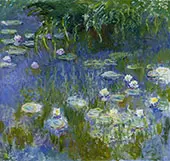
Water lilies allowed Monet to concentrate increasingly on the surface of the pond itself. Reflected trees and sky occupied the same pictorial space as floating lilies, giving him a subject in which solid forms and reflections could continually overlap.
As Monet returned to the pond at Giverny, conventional landscape features became less important. Many later paintings have no visible horizon, making it increasingly difficult to distinguish water, reflected vegetation and sky. His exploration of the subject eventually reached monumental scale in the Water Lilies decorations installed in two oval rooms at the Musée de l'Orangerie in Paris.
How Did Monet Capture Movement in Woman with a Parasol?
Monet created movement in Woman with a Parasol – Madame Monet and Her Son (1875) largely through the effects of wind. Camille Monet’s dress and veil are blown sideways, grasses bend around her, and clouds appear to move across the sky. The tilted parasol adds another strong diagonal to the composition.
The low viewpoint also changes our relationship with the figure. Camille rises against the sky rather than standing within a carefully arranged portrait setting, while their son Jean appears farther down the slope. The original painting, measuring 100 × 81 cm (39 3/8 × 31 7/8 in), is in the National Gallery of Art in Washington, D.C.
What Gives The Poppy Field near Argenteuil Its Sense of Depth?
Monet created depth in The Poppy Field near Argenteuil (1873) through repeated figures, changes in scale, and the distribution of red poppies across the landscape. Camille and Jean appear in the foreground, while another pair farther up the hillside draws the eye into the distance.
The poppies contribute to the effect. Larger red marks occupy the foreground before becoming smaller and less distinct farther away. Monet could therefore suggest distance without sharply defining every flower or blade of grass. The original painting is in the Musée d’Orsay in Paris.
How Do Monet’s Japanese Bridge Paintings Show His Changing Technique?
Monet’s Japanese Bridge paintings allow us to compare his technique across almost 30 years using one familiar subject. In paintings from the 1890s, the curved bridge, pond, and surrounding plants remain clearly distinguishable, creating a recognizable view of his garden at Giverny.
In the later versions, brushwork becomes looser and denser, colors more intense and individual forms increasingly difficult to separate. By the 1910s and 1920s, some Japanese Bridge paintings move much closer to abstraction. The bridge remains present but can become partially absorbed into broad areas of vegetation, color and heavily worked paint.
The bridge itself had barely changed, but Monet's treatment of it had. Comparing these paintings across several decades reveals a gradual move away from clearly described garden views as individual forms give way to denser areas of paint and more expressive handling.
How Our Artists Recreate Claude Monet Paintings by Hand
Recreating a Claude Monet painting by hand requires an artist who understands how Monet built his compositions through color, brushwork and layers of oil paint. Matching individual colors is not enough. Our specialist artists understand how neighboring colors interact and how Monet varied his technique across different periods of his career.
Access to Monet’s catalogue raisonné also provides us with high-quality reference sources for our artists to work from. This is particularly important when reproducing paintings where online images vary considerably in color, contrast or detail. A reliable reference helps us study the original composition, proportions, brushwork and color relationships before painting begins.
We assign each Monet reproduction to a specialist artist experienced in recreating Impressionist paintings and with a strong understanding of Monet’s color palette and brushwork. Using the selected reference image, the artist recreates the painting entirely by hand in oils on canvas, paying close attention to softened edges, broken brushstrokes, reflections and variations in paint texture. A Water Lilies painting, for example, requires different handling from an earlier landscape or one of Monet’s architectural paintings.
As part of our quality control process, we review every painting at each stage of creation. When complete, we photograph the finished Monet reproduction and send the image to the customer for approval. This allows them to review their painting and request any changes before shipping.
How to Choose the Right Claude Monet Wall Art?
Choosing the right Claude Monet wall art starts with the size and proportions of your wall, the colors in your room and the type of subject you prefer. With more than 600 Monet paintings in our catalog, there are options ranging from gardens and landscapes to architectural subjects and figure paintings.
To make such a large catalog easier to explore, we have created dedicated Art Collection listings for Monet’s Water Lilies, Haystacks and Rouen Cathedral paintings. These bring related paintings together so you can compare different compositions, colors and interpretations of the same subject before making a choice.
For customers looking for large wall art, Monet’s Water Lilies are particularly effective because many have wide compositions, areas of open water and broad passages of color. Paintings from our Monet Water Lilies Art Collection are the Monet reproductions most frequently ordered by our customers. His Japanese Bridge paintings combine the water garden with a stronger architectural focal point, making them a good choice when you want more structure in the composition.
The Haystacks offer considerable variation in color, making it possible to choose between cooler, more subdued paintings and compositions dominated by warmer gold, orange and violet tones.
For something quite different, his landscapes, coastal scenes and figure paintings provide many other choices. Woman with a Parasol, for example, introduces the human figure and a stronger sense of movement than his gardens and water scenes.
Size is equally important. We preserve the original proportions of each Monet painting rather than cropping or stretching the composition and offer multiple sizes wherever the original format allows. For larger walls or unusual spaces, we can also advise on the most suitable painting and size.
How Reproduction-Gallery Makes Buying a Claude Monet Oil Painting Reproduction Easy
Buying a Claude Monet oil painting reproduction should be an enjoyable experience, even with more than 600 paintings to choose from. Our team can help with your choice of painting, dimensions or special requirements before you place your order.
Each reproduction is available in a choice of sizes. We can also consider a custom size where the proportions of the original painting allow. If the painting you want is not already in our catalog, we can source suitable reference material and add it online with sizes and prices.
Once you place your order, we create your online order tracking so you can follow the progress of your painting. When your painting is complete, we send you a photograph to review before it is shipped. You can also see examples of our completed paintings before ordering.
We have been creating hand-painted oil paintings on canvas since 1996 and ship worldwide. From choosing a Monet to receiving the finished painting, our team is available to provide personal help throughout your order.




Testimonial from Mirbeau Inn and Spa

Enter Your Private Gallery
Log in with your gallery ID here
Track Your Order
Type your order number here
Most Popular Artists