




Frans Hals Oil Painting Reproductions
Frans Hals replica paintings on Canvas for sale
Is Frans Hals a Dutch Golden Age Painter?
Frans Hals was born in 1582 or 1583, and the exact date of his birth is unknown.
He was a painter of the Dutch Golden Age who created some of the most recognizable and admired portraits of the era.
Where was Frans Hals Born?
Frans Hals was the son of Franchois Frans Hals van Mechelen, a cloth merchant and his wife, Adriaentje van Geertenryck and he was born in Antwerp.
The family was reasonably well-off, but they fled the city after 1585, following the Fall of Antwerp and the Protestant siege of the city during the Dutch Revolt. This was a failed uprising against the Spanish rulers. After the surrender, anyone suspected of Protestant or Dutch sympathies had four years’ grace to settle their business affairs and leave the city.
The family settled in Haarlem in the new Dutch Republic, where Frans Hals remained for the rest of his working life. He pursued art early on and studied with the Flemish master Karel van Mander. Mander worked within the Mannerist art movement, drawing inspiration from the Classicism and naturalism of Renaissance masters. With an intense focus on style and technique, Mannerist paintings often feature complex poses and compositions, characterized by elongated limbs and stylized facial features.
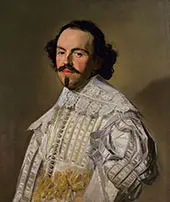
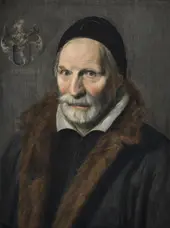
Despite this early experience, his paintings reflect few mannerist techniques. One of his earliest known portrait paintings is a Portrait of Jacobus Zaffius, 1611. Hals' highly realistic portrayal of a Catholic pastor set the tone for much of his famous paintings.
What is Frans Hals' Painting Style?
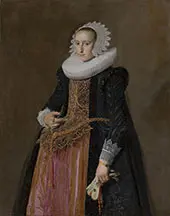
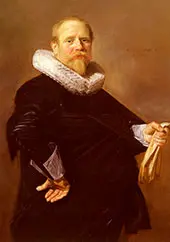
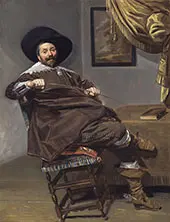
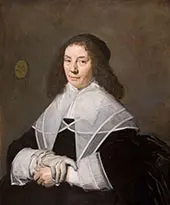
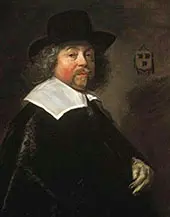
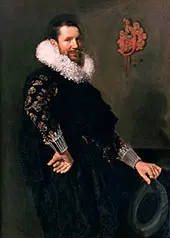
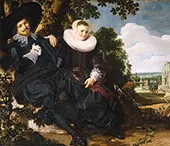
Hals joined the Haarlem Guild of Saint Luke in 1610 and earned a modest income as an art restorer for the Haarlem city council. He began painting portraits of wealthy citizens, including Willem Heythuijsen, 1634 – a local prosperous cloth merchant. Hals also quickly developed a reputation as a preeminent wedding portrait painter, amply demonstrated in his Portrait of Joseph Coymans and the Wife of Joseph Coymans (1644).
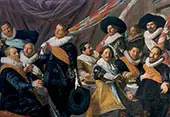
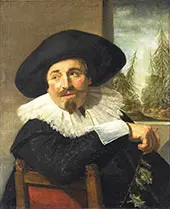
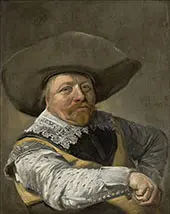
Hals was celebrated for his style of intimate Realism paintings and characteristic loose brushwork. Frans Hals' group portraits are particularly well known for depicting every figure as a unique individual in various poses. In famous paintings such as The Officers of the St. Adrian Militia Company (1633), the faces aren’t idealized, and each personality shines through. Today, this painting remains one of the leading attractions of the Frans Hals Museum.
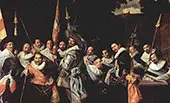
The earlier Banquet of The Officers of The St George Militia Company (1627) depicted the military men in an incredibly unusual, informal manner. Yet, despite the seeming informality, each figure patriotically wears the colors of the Dutch flag (orange, white, and blue).
Frans Hals married Anneke Harmensdochter around 1610. She sadly died just five years later, shortly after the birth of the couple’s third child. Hals then employed the young daughter of a local fishmonger to look after his children. This was Lysbeth Reyniers, and they married in 1617. The couple wed in a small village church just outside of Haarlem. Lysbeth was already eight months pregnant, a scandal at the time. Despite an unconventional start, the couple enjoyed a happy marriage and had eight children together.
Are Frans Hals' Famous Portrait Paintings Popular?
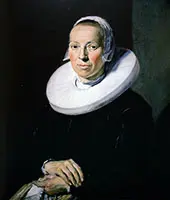
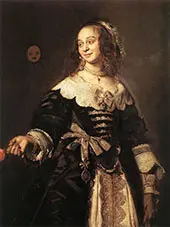
Frans Hals did not solely paint portraits for the wealthy upper classes, and he depicted all levels of society with unflinching honesty.
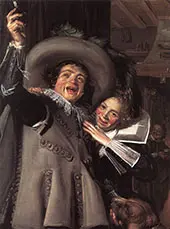
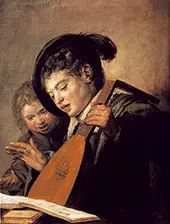
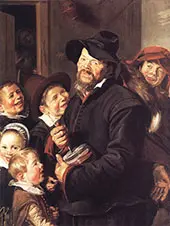
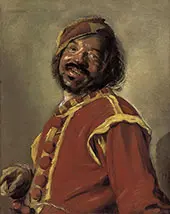
Early paintings demonstrating his spirited brushwork and vivid color palette are:
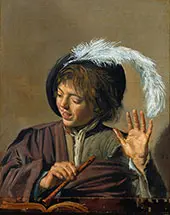
- Two Boys Singing 1925
- The Mulatto 1627,
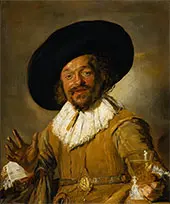
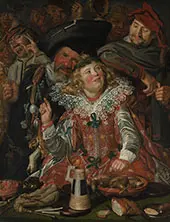
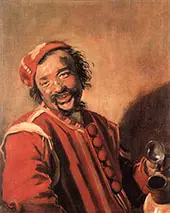
- The Merry Drinker 1628
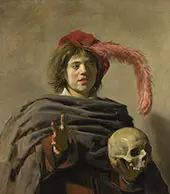
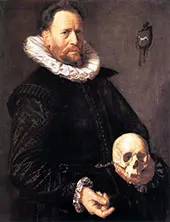
Other Hals' paintings, such as the serious Young Man with a Skull 1926, serve as an appropriate “memento mori” (a reminder of death) amidst his sitters’ characteristically rosy, alcohol-fueled cheeks.
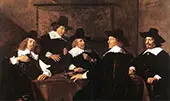
Later, Frans Hals’s portrait paintings employ more muted tones, with greys and blacks predominating. His oil paintings reflected his protestant sitters' dress and stylistic preferences. The darker palette is especially evident in later group portraits such as Regents of The St Elizabeth Hospital of Haarlem 1641.
Is Frans Hals' Laughing Cavalier painting his Most Famous Portrait?
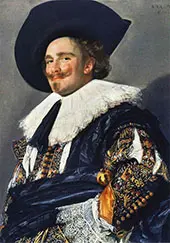
No introduction to the life and works of Frans Hals would be complete without mention of his most famous portrait painting, The Laughing Cavalier.
Painted in 1624, it’s an extraordinarily charismatic portrait depicting a smiling man with an upturned mustache, whose eyes are said to follow viewers from side to side uncannily. Frans Hals utilizes his skillful yet spontaneous brushwork and bold color palette to astounding effect in the painting. The detailing of the man’s expensive silk costume and embroidered sleeves is particularly masterful.
Despite the name, the sitter’s identity is unknown. The Laughing Cavalier epithet originated in the Victorian era. The painting caused a stir when exhibited at the opening of the Bethnal Green Museum in 1872. The museum is now known as the Young V&A. Most modern-day scholars believe the sitter is likely a member of one of the many local militias. There are suggestions that he could be Tieleman Roosterman, who frequently sat for Hals.
The Laughing Cavalier is part of the Wallace Collection, and it is well worth a visit for any art lover.
What is Frans Hals' Legacy?
Frans Hals' paintings were incredibly popular during his lifetime. Despite this, he enjoyed a remarkably long career. His paintings eventually fell out of fashion. As a result, the artist experienced financial difficulties later in life.
In 1652, a local baker sued Frans Hals for an outstanding debt. The subsequent inventory of Frans Hals’ seized property only consisted of mattresses and cushions, one table, and five paintings depicting himself and his sons. Hals was largely destitute from this point onwards. However, he was awarded a small annual payment of 200 florins by the city of Haarlem in 1664, and his financial situation improved in his final years. The award is a sign of the artist's previous success and reputation.
Frans Hals died two years later, in 1666, at the age of 83. He is buried at St Bavo’s Church in Haarlem alongside his first wife. Hals' surviving widow applied for aid at a local almshouse, where she spent her remaining days.
Today, Frans Hals' paintings enjoy celebrity. His famous portrait paintings ensure his legacy as one of the most famous portrait artists of the 17th Century. Hals' paintings are celebrated for their departure from the earlier, more formal portrait painting style, and his loose, expressive brushstrokes and vibrant colors inspired the future generation of artists to develop their artistic styles.
The Frans Hals Museum champions Frans Hals' paintings. With two locations, both situated in the heart of modern-day Haarlem, the museum showcases a diverse range of Dutch Golden Age art and contemporary paintings by artists from around the world.
Buy Frans Hals paintings from our extensive catalog of famous oil painting reproductions.





Enter Your Private Gallery
Log in with your gallery ID here
Track Your Order
Type your order number here




Cannot Find What You Are Looking For?
Reproduction Gallery Information
Customer Service

(Send Us A Message)

Tel: (302) 513 3464