




Ivan Aivazovsky Oil Painting Reproductions
Ivan Aivazovsky replica paintings on Canvas for sale
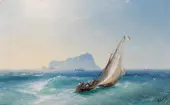
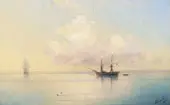
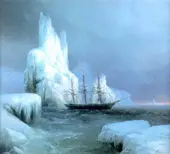
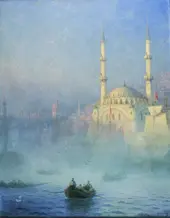
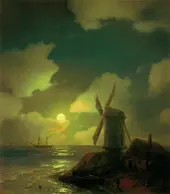
Seascape Oil Paintings by Ivan Aivazovsky
The Russian Romantic artist, Ivan Konstantinovich Aivazovsky, is considered one of the greatest seascape painters of all time.
The Ninth Wave 1850 by Ivan Aivazovsky is one of his most famous seascape oil paintings. The Ninth Wave is an atmospheric painting of chatting sailors clinging to a ship's wreckage. In this painting, the debris forms the shape of the cross, perhaps a Christian metaphor for salvation from earthly sin.
Ivan Konstantinovich Aivazovsky was baptized as Hovhannes Aivazian. He was born on July 29th, 1817, in the Crimean Port of Feodosia. Aivazovsky was the youngest of three sons, enjoying a happy childhood in a family house with a panoramic sea view.
Although a small town, Feodosia’s harbor had long held international significance as a Greek, Genoese, and later Ottoman and Russian territory. With its many languages, ships, and sailors, the bustling port proved a fertile environment for the young Aivazovsky. Indeed, the legend is that the young Ivan began drawing with charcoal on the family home’s whitewashed walls!
Ivan Aivazovsky's paintings depict the sea from this moment forward.
Although not wealthy, Ivan’s Armenian father, Konstantin, afforded Aivazovsky an education at Feodosia's St. Sargis Armenian Church. As a result, he took an interest in drawing from a young age and was encouraged by Jacob Koch, an architect friend of the family.
Jacob Koch showed Ivan Aivazovsky’s drawings to the local Governor, and it was he who funded the young man’s studies in Saint Petersburg.
Ivan Aivazovsky Famous Paintings
Aivazovsky was one of the most prolific artists of all time. During his 60-year career, he produced over 6,000 paintings with 55 solo exhibitions.
His later oil paintings include dramatic scenes, and Aivazovsky's artwork portrays the continual struggle between man and the elements. Paintings such as The Rainbow (1873) and the aptly titled oil painting Disaster (completed in 1898) illustrate the intention.
Many of his oil paintings depict wrecks and storms. The warm, pastel colors in Ivan Aivazovsky's paintings, such as The Rainbow, painted in 1873, indicate his ultimate faith in God and salvation.
Ivan Aivazovsky's Education and Early Oil Paintings
Following his education at the Imperial Academy of Arts in Saint Petersburg, Ivan Aivazovsky traveled to Europe and spent a brief period in Italy in the early 1840s.
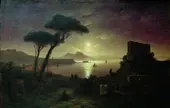
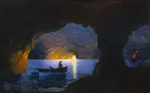
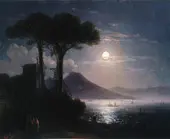
Early oil paintings on canvas from this period include The Azure Grotto, Naples, and The Bay of Naples at Moonlight.
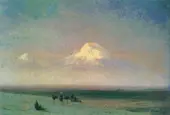
Aivazovsky traveled to Venice via Berlin and Vienna. He visited San Lazzaro degli Armeni, home to a large Armenian Catholic community. As a result, he became familiar with Armenian art, a theme that features in later Ivan Aivazovsky’s paintings, such as The Valley of Mount Ararat, dated 1882. Ivan Aivazovsky describes the great Italian museums as a second academy for him, and he launched several successful exhibitions during his time in Europe.
Pope Gregory XVI and the French Royal Academy of Sciences awarded him a gold medal.
Upon his return to Russia in 1844, he was appointed the leading painter of the Russian Navy “to paint seascapes, coastal scenes, and naval battles.”
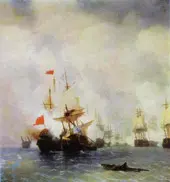
Aviazovsky’s oil painting, The Battle of Chios (1848), depicts the naval battle of 1770.
A year later, Ivan Aivazovsky resettled in his hometown of Feodosia. He built a small house and studio, maintaining a close circle of friends. However, while he enjoyed contentment, the move distanced him from some of the more avant-garde artistic circles. Moreover, his determination to stick to the traditional Romantic art style left him open to criticism throughout his later career.
In 1848, Aivazovsky married Julia Graves, an English governess. They divorced in 1877, but the marriage produced four daughters.
Recognition and Awards
In 1851, Aivazovsky traveled to Sevastopol with the Russian emperor Nicholas I to participate in military maneuvers. At the onset of the Crimean War two years later, Aivazovsky returned to Sevastopol to paint battle scenes. He later traveled extensively throughout Europe, winning awards and honors in Paris (the Legion of Honor), Constantinople (the Order of the Medjidie), and becoming a member of the Moscow Art Society.
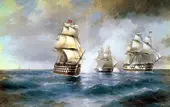
Ivan Aivazovsky continued to travel throughout the 1860s and 1880s. In the seascape oil painting, "Brig Mercury Attacked by Two Turkish Ships," the Greek resistance against the Turks is depicted.
Many international accolades continued to follow throughout the 1870s and 1880s. For example, Aivazovsky was appointed an Actual Civil Councilor (the fourth highest civilian rank in Russia) and made an honorary member of Stuttgart's Royal Academy of Fine Arts in 1878.
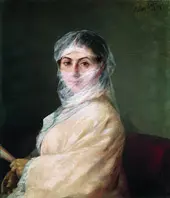
Anna Burnazian was Aivazovsky's second wife. She was a young Armenian widow, approximately 40 years his junior. Ivan Aivazovsky and Anna Burnazian married in 1882.
In 1887, as part of a jubilee celebration of his career, Aivazovsky was awarded honorary membership in the Imperial Academy of Fine Arts.
Ivan Aivazovsky: Later Life and Travels
Aivazovsky kept up his prolific travels in later life, traveling to Paris with his wife and later visiting Niagara Falls in 1892. The artist was deeply affected by the Hamidian massacres in the Armenian-inhabited areas of the Ottoman Empire between 1894 and 1896. His paintings include several works depicting the Armenian Massacres at Trebizond, 1895. He even threw the medals given to him by the Ottoman Sultan into the sea and told the Turkish consul in Feodosia:
“Tell your bloodthirsty master that I've thrown away all the medals given to me; here are their ribbons; send them to him, and if he wants, he can throw them into the seas painted by me.”
Aivazovsky spent his final years in Feodosia and died on May 2nd, 1900. A quote from Movses Khorenatsi's History of Armenia appears on his tombstone: “Born as a mortal, left the immortal memory of himself.”
Aivazovsky remains a highly popular artist in Russia and further afield to this day. In a fitting tribute, the saying “worthy of Aivazovsky’s brush” was used by Anton Chekov in Uncle Vanya to describe something extraordinary.
Buy Ivan Aivazovsky oil painting reproductions from our extensive marine and seascape oil paintings on canvas.




Testimonial from EK, Sydney, Australia




Enter Your Private Gallery
Log in with your gallery ID here
Track Your Order
Type your order number here




Cannot Find What You Are Looking For?
Reproduction Gallery Information
Customer Service

(Send Us A Message)

Tel: (302) 513 3464