




Pierre Bonnard Oil Painting Reproductions
Pierre Bonnard replica paintings on Canvas for sale
Who is Pierre Bonnard?
Pierre Bonnard was a French painter and illustrator renowned for his vibrant and decorative paintings. As a founding member of the Les Nabis group of artists, he also led the shift from the Impressionism art movement to Modernism in France.
This brief introduction presents some of Pierre Bonnard's most famous paintings and explores the artist’s fascinating personal life.
Where was Pierre Bonnard born?
Pierre Bonnard, born October 3, 1867, grew up in Fontenay-aux-Roses in Hauts-de-Seine in Northern France. His father worked as a senior official in the French Ministry of War, providing the family with a comfortable income.
As one of three children, Bonnard attended the Lycée Louis-le-Grand and Lycée Charlemagne. During his education, he showed an early aptitude for painting and drawing. Bonnard often painted his parents’ extensive country gardens in their new home at Le Grand Lemps, a small commune in southeastern France.
In addition to art, Bonnard also loved literature. He earned a Bachelor's degree in Classics and later obtained a law license. By 1888, at the age of 21, Bonnard began practicing law.
While working as a lawyer, Bonnard also started art classes at the prestigious Académie Julian in Paris. He met famous artists and future lifelong friends, including Paul Serusier, Paul Ranson, and Maurice Denis, during this time.
Bonnard continued his artistic studies at the École des Beaux-Arts, where he associated with the French artists Ker Xavier Roussel and Édouard Vuillard.
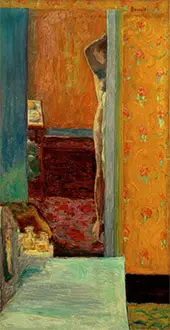
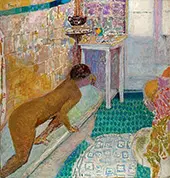
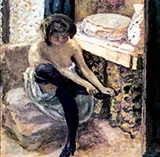
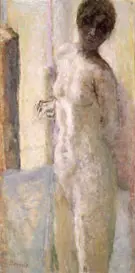
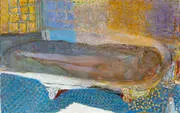
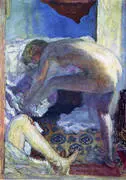
He lived with Marthe de Méligny from 1893 onwards, who appeared in many of his famous nude art. Bonnard's paintings include erotically charged yet emotionally intimate images such as Siesta 1899 and Nude Against Daylight 1908.
What Art Movement are Pierre Bonnard's Paintings?
Bonnard and his friends formed the informal artists’ group Les Nabis. The group focused on surface color and decoration as a precursor to the art of Post-Impressionism. As such, they played a crucial role in the transition from Impressionism to Modern Abstract Art and Symbolist art movements.
From 1888 to 1900, Pierre Bonnard and the Les Nabis artists revolutionized French art. Drawing inspiration from Paul Cézanne and Paul Gauguin, they created some of the most beautiful and colorful paintings in French art.
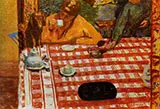
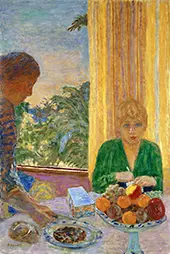
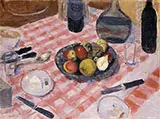
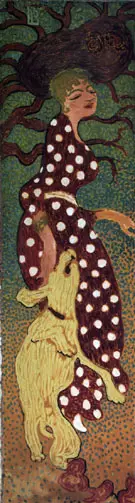
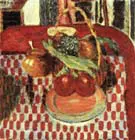
While many Les Nabis artists also worked with philosophical and religious themes, Pierre Bonnard's paintings remained secular and straightforward. His cheerful compositions often depict pets such as cats and dogs, notably in Le Chat Blanc (1894), Woman with a Dog (1891), and The Red Checkered Tablecloth.
With Le Chat Blanc, this Pierre Bonnard cat painting exemplifies his playful, expressive style. Indeed, the painter Aurelien Lugné-Poe described Bonnard as the “humorist” among their group. Poe spoke of Bonnard’s “nonchalant gaiety” expressed through his colorful paintings.
What is Pierre Bonnard's Painting Style?
Pierre Bonnard painted quickly and expressively, creating areas of color with tiny, swift brushstrokes, focusing on intimate domestic scenes filled with life. He often drew his subjects first, making notes on colors and tones. He then finished his compositions in the studio, working on multiple canvases simultaneously.
In 1893, the artist saw a major exhibition of Japanese art at the Durand-Ruel Gallery in Paris. The paintings of Hiroshige and Utamaro inspired him.
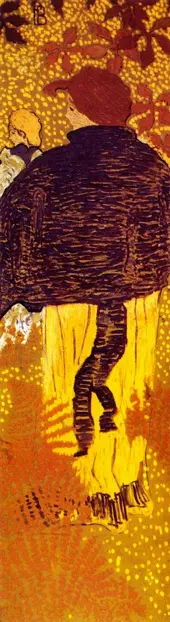
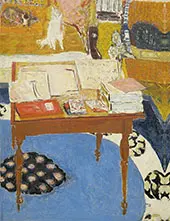
These Japanese artists’ use of multiple perspectives, bold geometric patterns, and bright colors changed Bonnard’s art forever. From this point onwards, his friends nicknamed him “Le Nabi le très Japonard”. After this date, Bonnard's paintings feature decorative fabrics, fans, and interior furnishings.
What colors did Bonnard use?
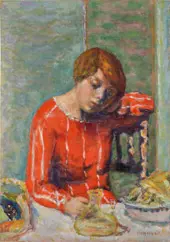
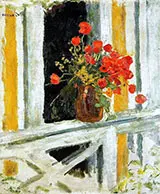
Pierre Bonnard's paintings employ a vast array of bright and vibrant colors, including vibrant yellows, rich reds, delicate pinks, and pastel shades, in his famous paintings.
Pierre Bonnard's Urban Paintings
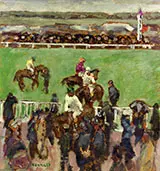
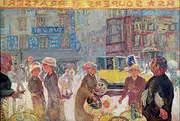
By 1894, Bonnard started including urban scenes and animals in his artworks. While his paintings often feature people, Bonnard usually obscures their faces. Images such as "Races at Longchamp, 1894" are typical of these mid-career creations.
The following year, Bonnard enjoyed his first solo exhibition. It took place at the prestigious Durand-Ruel Gallery, the same place where he discovered Japanese art. His first Exhibition was successful, and in 1896, Bonnard participated in a group show of Les Nabis artists at the Paris Ambroise Vollard Gallery. A further Les Nabis exhibition followed in 1899.
How Many Paintings did Pierre Bonnard paint?
Pierre Bonnard created over 240 oil paintings during his long and prolific career.
The early 20th century was a fascinating time for French artists, marked by the emergence of multiple art movements, including Neo-Impressionism and Cubism. He continued to refine his artistic style, exploring a range of subjects and techniques.
In 1900, he exhibited at the Paris Salon. He displayed nine other artworks at the Salon des Independents in 1901. However, some of Pierre Bonnard's most famous paintings appeared after 1905. This includes a series of famous nude paintings, such as "Woman in Front of a Mirror" (1908) and "Reclining Nude" (1909).
In 1914, World War I broke out. However, he was not involved in the fighting, and he continued focusing on his nude art portraits and interior scenes. By this point, Pierre Bonnard enjoyed a prestigious reputation in the French art world. In 1918, at the end of World War 1, the Association of Young French Artists elected him as their honorary president. His fellow nominee was Pierre-Auguste Renoir.
Why is Pierre Bonnard a Famous Artist?
Throughout his career, Bonnard created book illustrations, advertisements, and lithographs. His posters for France-Champagne are particularly well-known.
Despite this, his colorful and optimistic oil on canvas paintings remain his best-known works of art.
In 1939, World War II forced Bonnard to leave Paris. He moved to the South of France, where he stayed under German occupation. There, he lived a quiet life and completed his last painting, "The Almond Tree in Blossom," in 1947. Bonnard died a week later on 23 January 1947 at his country home near Le Cannet on the French Riviera.
In 1948, the Museum of Modern Art hosted a retrospective of Pierre Bonnard's paintings. Initially intended for the artist’s 80th birthday, the exhibition displayed some of his most celebrated works.
Pierre Bonnard Paintings: High Quality Art Reproductions
If you love the colorful beauty of Pierre Bonnard’s Les Nabis and Post-Impressionism art, please explore our extensive replica art collection of famous paintings.
Discover the finest modern art oil paintings and art reproductions to suit every taste.





Enter Your Private Gallery
Log in with your gallery ID here
Track Your Order
Type your order number here




Cannot Find What You Are Looking For?
Reproduction Gallery Information
Customer Service

(Send Us A Message)

Tel: (302) 513 3464