



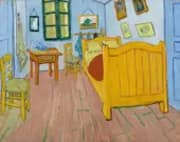
Bedroom in Arles By Vincent van Gogh



What Is Bedroom in Arles by Vincent van Gogh?
Bedroom in Arles (1888) is an oil painting by Vincent van Gogh that depicts the artist’s bedroom in the Yellow House in Arles, France. Painted during a crucial phase of van Gogh’s career, the work is widely regarded by art historians as one of the most important interior paintings of the Post-Impressionist movement, illustrating his shift toward emotional expression through color and form.
Rather than pursuing visual realism, van Gogh deliberately simplified forms, flattened perspective, and intensified color relationships. These formal choices mark a decisive move away from naturalistic representation and establish Bedroom in Arles as a work driven by expressive structure rather than literal depiction.
Why Is Bedroom in Arles So Recognizable?
The painting is instantly recognizable for several defining visual features:
- Simplified geometric forms
- Bold, dark outlines
- Tilted perspective
- Vivid yet restrained color contrasts
Together, these elements are hallmarks of van Gogh’s mature Post-Impressionist style and clearly signal his departure from traditional realism toward a more expressive visual language.
Why Is Color So Important in Bedroom in Arles?
In Bedroom in Arles, color replaces realism as the primary carrier of meaning. Van Gogh deliberately rejected naturalistic color in favor of carefully structured harmonies designed to suggest rest, balance, and emotional stillness within the interior space.
How Van Gogh Uses Color Emotionally
- Warm yellows – warmth, familiarity, rest
- Cool blues – grounding, stillness
- Muted reds and greens – subtle emotional tension
Although the painting appears calm and orderly at first glance, these color relationships work in tandem with the tilted perspective to create a space that feels emotionally charged rather than purely restful.
What Painting Techniques Did Van Gogh Use in Bedroom in Arles?
A defining feature of Bedroom in Arles is van Gogh’s use of impasto, an oil painting technique in which paint is applied thickly so that individual brushstrokes remain clearly visible.
This impasto technique:
- Creates a tactile, sculptural surface
- Enhances the interaction between paint and light
- Reinforces emotional immediacy and presence
For van Gogh, impasto was not decorative but expressive. It functioned as a means of making emotion physically visible through paint, reinforcing the psychological intensity of the image.
Why did Van Gogh Create Paintings in Arles?
Vincent van Gogh moved to Arles in 1888 in search of artistic renewal, solitude, and clarity. He believed the region’s Mediterranean light and slower pace of life would support a new and more emotionally focused artistic direction.
Unlike Paris, Arles offered an environment that emphasized:
- Quiet interiors
- Sunlit rooms
- Rural simplicity
Bedroom in Arles reflects van Gogh’s desire for order, emotional stability, and a sense of personal refuge during this period of his life.
Mental Health and the Arles Period
Despite significant creative productivity, van Gogh experienced profound emotional distress during his time in Arles. These struggles contributed to the heightened intensity and vulnerability that characterize his paintings from this period.
Within Bedroom in Arles, the bedroom can be read as a psychological self-portrait. While the space appears orderly and calm, subtle distortions in perspective and proportion introduce a quiet tension, suggesting the fragile emotional balance van Gogh experienced during his time in Arles.
How Did Vincent van Gogh Influence Post-Impressionism?
Vincent van Gogh helped define Post-Impressionism by transforming painting into a vehicle for emotional and psychological expression.
His innovations include:
- Color as emotion, not description
- Simplified form over realism
- Expressive, visible brushwork
These ideas directly influenced later movements such as Expressionism and Fauvism.
Where Is Bedroom in Arles Located Today?
The first version of Bedroom in Arles is housed at the Van Gogh Museum in Amsterdam, where it remains one of the museum’s most significant work.
It is considered the most important of the three versions painted between 1888 and 1889.
Is Bedroom in Arles Important in Art History?
Bedroom in Arles is regarded as one of van Gogh’s most significant works and a cornerstone of Post-Impressionist art.
The importance of Bedroom in Arles lies in its demonstration of how visual structure itself can carry meaning. Through simplified form, intentional perspective distortion, and non-naturalistic color, van Gogh expanded the expressive potential of painting and helped define the aims of Post-Impressionism.
It offers rare insight into van Gogh’s artistic philosophy and inner life.
Famous Paintings Created During Van Gogh’s Arles Period
Some of Vincent van Gogh’s most celebrated oil paintings were created during his stay in Arles, including:
These famous paintings highlight van Gogh’s radical approach to color, composition, and emotional storytelling.
Van Gogh’s Legacy on Modern Art
Although Vincent van Gogh received little recognition during his lifetime, his work became widely celebrated after he died in 1890. Today, his paintings are regarded as foundational to modern art, exerting a profound influence on the Expressionism and Fauvism art movements and early abstract art.
Van Gogh redefined artistic freedom by using color, brushwork, and distortion to communicate emotion rather than visual accuracy. His willingness to express vulnerability, inner turmoil, and personal experience through oil painting permanently reshaped the direction of Post-Impressionism and paved the way for modern expressive art.
Why Vincent van Gogh Is So Influential in Art History
Van Gogh’s influence lies not in technical innovation alone, but in his emotional honesty and radical approach to self-expression. Key contributions include:
- The use of color as a carrier of psychological meaning
- Visible, energetic brushstrokes that emphasize movement and feeling
- A focus on psychological depth over realism
- The belief that art should convey the artist’s inner life
These ideas became central to 20th-century modern art and continue to influence painters, designers, and visual culture today.
Vincent van Gogh Fine Art Reproductions
Buy Vincent van Gogh oil painting reproductions from Reproduction-Gallery.com, a family-owned fine art studio established in 1996 and trusted by collectors worldwide.
Every museum-quality reproduction is:
- 100% hand painted in oil by professional artists
- Never printed or digitally produced
- Carefully crafted to capture brushwork, texture, and color depth
- Backed by a 100% Money-Back or Replacement Guarantee
These reproductions are ideal for collectors, designers, and art lovers seeking faithful, museum-quality fine art reproductions of van Gogh’s most famous paintings.
We offer a 100% money back guarantee or replacement service. If for any reason you are dissatisfied with your painting please contact us within 7 days of receipt, advising the reason you are unhappy and we will provide you with all the information you need for its return or replacement.
We ship free to anywhere in the world via FedEx or DHL expedited service with online tracking.
Your painting will be shipped rolled in strong plastic tubing, ready for stretching and/or framing locally. This is the conventional method of transporting hand-painted oil on canvas. Learn more about how your painting is shipped.
We are able to offer a framing service intercontinental U.S. Please contact us if you would like a quotation. Alternatively, should you prefer, we can recommend a framer in your area.
Your painting will be shipped directly from our Studio in Thailand.
Notes About Your Painting
All of our paintings come with a 7.5cm (just under 3") clean surplus canvas so the framer can achieve good leverage and easy stretching.


Cannot Find What You Are Looking For?
Reproduction Gallery Information
Customer Service

(Send Us A Message)

Tel: (302) 513 3464