



Composition VIII 1923 By Wassily Kandinsky

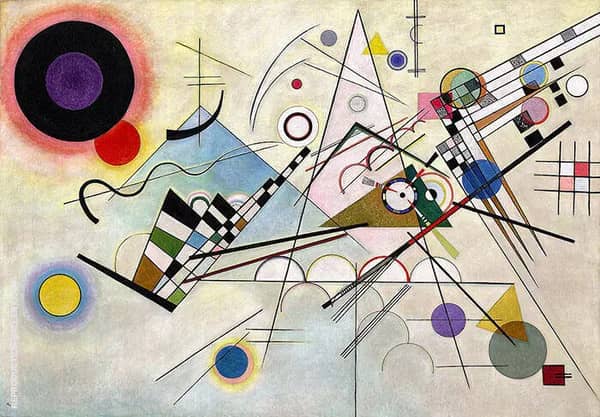

Composition VIII (1923) is an abstract oil painting on canvas and one of the most celebrated masterpieces of the Abstract Art Movement. Painted during Kandinsky’s Bauhaus years, it marks a defining moment in 20th-century Modern Art, where color, geometry, and emotion replace figurative representation.
These popular paintings are frequently selected as museum-quality hand-painted oil reproductions. Composition VIII remains influential among collectors, designers, and scholars for its intellectual structure and emotional depth.
Kandinsky's original painting is on display at the Guggenheim Museum in New York.
What Was Kandinsky’s Artistic Philosophy?
Kandinsky believed that great art should “cause vibrations in the soul.” Born in Moscow in 1866, his early musical training profoundly shaped his artistic philosophy. Music influenced not only his theories of color and form but also the titles of his works, which include Compositions, Improvisations, and Impressions, all of which parallel musical structures rather than visual narratives.
Among them, Composition VIII stands as one of the clearest expressions of visual rhythm and harmonic balance.
What Is the Meaning of Composition VIII?
Composition VIII represents Kandinsky’s belief that pure form and color can communicate emotion and spirituality without depicting the physical world.
Painted in 1923, Kandinsky regarded Composition VIII as his most important post-war achievement. The painting is constructed from a complex orchestration of circles, triangles, straight lines, and arcs, floating across a pale, shifting background.
Although Kandinsky rejected literal interpretation, recurring visual associations emerge:
Geometric Forms and Visual Symbolism
- Circular forms suggest celestial bodies or cosmic energy
- Sharp triangles evoke mountains or directional force
- Repeating semi-circles resemble clouds or waves in motion
- Vibrant reds, purples, and blacks contrast with calming blues and soft pastels
How Does Composition VIII Balance Emotion and Structure?
These elements interact to create a precise balance between tension and harmony, movement and stillness, and order and spontaneity. Kandinsky believed circles were the most spiritually powerful form, capable of uniting “great oppositions” through concentric and eccentric movement.
The result is a purely abstract composition that communicates emotion rather than narrative, a foundational principle of abstract art.
What Type of Painting Is Composition VIII?
Geometric Abstraction and Musical Structure
Rather than depicting the visible world, Kandinsky sought a universal visual language based on pure form and color. For this reason, Composition VIII is best described as geometric abstraction within the broader Abstract Art Movement.
Kandinsky, Suprematism, and Artistic Differences
Kandinsky shared certain ideas with avant-garde artists such as Kazimir Malevich, creator of Black Square, yet his approach remained distinct. Whereas the Suprematism art movement emphasizes reduction, Kandinsky’s paintings retain a lyrical and rhythmic complexity, inspired by music and spirituality.
In 1922, Kandinsky moved to Germany and began teaching at the Bauhaus in Weimar. It was during this influential period of combined rigorous design principles with expressive freedom that he painted Composition VIII.
Art historians widely regard Composition VIII as the clearest visual expression of Kandinsky’s mature Bauhaus philosophy.
Why Is Wassily Kandinsky Important to Modern Art?
Kandinsky is widely regarded as a pioneer of pure abstraction. As a co-founder of Der Blaue Reiter alongside the German Artist Franz Marc, he helped redefine the purpose of modern art.
How Did Kandinsky Create the First Abstract Paintings?
A pivotal moment occurred in 1910 when Kandinsky encountered one of his own paintings turned on its side. Unable to recognize objects, he experienced what he described as an “indescribably beautiful painting” composed solely of color and form. This realization led to groundbreaking oil paintings such as Composition VII (1913), often cited as among the first fully abstract paintings in modern art.
What Is Kandinsky’s Artistic Legacy?
In 1911, Kandinsky published Concerning the Spiritual in Art, the first major theoretical text on abstraction. The book established that color and form could communicate psychological and spiritual meaning without representing reality, permanently reshaping art theory.
Despite persecution by the Nazi regime, which labeled his work “degenerate art, Kandinsky’s influence permanently reshaped modern art.
How Does Composition VIII Influence Abstract Art Today?
Like many of Kandinsky’s most important works, Composition VIII avoids figurative imagery and instead draws inspiration from music, geometry, and spiritual philosophy. Its enduring relevance lies in its ability to feel both mathematically structured and emotionally expressive.
Today, it continues to inspire contemporary abstract artists, architects, and interior designers. For collectors seeking historically significant yet visually timeless works, geometric art remains among the most versatile and enduring choices.
KANDINSKY PRINTS vs HAND PAINTED REPRODUCTIONS
If you admire abstract paintings by Wassily Kandinsky, a hand-painted oil reproduction offers a fundamentally different experience from a standard print.
- Printed reproductions are mechanically produced on paper or canvas
- Hand-painted reproductions are individually created by trained artists using traditional oil paints
Why Collectors Prefer Hand-Painted Oil Reproductions
Each hand-painted piece carefully recreates brushwork, texture, color harmony, and compositional balance, producing surface depth and visual richness that prints cannot achieve. Subtle variations in paint application give every artwork its own character, echoing the material presence of Kandinsky’s originals.
For collectors and design professionals, hand-painted oil reproductions provide greater authenticity, craftsmanship, and long-term decorative value, making them an enduring way to bring Kandinsky’s visionary abstraction art into modern interiors.
We offer a 100% money back guarantee or replacement service. If for any reason you are dissatisfied with your painting please contact us within 7 days of receipt, advising the reason you are unhappy and we will provide you with all the information you need for its return or replacement.
We ship free to anywhere in the world via FedEx or DHL expedited service with online tracking.
Your painting will be shipped rolled in strong plastic tubing, ready for stretching and/or framing locally. This is the conventional method of transporting hand-painted oil on canvas. Learn more about how your painting is shipped.
We are able to offer a framing service intercontinental U.S. Please contact us if you would like a quotation. Alternatively, should you prefer, we can recommend a framer in your area.
Your painting will be shipped directly from our Studio in Thailand.
Notes About Your Painting
All of our paintings come with a 7.5cm (just under 3") clean surplus canvas so the framer can achieve good leverage and easy stretching.


Cannot Find What You Are Looking For?
Reproduction Gallery Information
Customer Service

(Send Us A Message)

Tel: (302) 513 3464