



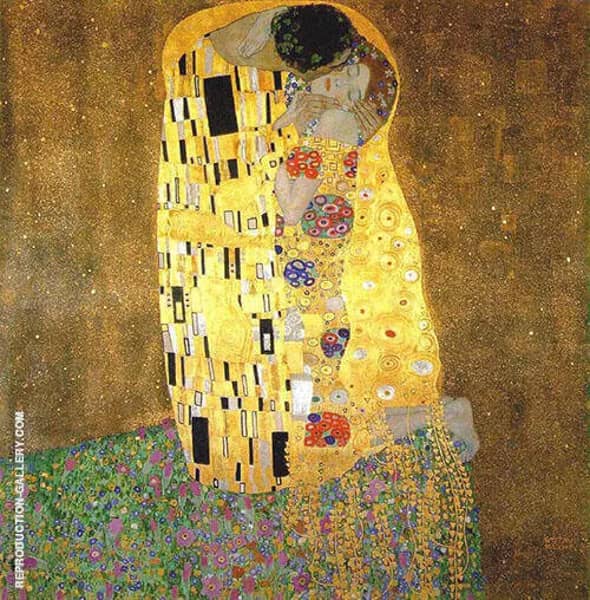
The Kiss 1907 By Gustav Klimt


What is Gustav Klimt's Most Famous Painting?
The Kiss, Gustav Klimt, is the artist's magnum opus. This painting is a masterpiece of the Austrian Symbolist movement, painted between 1907 and 1908.
The Kiss is one of the most iconic oil paintings, instantly recognizable worldwide.
The painting is embellished with gold, silver, and platinum leaf on the oil-on-canvas surface. Gustav Klimt loved adorning his works with precious metals, to such an extent that scholars consequently referred to this period as his “Golden Period.” Enjoy some of our Gold Leaf Art in our painting collections.
First displayed in 1908 at the Kunstschau in Vienna, "The Kiss" met with a warm reception from the critics. This reception was in distinct opposition to the previous scandalized reaction to Klimt’s ceiling paintings at the University of Vienna. Since destroyed, only fragments remain, such as Hygieia Medicine Detail 1900, which is part of the Medicine picture. At the time, they were described as “perverted excess,” but they engendered particular fame and notoriety for the artist.
What is the Meaning of Gustav Klimt's The Kiss Painting?
Initially titled "Liebespaar" (The Lovers), Gustav Klimt's famous painting depicts two bodies entwined in a tight embrace. The two-dimensional figures recline against a gold backdrop, supported by a flowery meadow. Intriguingly, the man’s face is unseen. Akin to other works such as The Kiss (1859) by Francesco Hayez, a possible inspiration for Klimt, this painting focuses the audience’s attention purely on the act of love itself.
Inspiration for Gustav Klimt’s The Kiss painting came from the leading artistic movements of the day. For instance, the decorative detailing on the clothing references the Art Nouveau art movement. Additionally, the floral meadow base features organic forms reminiscent of the Arts and Crafts era of the past.
The Kiss by Klimt is our most popular oil painting. It epitomizes the opulent fin-de-siecle spirit captured by the Vienna Secession artists. Klimt’s decadent inspiration drew from the gold leaf on medieval manuscripts and the decorative floral motifs found in classical Greek and Roman art.
Romantic intimacy frequently features in Gustav Klimt's paintings and the Art Nouveau movement. As a reaction to traditional academic art, Gustav Klimt's Art Nouveau paintings featured natural, curved shapes, dynamic whiplash lines, and elongated figures.
Was Gustav Klimt an Art Nouveau Painter?
The Kiss was part of Klimt's more comprehensive exploration of similar themes. Paintings such as Fulfillment (the Stoclet Frieze) play on similar designs and poses. Other artworks, such as Hymn to Joy (1902) and Hope II (1907), similarly feature the recurring motif of elongated, highly decorated figures set against largely abstracted backdrops.
Critics believe the painting depicts Klimt himself, alongside his companion Emilie Flöge. Debates rage on the identity of the woman, however. Alternative interpretations suggest “Red Hilda” is more likely; a model who often sat for Klimt. Some argue the picture isn’t a direct representation of people but shows the moment Apollo kisses Daphne in Ovid’s Metamorphoses.
Others believe it depicts the tale of Orpheus and Eurydice (representing the exact moment when Orpheus turns around and loses his love forever)—the woman’s passive posture and slight translucency support this last interpretation, suggesting her ultimate disappearance.
The Kiss remains one of the most popular Gustav Klimt reproductions, inspiring generations of art lovers since its inception.
Where is Gustav Klimt's The Kiss Painting?
Today, the original Kiss painting hangs in Vienna's Österreichische Galerie Belvedere museum.
You can own a fine art oil painting reproduction created using genuine gold and silver leaf, as well as gold paint, just like the original work of art. Our extensive catalog of reproduction paintings offers many of Gustav Klimt's gold leaf paintings.
We offer a 100% money back guarantee or replacement service. If for any reason you are dissatisfied with your painting please contact us within 7 days of receipt, advising the reason you are unhappy and we will provide you with all the information you need for its return or replacement.
We ship free to anywhere in the world via FedEx or DHL expedited service with online tracking.
Your painting will be shipped rolled in strong plastic tubing, ready for stretching and/or framing locally. This is the conventional method of transporting hand-painted oil on canvas. Learn more about how your painting is shipped.
We are able to offer a framing service intercontinental U.S. Please contact us if you would like a quotation. Alternatively, should you prefer, we can recommend a framer in your area.
Your painting will be shipped directly from our Studio in Thailand.
Notes About Your Painting
All of our paintings come with a 7.5cm (just under 3") clean surplus canvas so the framer can achieve good leverage and easy stretching.



Cannot Find What You Are Looking For?
Reproduction Gallery Information
Customer Service

(Send Us A Message)

Tel: (302) 513 3464