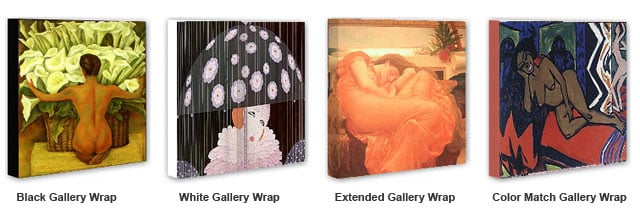




Return of the Prodigal Son c1669 By Rembrandt Van Rijn

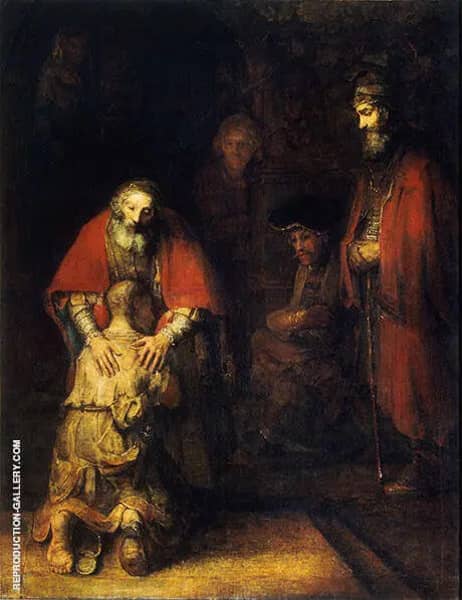

What Is The Return of the Prodigal Son by Rembrandt van Rijn?
The Return of the Prodigal Son is a late oil painting by Rembrandt van Rijn, created in the 1660s, depicting forgiveness from the biblical Parable of the Prodigal Son.
Known in Dutch as: De Terugkeer van de Verloren Zoon, widely regarded as among the most spiritually powerful religious paintings ever created by Rembrandt van Rijn and a defining masterpiece of the Baroque art movement.
Rembrandt's famous painting was described by art historian Kenneth Clark as “the greatest picture ever painted.” Through muted color, dramatic chiaroscuro, and restrained composition, Rembrandt strips the story of spectacle and focuses instead on inner emotion and moral truth.
When Did Rembrandt Paint The Return of the Prodigal Son?
Like many of Rembrandt’s paintings, it is undated. However, art historians broadly agree that it belongs to the final phase of his career.
Most scholars place its creation between 1661 and 1669, likely within the last two years of Rembrandt’s life. This dating is supported by key stylistic features of his mature period, including:
- A subdued, earthy color palette
- An introspective, contemplative mood
- An economical use of detail focused on emotional meaning rather than surface realism
These qualities reflect Rembrandt’s artistic style after personal loss, financial hardship, and spiritual reflection.
What Is the Meaning of The Return of the Prodigal Son?
The painting illustrates the climactic moment from the Parable of the Prodigal Son (Luke 15), when a wayward son returns home after squandering his inheritance.
Barefoot, exhausted, and broken, the son kneels before his father, expecting punishment or servitude. Instead, he is received with unconditional mercy. Rembrandt elevates this moment into a universal statement about grace, repentance, and forgiveness.
One of the most powerful symbolic elements is the father’s hands:
- One hand appears firm and protective
- The other soft and nurturing
Together, they suggest a union of strength and compassion, expressing forgiveness without judgment, an image often interpreted as the very nature of divine love.
Art historians and theologians have long studied this work as a culmination of Rembrandt’s spiritual vision, and it is frequently cited in academic writing as one of the most profound visual interpretations of Christian forgiveness.
Who Are the Figures in the Prodigal Son Painting?
Each figure contributes to the moral and emotional depth of the narrative:
- The Father (left, dressed in red): embodies mercy, grace, and unconditional love
- The Kneeling Son: represents repentance, humility, and spiritual return
- The Older Brother (right, standing with crossed arms): symbolizes judgment, resentment, and moral rigidity
The older brother’s presence reinforces the parable’s deeper lesson that righteousness without compassion can be as spiritually empty as indulgence and sin.
Additional figures remain in shadow. Some scholars suggest the faint female figure may represent the mother, while the seated man in rich attire could be an estate official or advisor, subtly reinforcing themes of wealth, authority, and loss.
Why Did Rembrandt Paint the Parable of the Lost Son?
Rembrandt explored the Prodigal Son repeatedly through drawings, etchings, and earlier paintings. The subject resonated deeply with his own life experiences, which included:
- Financial ruin
- The death of loved ones
- Social and professional isolation
In this final interpretation, Rembrandt distills the narrative to its emotional essence. Unlike conventional Dutch Golden Age religious art, which often emphasized drama or moral instruction, his approach is quiet, intimate, and psychological and invites contemplation rather than spectacle.
Where Is The Return of the Prodigal Son Today?
Today, The Return of the Prodigal Son is housed in the collection of the Hermitage Museum in St. Petersburg, Russia.
As one of the museum’s most revered works, the painting is viewed each year by millions of visitors, including scholars, theologians, and art lovers from around the world. It remains a cornerstone of the Hermitage’s collection of Religious Art.
Can You Buy a Replica Painting of The Return of the Prodigal Son?
Museum-quality, hand-painted oil painting reproductions of The Return of the Prodigal Son are available in a range of sizes for collectors and interiors.
Each reproduction is created by classically trained artists with many years of professional experience specializing in Old Master paintings.
Over nearly three decades, our studio has produced hundreds of Old Master reproductions, including multiple interpretations of The Return of the Prodigal Son, allowing our artists to develop deep familiarity with Rembrandt’s late technique.
Since 1996, we have been working in traditional oil on canvas. Our artists follow a meticulous process that includes studying Rembrandt’s original brushwork, layered glazing, chiaroscuro, and tonal structure, ensuring historical accuracy and visual depth. Every painting is produced entirely by hand, using time-honored techniques to achieve the richness, texture, and emotional presence of the original oil painting.
We offer a 100% money back guarantee or replacement service. If for any reason you are dissatisfied with your painting please contact us within 7 days of receipt, advising the reason you are unhappy and we will provide you with all the information you need for its return or replacement.
We ship free to anywhere in the world via FedEx or DHL expedited service with online tracking.
Your painting will be shipped rolled in strong plastic tubing, ready for stretching and/or framing locally. This is the conventional method of transporting hand-painted oil on canvas. Learn more about how your painting is shipped.
We are able to offer a framing service intercontinental U.S. Please contact us if you would like a quotation. Alternatively, should you prefer, we can recommend a framer in your area.
Your painting will be shipped directly from our Studio in Thailand.
Notes About Your Painting
All of our paintings come with a 7.5cm (just under 3") clean surplus canvas so the framer can achieve good leverage and easy stretching.
Recently Viewed:


Cannot Find What You Are Looking For?
Reproduction Gallery Information
Customer Service

(Send Us A Message)

Tel: (302) 513 3464