



The Night Watch 1642 By Rembrandt Van Rijn

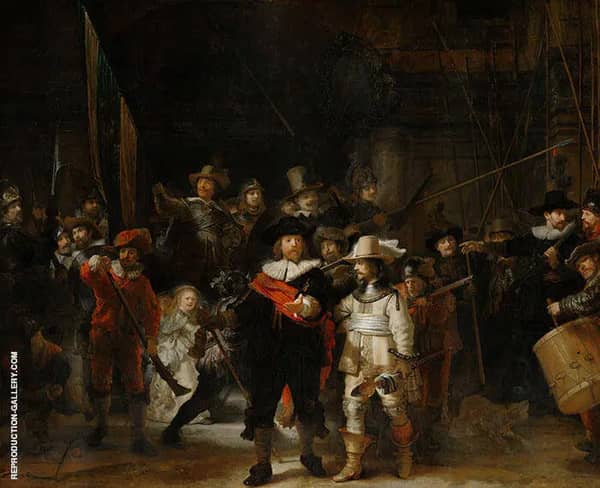

Rembrandt's famous Night Watch painting is officially titled the “Militia Company of District II under the Command of Captain Frans Banninck Cocq”. It is an oil on canvas painting on display at the Rijksmuseum in Amsterdam and is one of Rembrandt's most famous paintings.
Rembrandt van Rijn was a prolific artist, producing Baroque and Dutch Golden Age oil paintings.
When was the Night Watch painted?
Painted in 1642, The Night Watch is a true masterpiece of the Dutch Golden Age, placing Rembrandt van Rijn at the forefront of Dutch Golden Age artists.
The painting was commissioned in 1639 by Captain Banninck Cocq and his men; Rembrandt’s Night Watch depicts over thirty-four individuals. They paid 1,600 guilders for the group portrait, a substantial amount of money at the time. Each named man within the work paid just over one hundred guilders each. Even then, Rembrandt van Rijn's paintings sold for substantial sums.
Rembrandt’s Night Watch painting is famous not only for the artist's skill but also for its enormous size. It measures a staggering 363 cm by 437 cm, truly enveloping the viewer in the scene. The grand proportions of the newly constructed Musketeers Meeting Hall were well suited to display The Night Watch painting.
The large scale of the painting has led scholars to debate where Rembrandt could have painted the group portrait, as his studio was too small to accommodate it.
However, around this time, Rembrandt applied to the city to extend a summer kitchen at the rear of his property. The recorded dimensions of his extension would have just fitted the painting.
Where did Rembrandt paint The Night Watch?
The exact location where Rembrandt painted the original canvas is uncertain. However, there is also conjecture that it may have been the adjacent church. Other theories are that the location is the Kloveniersdoelen (the Musketeers' Meeting Hall).
As well as the sheer size of his famous painting, Rembrandt’s Night Watch demonstrates his proficiency with light and shadow. The artist employs the technique of “tenebrism,” which, from the Italian, literally translates as “gloomy and mysterious.” The style incorporates particularly strong chiaroscuro (bold contrasts between light and dark), with darker tones dominating. Similarly to theater spotlights used today, it adds excellent drama and movement to Rembrandt’s famous painting.
Within the work, Rembrandt depicts the Night Watch company led by Captain Frans Banninck Cocq and his lieutenant, Willem van Ruytenburch. Cocq appears in black with a red sash, while Ruytenburch is in yellow with a white sash. Within Dutch Golden Age art, yellow was commonly associated with victory.
The viewer's gaze is drawn to the most significant figures in the composition, which are situated in the center. An enigmatic woman in the background emerges, carrying a chicken, referencing the militia’s traditional emblems and signifying a (dead) defeated enemy. The woman also holds the militia's goblet, while the man in front wears a helmet with an oak leaf, another company emblem.
Why is the painting smaller than it was initially painted?
In 1715, Rembrandt’s famous painting hung in the Amsterdam Town Hall. To accommodate the painting between two pre-existing columns, the installers cut and trimmed the canvas on all four sides.
While this practice is shocking now, it was common at the time. Despite this, the cropping resulted in two characters on the left-hand side disappearing from existence.
To this day, these sections of the portrait are still missing. We only know the original composition from a Gerrit Lundens copy, which hangs in the National Gallery, London.
In 2021, these missing sections were recreated by Amsterdam’s Rijksmuseum using Lunden’s copy and AI techniques. The lieutenants appear slightly off-center, reintroducing blank space into the painting. These additions created a dynamic feeling of marching to the left, which is more representative of Rembrandt’s original composition.
Buy Rembrandt's famous Baroque painting, The Night Watch, from our extensive catalog of painting reproductions. Famous art reproductions are for sale in many sizes, and we specialize in oversized wall art.
We offer a 100% money back guarantee or replacement service. If for any reason you are dissatisfied with your painting please contact us within 7 days of receipt, advising the reason you are unhappy and we will provide you with all the information you need for its return or replacement.
We ship free to anywhere in the world via FedEx or DHL expedited service with online tracking.
Your painting will be shipped rolled in strong plastic tubing, ready for stretching and/or framing locally. This is the conventional method of transporting hand-painted oil on canvas. Learn more about how your painting is shipped.
We are able to offer a framing service intercontinental U.S. Please contact us if you would like a quotation. Alternatively, should you prefer, we can recommend a framer in your area.
Your painting will be shipped directly from our Studio in Thailand.
Notes About Your Painting
All of our paintings come with a 7.5cm (just under 3") clean surplus canvas so the framer can achieve good leverage and easy stretching.


Cannot Find What You Are Looking For?
Reproduction Gallery Information
Customer Service

(Send Us A Message)

Tel: (302) 513 3464