




Saturn Devouring his Son By Francisco Goya

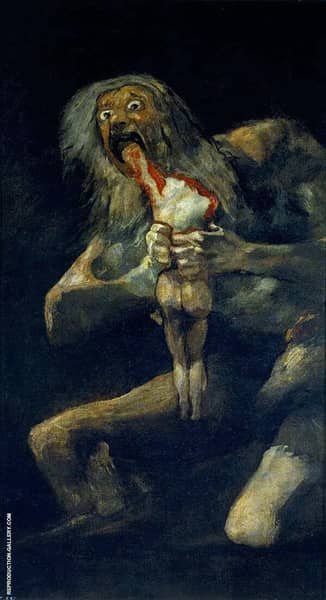

Saturn Devouring His Son is widely regarded as Francisco de Goya’s most famous and disturbing painting and one of the most unsettling images in the history of Western art. Painted between 1819 and 1823, the work stands as a defining masterpiece of Romantic art and a central image within Goya’s Black Paintings.
Why did Francisco de Goya paint Saturn Devouring his Son?
Goya painted Saturn Devouring His Son as part of his Black Paintings, a private series created late in life that reflected his fears of madness, political repression, aging, and humanity’s capacity for violence. Created without patronage or public intent, these murals represent Goya’s most unfiltered psychological and political expression.
Between 1819 and 1823, Goya created a series of deeply unsettling wall paintings, now known as the Black Paintings, inside his private residence. Painted late in life and never intended for public view, these works provide rare insight into the artist’s inner fears, political disillusionment, and psychological decline.
In 1819, Goya purchased a house outside Madrid known as the Quinta del Sordo (“Villa of the Deaf Man”). Although named after a previous owner, the title resonated painfully with Goya, who had been permanently deaf since a severe illness in 1792.
His murals utilized mixed media, adorning almost every room in the villa. Art historians believe Goya originally decorated the various rooms with more uplifting imagery in bright colors. Over the years, however, he painted over these artworks with the darker images we see today.
Unlike his court portraits or religious commissions, the Black Paintings were created solely for Goya himself. With no patron, audience, or obligation, the murals reflect an unfiltered psychological state shaped by war, repression, illness, and aging.
Why did Saturn Eat His Sons?
In classical mythology, Saturn devours his children after receiving a prophecy that one of them would overthrow him, mirroring how Saturn himself had deposed his own father. Goya draws from this myth but radically transforms it.
- Saturn overthrew his own father, Caelus
- He feared repeating the cycle of violence
- To prevent this, he consumed his children at birth
- His wife hid Jupiter (Zeus), who later overthrew him
Goya radically transforms this myth, replacing symbolic allegory with graphic violence and psychological horror.
The Roman myth told how Saturn previously overthrew his father (Caelus). Saturn ate his children, including Vesta, Dis, Ceres, Juno, and Neptune. After this bloodshed, however, his wife hid their sixth child (Jupiter) on the island of Crete.
To fool Saturn, she gave him a stone wrapped in children’s swaddling to eat. Realizing Saturn’s worst fears, Jupiter eventually overthrew his father, just as the fates predicted.
Traditionally, Saturn is said to swallow his children whole, later regurgitating them alive. Goya rejects this version entirely, instead portraying a feral god tearing into an adult human body, already decapitated, emphasizing madness, brutality, and loss of control.
Goya changes this detail, however, depicting a ruthless God chewing on a naked body. He’s already bitten off the head (and probably the right arm, too) and is currently gnawing on the figure’s left arm.
However, art historians have questioned the age of the dead figure (placing doubt on the link with the myth of Saturn) as the body appears fully grown. As Goya didn’t leave written evidence or titles for his works, this will ultimately remain an art historical mystery.
What is the Meaning of Saturn Devouring His Son?
Art historians generally interpret Saturn Devouring His Son as a symbolic work rather than a literal depiction of classical myth, viewing it as a meditation on time, aging, political self-destruction, and humanity’s capacity for violence.
Painted in Goya’s dining room, Saturn looms from the darkness. His eyes bulge madly, and his mouth gapes wide open. The only brightness in the mural comes from the bright red blood dripping down the victim’s body, the white flesh, Saturn’s eyes, and gnarled knuckles.
This depiction may represent a message of “youth against old age” or time as the inevitable devourer of life. During this period, Goya lived with his young housekeeper (and possibly mistress). His aging and ill health increasingly played on his mind.
Art historians widely interpret Saturn Devouring His Son as a political allegory, reflecting Spain’s self-destruction during an era of war, absolutism, and repression under Ferdinand VII.
Other interpretations point toward Goya’s son (Xavier). As the only one of Goya’s six (known) children to survive, this provides a fascinating parallel with the Greek and Roman myths.
How Does Goya’s Saturn Compare to Rubens’?
Goya was almost certainly familiar with Peter Paul Rubens’ Saturn Devouring His Son (1636), now housed in the Museo del Prado. While Rubens depicts a controlled, mythological god consuming an infant, Goya replaces allegory with raw psychological terror.
Where Rubens emphasizes physical cruelty within a Baroque framework, Goya strips the myth of grandeur entirely, confronting the viewer with madness, fear, and uncontrollable violence.
Is Saturn Devouring His Son a Romantic Painting?
Goya’s Black Paintings are now considered among the most radical and original expressions of Romanticism, emphasizing emotion, imagination, and subjective experience over classical harmony or rational order.
As an artistic movement, Romanticism emphasized individual emotion and intuition. It was highly suspicious of scientific logic and deductive reasoning. Art had to originate from the personal imagination of the artist, unconstrained by artificial rules and technical styles.
Artists working in the genre (with Goya as a prime example) focused on ancient narratives and intense emotion. Saturn Devouring, His Son, is particularly representative of the movement’s emphasis on powerful negative emotions such as awe, terror, horror, and fear.
For Goya, these emotions originated from our direct relationship with the sublime and nature. In addition, he had a deep-seated personal fear of madness, and these feelings are especially evident in the Black Paintings series.
What are Francisco Goya's Black Paintings?
The Black Paintings comprise fourteen murals painted directly onto the walls of Goya’s home. Executed in a severely limited palette of blacks, browns, and muted earth tones, they represent a complete departure from the luminous court portraits of his earlier career.
There has been some speculation surrounding whether Goya painted the artworks. His authorship is convincingly demonstrated by multiple scholars, however.
Painted directly onto the walls of his villa, they employ an unusual color palette consisting almost exclusively of blacks and browns. The contrast with Goya’s sunny earlier works (mainly portraits such as The Marquesa de Pontejos and The Kite) explains the widespread shock at these artworks. Interspersed by the tiniest specks of whites and greens, the ominously dark and gloomy effect is overpowering.
After Goya’s death, the murals were transferred from the walls to canvas and are now preserved in the Museo del Prado. Although the transfer caused irreversible damage, Saturn Devouring His Son remains one of the best-preserved and most powerful works in the series.
This act has since met with controversy. Although overseen by the chief art restorer at the Museo del Prado (Salvador Martinez Cubells), at least one critic has described the act as “hacking” the murals off the walls.
Today, the paintings are in relatively poor condition, resulting in the loss of much original detailing. Despite this, Goya's famous painting, Saturn Devouring His Son, has fared the test of time much better than many of his other murals.
Saturn Devouring His Son is regarded not merely as a mythological scene but as one of the earliest modern explorations of psychological terror in art. By rejecting allegory in favor of raw violence and emotional extremity, Goya anticipated later developments in Expressionism and modern horror imagery.
Explore a museum-quality, hand-painted reproduction of Saturn Devouring His Son in our online collection, faithfully recreated in oil on canvas by skilled artists using professional-grade materials.
We offer a 100% money back guarantee or replacement service. If for any reason you are dissatisfied with your painting please contact us within 7 days of receipt, advising the reason you are unhappy and we will provide you with all the information you need for its return or replacement.
We ship free to anywhere in the world via FedEx or DHL expedited service with online tracking.
Your painting will be shipped rolled in strong plastic tubing, ready for stretching and/or framing locally. This is the conventional method of transporting hand-painted oil on canvas. Learn more about how your painting is shipped.
We are able to offer a framing service intercontinental U.S. Please contact us if you would like a quotation. Alternatively, should you prefer, we can recommend a framer in your area.
Your painting will be shipped directly from our Studio in Thailand.
Notes About Your Painting
All of our paintings come with a 7.5cm (just under 3") clean surplus canvas so the framer can achieve good leverage and easy stretching.



Cannot Find What You Are Looking For?
Reproduction Gallery Information
Customer Service

(Send Us A Message)

Tel: (302) 513 3464