




Bartolome Esteban Murillo Oil Painting Reproductions
Bartolome Esteban Murillo replica paintings on Canvas for sale
Bartolomé Esteban Murillo: Famous Oil Paintings
Bartolomé Esteban Murillo is a leading Spanish artist who transformed 17th-century art with his Baroque art movement portraits and religious paintings.
Here, we explore Murillo’s fascinating life and broad artistic influences to gain a deeper understanding of his fine art oil paintings.
When was Bartolomé Murillo born?
Born in late December 1617 and baptized on January 1st, 1618, Bartolomé Esteban Murillo hailed from a middle-class Spanish family. His baptism occurred in Santa Maria Magdalena, a beautiful Baroque church in Seville. The artist's mother is María Pérez Murillo, and his father, Gaspar Esteban, was a distinguished surgeon and barber in the City. It’s unknown whether Bartolomé Murillo is from Seville City or Pilas, a smaller town in the province of Seville. Nonetheless, we know his parents sadly died in 1627 and 1628. After this date, Murillo’s sister, Ana Lagares, who lived in Seville, took care of the young boy. Ana’s husband, Juan Agustin Lagares, was also a barber. Murillo had a happy upbringing, and he remained close to his sister throughout his adulthood. Indeed, Murillo did not leave their home until his marriage in 1645.
Information about Bartolomé Murillo’s early life is scarce. However, he began his artistic studies in the workshop of Juan del Castillo, based in Seville. Castillo was Murillo’s godfather and uncle, and a Baroque painter whose skills provided deep inspiration to Murillo. Murillo's paintings emulate Castillo’s detailed facial expressions and intense realism.
What inspired Bartolomé Esteban Murillo's Baroque Paintings?
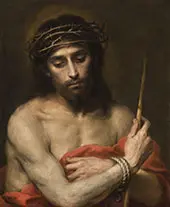
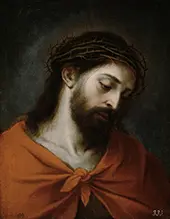
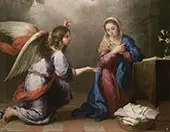
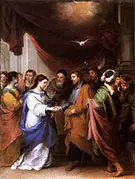
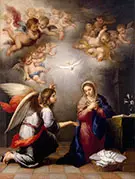
In the early 17th century, Seville was a bustling commercial center. As a young artist, Murillo found inspiration from the paintings of leading artists such as Alonso Cano, Jusepe de Ribera, and Francisco de Zurbarán. His career and style evolved to meet the upper-class tastes, particularly those of the Roman Catholic Church. As a result, his religious art is polished with a controlled technique, as evidenced in works such as The Marriage of the Virgin and The Annunciation (1660-1665). One of Bartolomé Murillo's beautiful paintings of Christ, Ecce Homo, is held by the El Paso Museum of Art, having previously been owned by the King of France, Louis-Philippe d'Orléans.
In terms of his personal life, Murillo fathered ten children with his wife, Beatriz Cabrera y Villalobos. Sadly, only five children outlived their parents. Nonetheless, one son, Gabriel, continued his father’s artistic focus and set up a career as a painter.
Why is Bartolomé Esteban Murillo a famous artist?
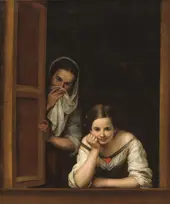
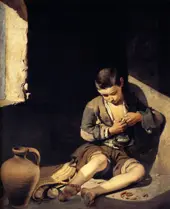
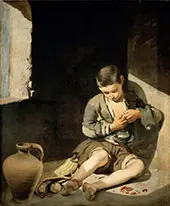
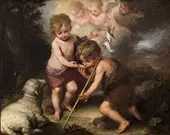
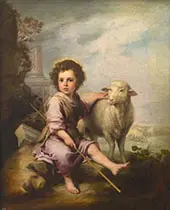
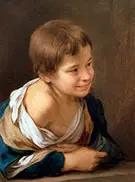
Murillo’s fame stems from his reputation for Baroque art, particularly in the realms of religious paintings and portraits of women and children. Secular paintings include stunning portraits, such as "Two Women at a Window" (1655-1660) and "The Young Beggar" (c. 1645). At the time, Genre paintings were scarce in Spanish art, and Murillo created oil paintings to appeal to the Dutch and Flemish merchants trading from Seville’s bustling port. Indeed, his paintings are particularly reminiscent of Dutch Golden Age oil paintings by Rembrandt van Rijn.
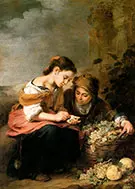
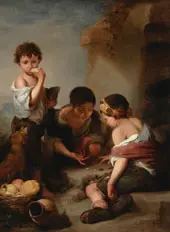
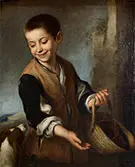
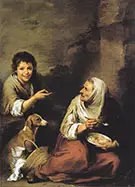
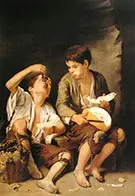
Murillo’s portrait paintings offer fascinating insights into everyday life in 17th century Spain. From street urchins to chatty friends, flower girls, and beggars, they form a unique document of clothing and social norms. His children were frequently cheeky and grubby, seen in humorous works such as Urchin Mocking an Old Woman Eating Polenta and Boys Eating Fruit.
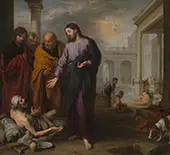
In 1645, the year of his marriage, Bartolomé Murillo received a significant commission for eleven religious paintings for the Convent of San Francisco in Seville. The paintings present narratives of lesser-known Franciscan saints, focusing on their lives of Christian contemplation and prayer. Following this success, in 1658, Murillo created other religious art for the Seville Cathedral and the Church of the Caridad. This latter commission included Christ healing the Paralytic at the Pool of Bethesda, 1667-70, painted for the brotherhood’s hospital. Murillo was a member of the Church brotherhood, dedicated to helping the sick and poor citizens of Seville.
What is Bartolomé Murillo’s art style?
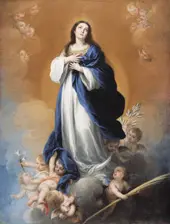
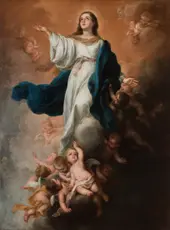
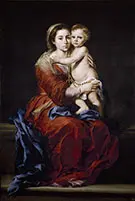
Murillo's Oil paintings join Tenebrism, inspired by the techniques of Zurbarán and Caravaggio, with soft luminescence. The influence of Caravaggio's paintings, with their strong chiaroscuro, is evident in Murillo’s Virgin of the Rosary (1650), a renowned example of Murillo’s finest double portrait. Unlike Caravaggio, however, Murillo paints both figures with a softness and sweetness reminiscent of the famous Renaissance paintings of Raphael. From the 1660s onwards, Bartolome Esteban Murillo focused on particularly demanding topics, notably the Immaculate Conception and portraits of the Virgin and Child. These included works such as The Assumption of the Virgin (1670) and the monumental Immaculate Conception of Los Venerables (c. 1678).
Intriguingly, the Empress of Russia, Catherine the Great, purchased Murillo’s Baroque painting, Assumption of the Virgin. This painting is on display at The Hermitage, Russia’s national gallery. While many art historians speak of Murillo’s famed kindness, he also had a significant connection to the slave trade. In 1671, Murillo sold Juan de Santiago, his enslaved assistant, but he later freed another enslaved assistant, Sebastián Gómez.
Where did Bartolomé Esteban Murillo spend most of his life?
Murillo spent most of his adult life in Seville, Spain. Nonetheless, he often visited Madrid, Spain’s capital city. During these visits to Madrid, Murillo saw the famous oil paintings of Baroque artists Peter Paul Rubens and Anthony Van Dyck, as well as modern Italian artists. Following a trip to Madrid in 1658, Murillo’s artistic style underwent a significant change. His brushwork is more expressive and accessible, with a muted, darker color palette. He had seen Diego de Velázquez's paintings and loved the softly modeled forms and rich tones of the great Spanish master. In religious paintings of Christ, such as Ecce Homo c1670, Bartolomé Murillo’s new heightened emotion and loose, skillful brushwork are evident. This fresh style influenced later Spanish painters such as Francisco de Goya. Goya’s religious paintings similarly conveyed the psychological drama of biblical narratives with long, free brushstrokes, elongated bodies, and dark backgrounds.
What is Bartolomé Murillo's influence on Baroque Painting?
Once back in Seville from his travels in Madrid, Murillo founded the Academia de Bellas Artes in 1660. The Academy influenced a generation of later artists, and alongside the architect Francisco Herrera the Younger, the men supported many young artists with their education and early careers. Bartolome Esteban Murillo's output of Baroque oil paintings was substantial during these years. He received many large commissions, including paintings for the Santa Maria la Blanca Church in 1665 and fantastic altarpieces for an Augustinian monastery.
Murillo died in 1682 at the age of 64. He fell off some scaffolding in Cádiz while working on frescoes at the Church of the Capuchins. Even after his death, Murillo's oil paintings remained among Europe's most famous Baroque masterpieces. His fame lasted throughout the 18th and early 19th centuries, with many followers and pupils. Murillo’s art didn’t just influence Spanish painters. The iconic English artist Thomas Gainsborough and French artist Jean-Baptiste Greuze spoke of his influence.
Bartolomé Esteban Murillo Painting Reproductions
If you love the incredible skill and beauty of Bartolome Esteban Murillo's Baroque art, explore our extensive collection of famous oil paintings. Explore more masterpiece paintings by famous artists such as Caravaggio, Velázquez, Francisco Goya, Anthony van Dyck, and El Greco. Buy oil painting reproductions, 100% hand-painted by one of our resident professional artists. We have been creating replica paintings since 1996. Our Money Back Guarantee covers standard catalog paintings. INTERNATIONAL SHIPPING IS FREE.





Enter Your Private Gallery
Log in with your gallery ID here
Track Your Order
Type your order number here




Cannot Find What You Are Looking For?
Reproduction Gallery Information
Customer Service

(Send Us A Message)

Tel: (302) 513 3464