




Francisco Goya Oil Painting Reproductions
Francisco Goya replica paintings on Canvas for sale
Who is Francisco de Goya
Francisco Goya was born in 1746 in Aragon, Spain, into a lower-middle-class family. He was a Romanticism Art Movement artist and printmaker.
At the age of 14 and after failing to win a Scholarship to the Royal Academy, Goya began his studies in Aragon and later in Madrid.
Goya's visit to Rome led to the creation of two of his earliest paintings: Sacrifice to Vesta and a Sacrifice of Pan.
Returning to Madrid in 1777, Goya won a commission to design a series of tapestries for the Royal Tapestry Factory.
Over five years, Goya created approximately 42 patterns that adorned the stone walls of Spanish Royal palaces, such as El Escorial.
Is Goya a Spanish Romantic Painter?
Some of his earlier paintings reveal traits of the Rococo art movement. However, his famous paintings from the late 18th Century and early 19th century reflect the emotional and dramatic characteristics of Romanticism art. These paintings often explore darker themes, including madness and the supernatural.
Why is Francisco de Goya Famous?
Francisco de Goya is considered one of the most important figures in the history of Spanish Art. Through his extensive body of work, he made significant contributions to the development of Modern Art. His famous paintings reflect the social and political turmoil in Spain during the Napoleonic Wars and the Enlightenment period. His paintings particularly capture the spirit of the time, and he explores themes such as war, suffering, and the darker aspects of human nature. The artist's innovative techniques created a unique artistic style which evolved throughout his career.
Discover Goya’s Portrait Paintings
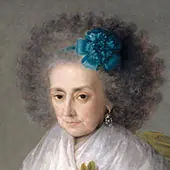
In 1786, Francisco de Goya became a court painter for the Spanish Crown. This position allowed him to create numerous portrait paintings of the Spanish aristocracy. His portraits are acknowledged for their depth and realism, capturing not only the physical likeness of his subjects but also their mood and personalities.
Goya’s best-known portrait of Spanish nobility is his painting of The Count of Floridablanca, completed in 1783, now in the collection of the Bank of Spain in Madrid. This commission earned him royal favor, and in 1790, he was appointed First Court Painter. Subsequently, the Spanish Aristocracy commissioned Francisco de Goya to paint their portraits. Many of his portrait paintings include scenes of the Spanish Royal Family.
Two other famous portrait paintings, "The Family of Infante Don Luis" (1784) in the Magnani-Rocca Foundation in Italy, and "The Marquesa de Pontejos" (1786), are in the National Gallery of Art in Washington, DC.
Manuel Osorio Manrique de Zuniga, 1788, and The Countess of Altamira and her Daughter, 1788, are on view at the Metropolitan Museum of Art in New York.
Why are Francisco Goya’s Paintings Famous?
Francisco Goya's paintings are famous for many reasons. They highlight both his artistic talent and the significant historical context in which he created his work. First and foremost, Goya is celebrated for his ability to convey deep emotional intensity and complex themes through his use of color, light, and shadow. His paintings often reflect the struggles of human existence, which resonate with viewers on multiple levels.
Additionally, Goya's role in the transition from traditional classical art to the more expressive forms characteristic of the modern era is a key factor in his enduring fame. Throughout his career, he moved away from conventional approaches to explore new ideas. His paintings not only reflect the social and political issues of his time but also anticipate art movements that followed, such as Romanticism and Impressionism.
Francisco de Goya's powerful paintings, with their innovative use of imagery and techniques, have a lasting impact on artists and art movements that followed him. His ability to depict the human condition, coupled with his unique style, has earned him a place in the pantheon of great artists in history. Overall, Goya's paintings are renowned for capturing a moment in history while continuing to engage and provoke thought among contemporary audiences.
Famous paintings by Francisco de Goya include The Parasol 1777, The Swing 1779, and The Snowstorm 1786. These three paintings form part of the Permanent Collection at the Prado Museum in Madrid.
Goya portraits, The Duchess of Alba 1795 (The White Duchess), is owned by the Alba Family in Madrid. The Hispanic Society of America holds the Duchess of Alba 1797 (The Black Duchess) in New York City.
The Naked Maja: Goya's Famous Nude Painting
Goya’s most famous nude painting, and the first life-sized nude in Western art, is La Maja Desnuda. The painting was commissioned by the Prime Minister of Spain, Manuel de Godoy, for his private collection. A second painting, this time with the same model fully clothed, La Maja Vestida – The Clothed Maja (1805) was also commissioned.
Goya's two nude art paintings sit happily together in The Prado Museum in Madrid. Both of Goya's Nude Maja oil paintings are available in our online catalog of fine art reproductions.
Where are Goya’s Black Paintings?
Goya’s career changed when the French army invaded Spain in 1808, in the Peninsular War from 1808 – 1814. During this period, Goya received commissions from the new French King Joseph, Napoleon's brother. Goya’s two famous paintings from the period, painted after the war, are The Third of May, 1808, and The Second of May, 1808, both of which reside in the Prado Museum in Madrid.
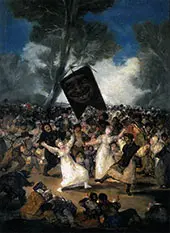
Goya painted a series of 14 paintings known as the Black Paintings, which are murals painted in oils directly on the walls of his farmhouse. Francisco Goya's black paintings were completed from 1819 onwards after he suffered from an unknown illness, leaving him very weak and deaf.
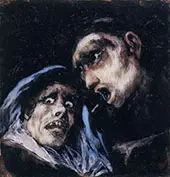
The most famous Goya paintings from this period are Saturn Devouring His Son, The Dog, The Fates, Monk Talking to a Blind Woman c1824, and Witches Sabbath.
After Goya died in Bordeaux in 1828, the murals were carefully cut from the walls, restored, and later donated to the Spanish Government.
All fourteen murals, now transferred to canvas and wooden frames, are displayed at the Prado Museum in Madrid.
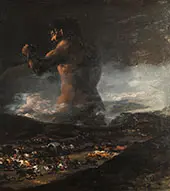
Goya painted The Colossus in 1808-1812. It is also known as The Giant. Although this oil painting pre-dates Goya’s black paintings, it is clear that the technique references his art from that time.
Art reproductions on canvas are created entirely by hand by our resident professional artists, and all of Goya’s Romanticism paintings are available in a wide choice of sizes.
Whether you are looking for famous nude paintings or romantic art, please enjoy our extensive catalog of oil painting reproductions for sale.








Enter Your Private Gallery
Log in with your gallery ID here
Track Your Order
Type your order number here




Cannot Find What You Are Looking For?
Reproduction Gallery Information
Customer Service

(Send Us A Message)

Tel: (302) 513 3464