




Franz Marc Oil Painting Reproductions
Franz Marc replica paintings on Canvas for sale
Franz Marc Paintings: An Artistic Biography
Born on 8 February 1880, Franz Moritz Wilhelm Marc grew up in Munich, Germany.
His father (Wilhelm) worked as a landscape painter. Consequently, his father encouraged the young Franz Marc to take up painting. Initially, Marc wanted to study theology like his brother, Paul. However, Marc entered an arts program at the University of Munich in 1899.
In 1900, Marc began his studies at the Academy of Fine Arts in Munich. In 1903 and again in 1907, Marc went to France. He mostly stayed in Paris, where he studied in museums and copied the various Old Master paintings on display. Franz Marc also particularly admired the work of modern painters, most notably Van Gogh. The influence of Van Gogh’s post-impressionist color and expressive brushstrokes is apparent in Franz Marc’s later paintings.
Why did Franz Marc paint animals?
During his first visit to Paris in 1903, Marc studied modern and impressionist paintings for six months. During this time, he also met the French painter Jean Niestle. Famed for his animal paintings, Niestle was revolutionary. This meeting influenced the young Franz Marc, whose subjects quickly shifted to animal art.
Early Franz Marc paintings depict animals. While he experimented with Impressionism and Pointillism early in his career, he instead turned towards the full and expressive use of color pioneered by the Fauvist artists.
Marc focused on vivid colors and intense compositions. He consistently displayed the connection between man, nature, and the eternal in his art.
Returning to Munich, Marc spent a considerable amount of time studying the anatomy of animals. While living in Berlin, he frequently visited the Berlin Zoo. Here, Marc studied and sketched animals from as many angles as possible.
Why did Franz Marc paint horses?
As Marc’s style progressed, animals overtook human and natural forms. For Marc, animals were the ideal subject matter to show truth, beauty, and purity. Marc further believed horses perfectly symbolized strength and innocence.
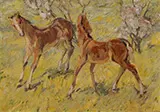
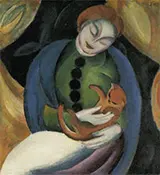
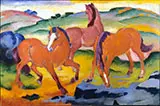
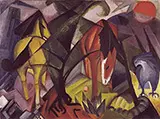
In 1910, Marc made a meaningful friendship with the painter August Macke. As a famous German Expressionist artist, he also played a leading role in Der Blaue Reiter group. That same year, Franz Marc painted works such as Nude with a Cat and Grazing Horses, Red Horses. Both were produced for the New Artists Association (the Neue Künstlervereinigung München, NKVM) and debuted at the Thannhauser Galleries in Munich.
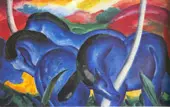
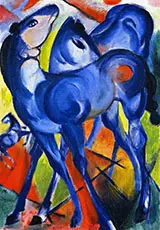
By early 1911, Marc had developed a highly personal color symbolism. Created alongside August Macke and building on Wassily Kandinsky's thought, blue was the overarching principle. It was a masculine color of spiritualism, intellectualism, and the infinite. The same year, Franz Marc completed one of our most famous art reproductions, Large Blue Horses.
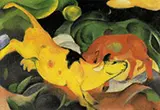
Yellow represented femininity, gentleness, happiness, and sensuality. On the other hand, red was heavy and brutal. For Franz Marc, using a lot of red in a painting could easily oppose and overcome other colors. This color theory is exemplified in Franz Marc's "Yellow Cow," painted in 1911. The leaping yellow cow, a symbol of femininity, is a veiled reference to Marc’s fiancée, Maria Franck. The couple married in 1911.
In this reading, the triangular blue mountains form an abstract self-portrait. Thus, Yellow Cow is one of the most unusual wedding portraits ever produced.
To Which Art Movement did Franz Marc belong?
Franz Marc contributed to Der Blaue Reiter group. Translated as The Blue Rider art movement, it was an important offshoot of German Expressionism. Alongside Macke, Kandinsky, Marianne von Werefkin, and Alexej von Jawlensky, these artists rejected the stricter approach of the Neue Künstlervereinigung München (NKVM).
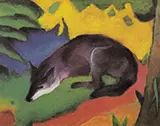
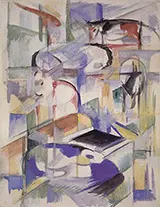
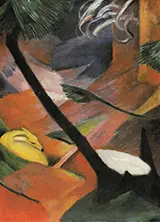
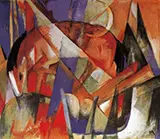
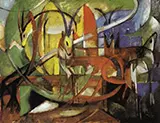
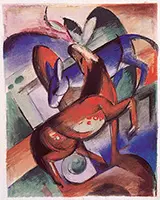
Marc also met the cubist and futurist painter Robert Delaunay. Delaunay proved another influential force in Marc’s work. His geometric forms and dynamic approach are evident in Marc’s "The Tiger" and "Red Deer II" (1912). This cubist approach also appears in paintings of the following year, including The Tower of Blue Horses, Fate of the Animals, and Franz Marc: The Fox.
The Fate of the Animals is a remarkably prescient view of the horrors of World War One, about to engulf the entirety of European society. Later damaged in a warehouse fire in 1916, Marc’s friend Paul Klee repaired the work.
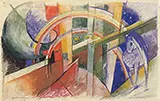
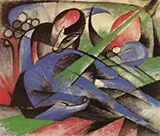
\With war imminent, Marc moved towards near-complete abstraction. He created heavily atmospheric works such as Fighting Forms and Broken Forms.
What happened to Franz Marc?
When the First World War broke out in 1914, Franz Marc joined the Imperial German Army. Initially working as a cavalryman, he soon transferred to military camouflage due to his artistic talents. By 1916, Marc helped hide guns and artillery under large canvas sheets.
He painted these in pointillist styles ranging from Manet to Kandinsky. Marc took great pleasure in this work, feeling the Russian Suprematist style was best suited for the task. Indeed, this predates the geometric “dazzle” painting techniques, first used by the British artist Norman Wilkinson in 1917.
In 1916, the German government decreed that famous artists, such as Franz Marc, be exempt from front-line military service. Although an order came to remove him from combat, the instructions arrived too late. A mortar round struck Marc at the Battle of Verdun. Sadly, he died instantly from a shell splinter. Franz Marc passed away on 4 March 1916, aged 36, in Braquis, France.
Why is Franz Marc a Famous Artist?
Franz Marc was a pioneering artist and a leading figure of the German Expressionist art movement. Alongside figures such as Kandinsky, he redefined art to focus on more abstract and spiritual concerns. His transition from figurative forms to increased abstraction paved the way for future generations of painters.
Marc’s vivid and dynamic color influenced artists such as Jackson Pollock and Willem de Kooning, as well as Color Field artists like Mark Rothko.
The Nazi party in Germany suppressed modern art and from 1936 and 1937, the Nazis condemned many artists. These artists include Franz Marc, whose oil paintings were considered degenerate and were removed from museums. They often disappeared or were destroyed.
Where is Franz Marc's Famous Painting, Blue Horse?
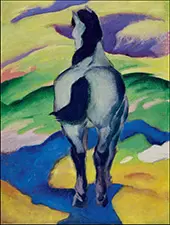
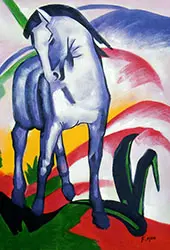
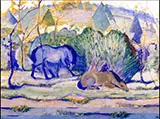
During the Nazi degenerative art purge, around 130 Franz Marc artworks left German collections. His famous painting Blue Horse went to the Musée des Beaux-Arts in Liège, France. Other famous oil paintings, such as Landscape with Horses, were only rediscovered in 2012.
This painting appeared alongside over a thousand other images in the Munich apartment of Cornelius Gurlitt. His father, Cornelius Hildebrand, served as one of Hitler’s four official art dealers. In 2017, the family of Kurt Grawi demanded the restitution of Marc’s painting The Foxes from the Kunstpalast Museum in Dusseldorf. The Nazis had previously confiscated the painting from Grawi.
In 2021, the German Advisory Commission ruled in favor of the return of the painting to the Grawi family. Franc Marc Foxes painting was sold in 2022, setting an auction record by selling for a staggering £42.6 million. This price exceeds Marc’s Grazing Horses III, which sold in 2008 for just over £12 million. The Franz Marc Museum in Bavaria holds some 150 of his paintings.
What techniques did Franz Marc use?
Franz Marc's oil paintings almost always used oil paint on canvas. He painted in an accessible, expressive manner, using long, sweeping lines to create contours and forms.
While Marc’s early paintings used a naturalistic and highly academic style, he soon switched to more expressive forms. This change came after seeing impressionist art in Paris in 1903.
At this point, his color theory progressed, and the interplay of color and form became crucial to Franz Marc..
In later years, Marc adopted futurist and cubist techniques. Characterized by sharp angles and geometric lines, his colorful paintings employ violent, chaotic shapes.
Franz Marc paintings: Museum quality oil painting on canvas
If you love the colorful beauty and energy of Franz Marc paintings, explore our extensive catalog of oil painting reproductions.
You will discover fine art reproductions to enrich your walls.. Replica art of famous oil paintings is available in various sizes, and we specialize in oversized wall art.






Enter Your Private Gallery
Log in with your gallery ID here
Track Your Order
Type your order number here



Cannot Find What You Are Looking For?
Reproduction Gallery Information
Customer Service

(Send Us A Message)

Tel: (302) 513 3464