




Peter Paul Rubens Oil Painting Reproductions
Peter Paul Rubens replica paintings on Canvas for sale
What Nationality Was Peter Paul Rubens?
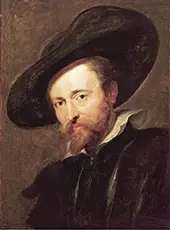
Peter Paul Rubens is a Flemish artist born in June 1577 in Siegen, Germany, who is famous for his Baroque period paintings.
His father, Jan Rubens, was a lawyer from a well-established merchant family in Antwerp. However, Peter Paul Rubens was baptized Catholic and raised by his mother, who was also a Catholic. Rubens and his mother returned to live in Antwerp following the death of Jan Rubens. As a protestant, Jan Rubens left Antwerp and went to Cologne to escape persecution.
Where Did Peter Paul Rubens Live?
As a young man, Peter Paul Rubens lived in Antwerp, where he received a classical education, including studies in Latin and classical literature. Then, at the age of fourteen, he began a series of artistic apprenticeships. His tutors are two of Antwerp’s leading painters, Adam van Noort and Otto van Veen.
What was Peter Paul Rubens's education?
As was typical of the time, Peter Paul Rubens's training included copying the work of earlier artists, notably Hans Holbein the Younger.
At twenty-one, Rubens finished his education in 1598 and joined the Guild of St. Luke as an independent artist.
In 1600, Peter Paul Rubens traveled to Italy to further his education and seek employment. He first stopped in Venice, where he encountered masterpieces by Old Masters such as Titian and Tintoretto.
Rubens then went to Mantua, where he settled at the court of the Duke of Mantua, who financed his travels to Rome and Florence. He studied paintings by Michelangelo, Raphael, and Leonardo da Vinci. These artists were instrumental in influencing Rubens’ style and use of color.
Paintings by Caravaggio in the new Baroque art style had a profound impact on his future work.
Who commissioned the Famous Paintings by Peter Paul Rubens?
In Rome, Rubens received his first major commission. Archduke Albert of Austria commissioned a series of three paintings for the chapel of St. Helena in the Basilica of Santa Croce.
In 1603, the Duke of Mantua sent Rubens to Spain on a diplomatic assignment. Rubens delivered a shipment of paintings to King Philip III, a notable collector of artworks.
Here, Rubens studied the many works of Titian and Raphael in the King’s collection. Rubens also painted an equestrian portrait of the Duke of Lerma, King Philip’s prime minister.
Upon his return to Italy in 1604, Rubens stayed first in Mantua and then traveled to Genoa and Rome.
Many of his portraits influenced the style of famous Baroque paintings by Anthony van Dyke and the English portrait artists Joshua Reynolds and Thomas Gainsborough. In 1608, Rubens heard that his beloved mother was seriously ill. He left Italy to return to Antwerp to be with her. Unfortunately, Ruben's mother died soon after his arrival.
In 1609, he was appointed Court painter to the Archduke of Austria and the Infanta Isabella of Spain. However, he continued to live in Antwerp, where he painted in his studio rather than at the court in Brussels itself.
Rubens remained in Antwerp for most of his life, and it was in his studio here that he painted many of his religious oil paintings on canvas.
Did Peter Paul Rubens create Religious Wall Art?
Rubens is acknowledged as being one of the most famous artists of religious art during the 17th Century. In 1610 and 1611, he painted The Raising of the Cross and The Descent from the Cross, for the Cathedral of Our Lady, in Antwerp.
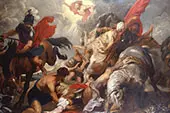
The Conversion of Saint Paul was one of a series of religious oil paintings of Saints by Rubens, painted in the 1620s in Antwerp for the King of Poland. The French Montesquieu family bought the painting in 1673. It stayed in France for nearly one hundred years before being purchased by the Gemäldegalerie in Berlin in 1903. The painting was relocated during World War II but is believed to have been lost or destroyed in mid-1945.
The Entombment is part of the Permanent Collection at the Getty Museum in Los Angeles, CA. The Getty describes the painting as being Rubens’s depiction of the moment after the Crucifixion, before the Resurrection, when the body of Christ is placed in the tomb.
Rubens painted The Entombment as a commission for the altarpiece of a small chapel, where the Eucharist, or Holy Communion, would have been given.
Are Peter Paul Rubens' Religious Paintings Famous?
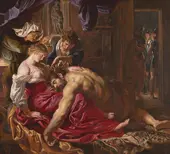
Early in his career, Rubens was commissioned to paint the famous Samson and Delilah by the Lord Mayor of Antwerp for his own home. The National Gallery in London holds the completed painting.
As was customary, Rubens first made an ink sketch of his intended work, and a private collector in Amsterdam owns this sketch. After the sketch, Rubens created an oil sketch on a wood panel, which the Cincinnati Art Museum in Ohio now owns.
In 1635, having returned from his various diplomatic missions in the courts of Spain and England, Rubens painted The Three Graces.
This painting is one of his masterpieces in the Prado Museum in Madrid. It exemplifies the term “Rubenesque,” referring to his depiction of full-figured women in his works, as well as Peter Paul Rubens' art, particularly in his religious art and mythological paintings.
Who inspired the Rubenesque nude women in Rubens' paintings?
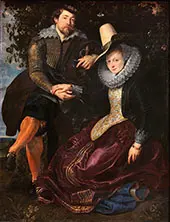
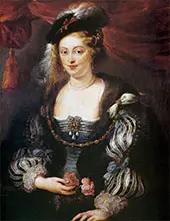
Inspiration for these Rubenesque female figures comes from Rubens' marriage to sixteen-year-old Helene Fourment. She was the niece of his first wife, Isabella Brant, who had passed away four years prior.
In 1635, Rubens purchased an estate outside Antwerp, the Chateau de Steen, and spent his remaining years there. He often painted landscapes for pleasure rather than for commercial benefit. Other landscape artists, such as the famous English landscape artist John Constable, greatly admired his landscape art. Peter Paul Rubens died from heart failure in 1640.
Discover an excellent selection of Baroque period paintings and religious paintings, not only from Peter Paul Rubens but from many famous Renaissance artists.
Oil painting reproductions are available in various sizes, with each oil painting maintaining its original aspect ratios.





Enter Your Private Gallery
Log in with your gallery ID here
Track Your Order
Type your order number here



Cannot Find What You Are Looking For?
Reproduction Gallery Information
Customer Service

(Send Us A Message)

Tel: (302) 513 3464