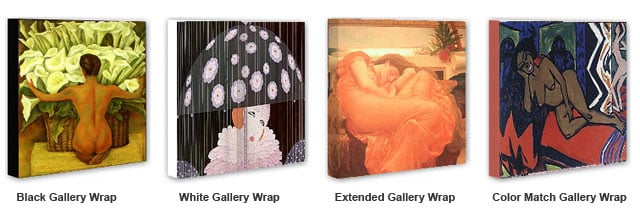




Portrait of Adele Bloch-Bauer I 1907 By Gustav Klimt

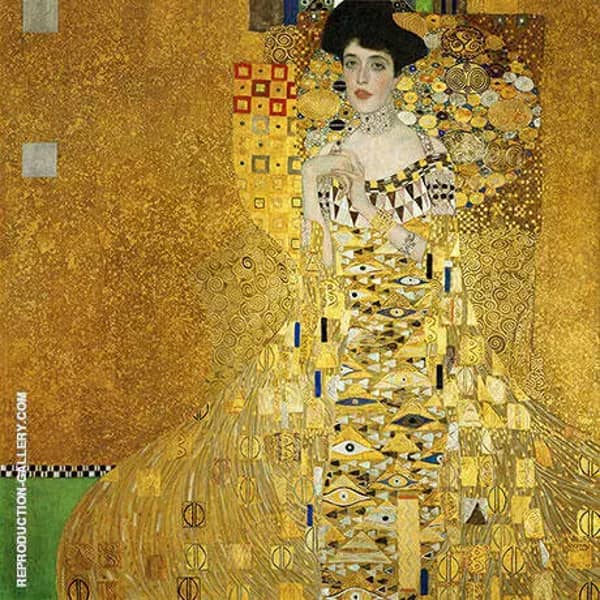

What Is Portrait of Adele Bloch-Bauer I by Gustav Klimt?
Portrait of Adele Bloch-Bauer I (1903–1907), also known as The Lady in Gold or Woman in Gold, is an oil, gold, and silver leaf painting by Gustav Klimt created during his celebrated Golden Phase. Measuring approximately 55 x 55 inches (138 x 138 cm), the portrait was executed in Vienna at the height of the Vienna Secession movement and exemplifies the fusion of Symbolism, Jugendstil (Art Nouveau), and Byzantine-inspired mosaic design.
Klimt co-founded the Vienna Secession Art Movement in 1897, rejecting the academic conservatism of the Künstlerhaus and advocating modern artistic freedom. Today, this famous painting is permanently housed at the Neue Galerie in New York and is widely regarded as one of the most important masterpieces of early 20th-century European modernism.
Why Did Gustav Klimt Paint Portrait of Adele Bloch-Bauer?
Adele Bloch-Bauer (1881–1925), a prominent Jewish patron within Vienna’s cultural elite, was commissioned by her husband Ferdinand Bloch-Bauer, an influential Austrian industrialist. Klimt devoted four years to the portrait, completing more than one hundred preparatory studies before finalizing the intricately gilded surface.
The Bloch-Bauer family became key supporters of Klimt’s work, and he later painted Portrait of Adele Bloch-Bauer II (1912), a more chromatic and painterly composition. Adele’s death in 1925, followed by the collapse of Habsburg Vienna, transformed the painting into a poignant symbol of a vanished fin-de-siècle world.
Why Is This Painting Considered the Masterpiece of Klimt’s Golden Phase?
Executed during Klimt’s Golden Phase (c. 1899–1909), the painting reflects his study of Byzantine mosaics in Ravenna, particularly the shimmering surfaces of San Vitale. Klimt combined oil with hand-applied gold and silver leaf, geometric patterning, and Symbolist iconography to create a flattened, immersive surface that anticipates modern abstraction. The richly textured gilding embodies the Secessionist ideal of Gesamtkunstwerk (a total work of art) in which painting, decoration, and design merge into a unified aesthetic statement.
The painting stands as one of the most radical syntheses of portraiture and abstraction in European art before World War I.
How Was the Painting Received When First Exhibited?
First exhibited at the 1907 Mannheim International Art Exhibition, the portrait provoked divided reactions. Some critics dismissed it as excessively decorative, arguing that Adele’s likeness was overshadowed by gold ornament. Journalist Eduard Pötzl famously quipped that it was “more brass than Bloch.” Over time, however, scholars have recognized the painting as a landmark of early modernism, balancing ornamental abstraction with psychological presence.
Today, however, art historians regard it as a landmark of early modernism, bridging Symbolism, Jugendstil, and emerging abstraction while retaining psychological intensity.
Who Owns Portrait of Adele Bloch-Bauer I Today?
The painting’s ownership history is central to its legacy. After the 1938 Anschluss, Nazi authorities seized the work in 1941 and transferred it to the Österreichische Galerie Belvedere, where it remained for decades.
Following a landmark legal battle culminating in The Supreme Court case Republic of Austria v. Altmann, the painting was restituted in 2006 to the Bloch-Bauer heirs, including Maria Altmann. That same year, it was acquired for the Neue Galerie by Ronald Lauder for $135 million, then one of the highest prices ever paid for a painting.
How Much Is Portrait of Adele Bloch-Bauer I Worth?
In 2006, the painting was acquired for $135 million, then one of the highest prices ever paid for a work of art. Based on comparable early modernist auction records and sustained global demand for works from Klimt’s Golden Phase, art market analysts note that similar masterpieces have achieved substantially higher results in recent years.
While privately held and unlikely to return to auction, the painting remains consistently ranked among the most valuable works by Gustav Klimt and among the most significant early 20th-century European artworks in private hands.
Which Klimt Paintings Were Restituted to the Bloch-Bauer Family?
In 2006, five paintings by Gustav Klimt were returned to the Bloch-Bauer heirs:
- Portrait of Adele Bloch-Bauer I (1903–1907)
- Portrait of Adele Bloch-Bauer II (1912)
- Beech Forest (Birch Forest) (1903)
- Apple Tree I (1912)
- Houses in Unterach on Lake Attersee (1916)
These restitutions remain among the most important examples of Nazi-looted art returned to rightful heirs.
What Was the Vienna Secession Movement?
The Vienna Secession Art Movement was founded in 1897 by Gustav Klimt and fellow modernist artists seeking freedom from the conservative Viennese Künstlerhaus.
The movement promoted:
- Artistic independence
- The integration of fine and decorative arts
- International modernism
- Art Nouveau aesthetics
Gustav Klimt served as the group’s first president. The Secessionists believed art should reflect contemporary life rather than academic tradition.
Portrait of Adele Bloch-Bauer I perfectly embodies these ideals, merging portraiture, symbolism, and ornamental abstraction.
How Does This Painting Compare to The Kiss?
While The Kiss (1907–1908) is Klimt’s most universally recognized image, Portrait of Adele Bloch-Bauer I is arguably his most intellectually complex work. Both belong to his Golden Phase and use extensive gold leaf, yet The Kiss emphasizes romantic symbolism, whereas Adele’s portrait merges psychological intensity with ornamental abstraction and carries profound historical significance due to its restitution history.
Both paintings:
- Belong to Klimt’s Golden Phase
- Use extensive gold leaf
- Blend symbolism with ornament
However, Portrait of Adele Bloch-Bauer I stands apart as one of the greatest portrait paintings ever created, combining psychological intensity with decorative brilliance.
Where Can You See Portrait of Adele Bloch-Bauer I Today?
The painting is permanently displayed at the Neue Galerie in New York, a museum dedicated to German and Austrian art from 1890 to 1940. The collection also includes major works by Egon Schiele and Ernst Ludwig Kirchner, situating Klimt within the broader narrative of early European modernism.
Where Can You Buy a Hand-Painted Reproduction of Portrait of Adele Bloch-Bauer?
Museum-Quality Hand-Painted Reproductions Since 1996
At Reproduction-Gallery.com, we have specialized exclusively in 100% hand-painted oil painting reproductions for nearly three decades.
Our Klimt reproductions:
- Are individually hand-painted by trained fine-art artists
- Recreate Klimt’s layered gilding technique using hand-applied metallic leaf
- Use traditional oil painting methods, never printed or digitally produced
- Undergo strict in-house quality control for surface texture and luminosity fidelity
- Are covered by our 45-Day Money-Back Guarantee
With over 40,000 famous paintings available, including Portrait of Adele Bloch-Bauer I, we offer museum-quality art at accessible prices.
Custom commissions represent nearly one-third of our studio production, allowing collectors to request bespoke sizes and formats. A Klimt gold leaf art masterpiece creates a dramatic focal point in luxury interiors, hospitality spaces, and private collections worldwide.
We offer a 100% money back guarantee or replacement service. If for any reason you are dissatisfied with your painting please contact us within 7 days of receipt, advising the reason you are unhappy and we will provide you with all the information you need for its return or replacement.
We ship free to anywhere in the world via FedEx or DHL expedited service with online tracking.
Your painting will be shipped rolled in strong plastic tubing, ready for stretching and/or framing locally. This is the conventional method of transporting hand-painted oil on canvas. Learn more about how your painting is shipped.
We are able to offer a framing service intercontinental U.S. Please contact us if you would like a quotation. Alternatively, should you prefer, we can recommend a framer in your area.
Your painting will be shipped directly from our Studio in Thailand.
Notes About Your Painting
All of our paintings come with a 7.5cm (just under 3") clean surplus canvas so the framer can achieve good leverage and easy stretching.


Cannot Find What You Are Looking For?
Reproduction Gallery Information
Customer Service

(Send Us A Message)

Tel: (302) 513 3464