



Several Circles 1926 By Wassily Kandinsky

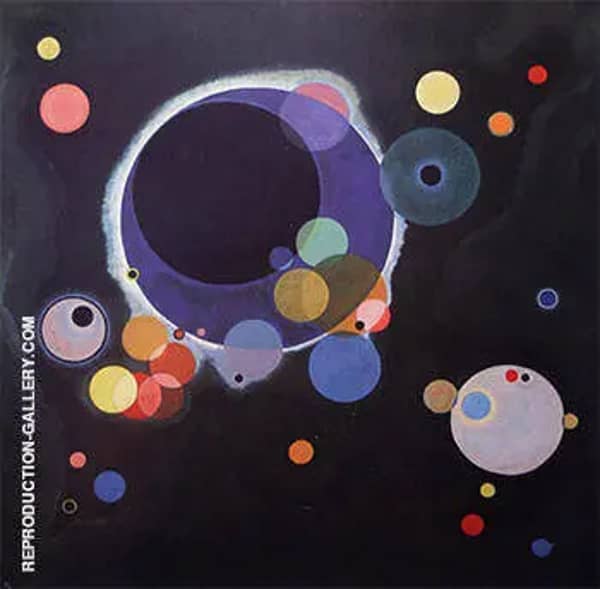

Several Circles 1926 symbolizes Wassily Kandinsky's approach to color theory. He was a famous Russian Artist instrumental in pioneering abstract oil paintings.
What is the meaning behind the painting, Several Circles?
Several Circles by Wassily Kandinsky represents Kandinsky’s exploration of abstraction and spiritual expression through art. It uses one straightforward form, the circle, to investigate color relationships, shape, and composition.
As a genuinely abstract painting, the meaning of Kandinsky’s work is entirely subjective. The painting nonetheless demonstrates Kandinsky’s love of circles. Moreover, it marked a substantial shift from his earlier Blue Rider creations, which often focused on people and animals.
Kandinsky's famous painting is relatively simple, with circles imposed upon a black background. They appear in different sizes and colors, and when the shapes overlap, their colors change. Some have white halos while others sit amongst vibrant, concentric designs. Some are offset, such as the large blue and black shapes in the middle. In addition, the forms become smaller and more spaced out towards the edge of the canvas. Kandinsky’s positioning seems a curious combination of random arrangements and purposeful design.
Kandinsky primarily focused on color theory during this period. However, he found Johann Wolfgang von Goethe’s ideas about the “emotional effects” of color fascinating. Consequently, his painting illustrates the artist's reflections on how color and form evoke our most profound emotions.
Where did Wassily Kandinsky paint this artwork?
Kandinsky painted Several Circles after returning to Moscow at the end of World War I. From the early 1920s onwards, his increasingly abstract style underwent a substantial transformation. He progressively focused on the three foundational geometric forms: squares, triangles, and circles.
Artists such as Aleksandr Rodchenko, Kazimir Malevich, and Liubov Popova championed these ideas with the Suprematist art movement—their attempts to create universal artistic forms deeply inspired Kandinsky. As a result, he worked alongside both Suprematist and Constructivist artists.
Wassily Kandinsky's Several Circles currently hangs in the Solomon R. Guggenheim Museum in New York.
To what Art Movement does Several Circles belong?
Despite these exciting ideas, Wassily Kandinsky never fully adopted the geometric push of Suprematism and Constructivism. Instead, he used elements such as flat planes of color and clearly defined shapes. However, he maintained his crucial belief in the expressive power of abstract, organic forms.
As such, Several Circles is pure Abstract Art. Unfortunately, Kandinsky’s focus on abstraction meant he became increasingly isolated from many of his Russian colleagues.
Contrastingly, Kandinsky found the ideas of the German Bauhaus particularly inspiring. As the 1920s progressed, this school became an international movement. Like Suprematism, it championed geometric, abstract styles. Nonetheless, Bauhaus also prioritized linking art with everyday life and functionality.
Why did Kandinsky use shapes in his paintings?
Among Wassily Kandinsky's famous paintings, many feature circles. He felt this shape was the essential art form, as all mark-making arises from a single dot.
In addition, Kandinsky believed circles represent universal ideas of harmony, balance, and our place in the cosmos. He felt that circles directed viewers toward the “fourth dimension.”
Other famous paintings by Wassily Kandinsky featuring circles include Circles in Circles and Concentric Squares and Circles.
Kandinsky's Several Circles painting illustrates a continued interest in this simple shape.
Speaking of orbs and spheres, Kandinsky claimed they allow the “greatest oppositions” to merge into one.
If you love the energy and beauty of Wassily Kandinsky's famous paintings, discover our extensive collection of abstract art reproductions.
Enjoy our collection of museum-quality art reproductions, available in our online art catalog, featuring colorful wall art.
We offer a 100% money back guarantee or replacement service. If for any reason you are dissatisfied with your painting please contact us within 7 days of receipt, advising the reason you are unhappy and we will provide you with all the information you need for its return or replacement.
We ship free to anywhere in the world via FedEx or DHL expedited service with online tracking.
Your painting will be shipped rolled in strong plastic tubing, ready for stretching and/or framing locally. This is the conventional method of transporting hand-painted oil on canvas. Learn more about how your painting is shipped.
We are able to offer a framing service intercontinental U.S. Please contact us if you would like a quotation. Alternatively, should you prefer, we can recommend a framer in your area.
Your painting will be shipped directly from our Studio in Thailand.
Notes About Your Painting
All of our paintings come with a 7.5cm (just under 3") clean surplus canvas so the framer can achieve good leverage and easy stretching.





Cannot Find What You Are Looking For?
Reproduction Gallery Information
Customer Service

(Send Us A Message)

Tel: (302) 513 3464