




Frida Kahlo Oil Painting Reproductions
Frida Kahlo replica paintings on Canvas for sale
Frida Kahlo is a Mexican artist who was married to Diego Rivera.
Living at a time of significant political and historical upheaval, Frida Kahlo's paintings provide a fascinating insight into not only her own life and experiences as a woman in Mexico but also into some of the most tumultuous events of the 20th Century.
Who is Frida Kahlo?
Born on July 6th, 1907, Frida Kahlo de Rivera (née Magdalena Carmen Frieda Kahlo y Calderón) created some of the most recognizable paintings of the 20th century.
With a German father of Hungarian heritage and a Mexican mother of Native American and Spanish descent, Frida Kahlo's self portrait paintings frequently explore themes of identity and the human body.
As a young girl, Kahlo contracted polio. An acute viral disease impacting the nervous system, this infection left her with a limp that lasted her entire adult life. She consequently spent extended periods at home and was particularly close to her father. He was a professional photographer, and she assisted him in his studio. This is where Frida Kahlo's art and her love of imagery first blossomed. Despite taking some drawing classes, Kahlo initially studied Science and Medicine. She enrolled in the National Preparatory School of Mexico City in 1922 to pursue a career in medicine.
While living in Mexico City, Kahlo met another famous Mexican artist, Diego Rivera, who was working on a mural for the school auditorium.
What was Frida Kahlo’s Disability?
In 1925, she was involved in a catastrophic bus accident. It was an extreme incident that almost killed her and broke nearly every bone in her body. In addition, the bus rail pierced straight through Frida Kahlo’s abdomen.
She underwent over thirty medical operations at various points during her life. This was a constant financial worry, causing the artist significant distress. Whilst she initially recovered well, from her mid-thirties onwards, Kahlo found it increasingly difficult to walk.
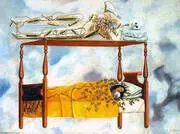
During her slow and painstaking recovery, Kahlo began to paint. Her parents installed a mirror above her bed, allowing her to use her medical insights and diligence. She turned her creative talents towards understanding her psyche and broken body.
After a long convalescence, Frida Kahlo joined the Mexican Communist Party. At political meetings, she met Diego Rivera once again. The couple married in 1929 and forged an unlikely yet creatively rich partnership.
Famous Frida Kahlo paintings after this date frequently return to themes of Mexican folk art, a topic Rivera strongly supported. In 1930, as a result of Diego Rivera's commissions, they traveled to North America, returning in 1933.
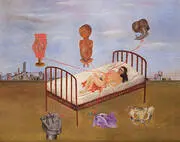
During this period, Kahlo suffered multiple complicated pregnancies and miscarriages, which are represented in some of her famous paintings. Referencing these disappointments, Frida Kahlo's portrait paintings from this period, such as Henry Ford Hospital and My Birth, are particularly harrowing.
What is Frida Kahlo's Most Famous Painting?
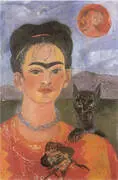
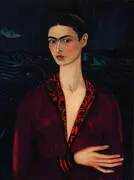
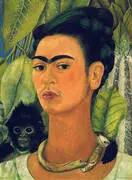
For anyone searching for Frida Kahlo's most famous painting, the artist’s self-portraits are particularly iconic. In all of her paintings, her direct gaze is arresting and unavoidable.
Famous paintings often focus on her face and physique, the result of years spent in bed, with only a mirror for company. Oil paintings such as The Broken Column are particularly representative of the medicalization of her body. It was painted in 1944, shortly after spinal surgery, and the all-encompassing presence of ongoing pain and suffering is evident. Kahlo stands as a solitary presence amongst a barren landscape, supported by her metal spinal “column”.
This contrasts with earlier works, such as Frida Kahlo's Self-Portrait with Thorn Necklace and Hummingbird 1940, in which the artist appears surrounded by nature.
Despite the idyllic background of luscious green leaves, her pain still speaks loudly. Thorns knot around Kahlo’s throat, in a possible Christian reference, as she stoically endures her suffering.
Why is Frida Kahlo Famous?
Besides her famous paintings and iconic self-portraits, Frida Kahlo’s personal life is particularly fascinating. The house she shared with Diego Rivera became a meeting place for leading political revolutionaries and artists.
Visitors include Leon Trotsky, with whom Kahlo had a brief affair, and the famous Surrealist artist André Breton. Breton particularly championed Frida Kahlo’s art and wrote the introduction to her first solo exhibition held in New York in 1938.
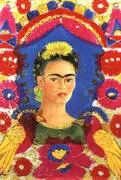
Later, traveling to Paris, she met the surrealist artist Marcel Duchamp. Kahlo commented that he was the only surrealist artist she ever really admired. Whilst in France, the Louvre Museum purchased her painting titled The Frame. In doing so, Frida Kahlo became the first 20th-century Mexican artist in the Louvre’s art collection.
Why is Frida Kahlo a Feminist Icon?
Frida Kahlo's feminist paintings significantly contributed to her subsequent fame. Her self-portrait paintings are bold and brave, serving as true icons of the feminist movement and women’s ownership of their bodies.
Furthermore, paintings such as A Few Small Nips reference the violent treatment of women in Mexico and Frida’s outrage at personal events. Diego Rivera had a prolonged affair with Kahlo’s younger sister, which left Frida distraught. This led to the couple’s divorce in 1939. Many scholars have noted the similarity between the man in A Few Small Nips and Rivera, with the woman possibly representing her sister.
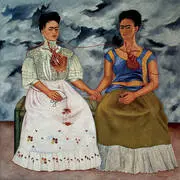
Other famous paintings, such as The Two Fridas, depict the split nature of womanhood and Kahlo’s identity. In this painting, the artist is dressed in a European-style wedding dress and Tehuana clothing, referencing the complex expectations of society and family. The painting reveals an artery leading straight from her heart to a miniature portrait of Diego Rivera. Her European form attempts to stem the flow of blood, however, threatening her pure white dress.
Diego Rivera and Frida Kahlo reconciled in 1940. They returned to Kahlo’s childhood home, La Casa Azul, also known as the Blue House, located in a residential area just south of central Mexico City.
In a significant personal achievement, Kahlo became a professor of painting at Mexico City's La Esmeralda Art School in 1943.
When Did Frida Kahlo Die?
Unfortunately, Kahlo’s health rapidly deteriorated in the years that followed. She turned to alcohol and drugs for relief from extreme pain. This led to her mental state deteriorating and the decline of her painterly skills.
She underwent many surgeries during the 1940s and 1950s, spending prolonged periods in the hospital. In 1953, unable to walk and in near agony, she attended her first and only solo exhibition lying on a bed. Despite this, Frida Kahlo continued painting right up to her death in July 1954. One of her last paintings, Self-Portrait with Portrait of Dr. Farill (1951), depicts the artist sitting in a wheelchair.
After her death, Diego Rivera redesigned their home at La Casa Azul as a museum dedicated to Frida Kahlo’s art. It opened in 1958, a year after Rivera’s death.
Discover the world of famous Frida Kahlo paintings. Oil painting reproductions from our catalogue of Famous Portraits are available in many size options.





Enter Your Private Gallery
Log in with your gallery ID here
Track Your Order
Type your order number here




Cannot Find What You Are Looking For?
Reproduction Gallery Information
Customer Service

(Send Us A Message)

Tel: (302) 513 3464