




Paula Modersohn-Becker Oil Painting Reproductions
Paula Modersohn-Becker replica paintings on Canvas for sale
Paula Modersohn-Becker: German Expressionist Paintings
Paula Modersohn-Becker was one of the most exciting and tragic artists of German Expressionist paintings.
In her short life, she created over 700 Expressionist paintings and well over 1,000 drawings. These artworks, primarily focusing on portraiture paintings, revolutionized modern art.
Today, we explore some of the most famous Paula Modersohn Becker paintings and the artist's personal life.
Paula Modersohn Becker Early Life.
Paula Modersohn-Becker, born 8 February 1876, grew up in Dresden, Germany. As one of seven children, she enjoyed a prosperous and comfortable upbringing.
Becker's mother, Mathilde, came from an aristocratic background, while her father, Carl, worked as an engineer with the German railway.
However, in 1861, a disaster struck the family. Carl's brother, Oskar Becker, attempted the assassination of King Wilhelm of Prussia. While the King was not severely injured, the family suffered social and professional ostracization.
The Modersohn Becker family moved to Bremen in 1888. There, they socialized among intellectuals and avant-garde Russian artists of the time. Paula learned to draw, developing a life-long passion for art.
In 1892, Paula Modersohn Becker traveled to England. She lived with an aunt and studied drawing at St John's Wood Art School. After returning to Bremen and at her parents' request, Modersohn-Becker trained to become a teacher.
Famous Women Artists
As one of Germany's famous women artists, Modersohn-Becker received private painting lessons. Her father even allowed her to set up a studio in their family home. During this period, she painted self-portraits and portrait paintings of her siblings.
Becoming increasingly independent, Becker traveled to Berlin in 1896. Here, she completed a six-week art course at the Verein der Berliner Künstlerinnen before enrolling at the Women's Academy of Art.
What art movement was Paula Modersohn Becker?
After briefly returning to her family in Bremen, Becker moved to the northern German town of Worpswede. She joined the Worpswede Art Movement and Artists' Colony, which Fritz Mackensen and Heinrich Vogeler managed.
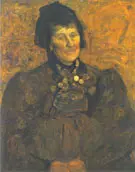
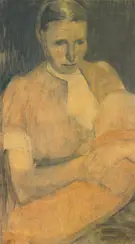
Alongside artists such as Otto Modersohn and Fritz Overbeck, Becker created numerous landscapes and scenes of peasant life. These included oil paintings such as Peasant Woman Nursing her Baby (1898) and Old Woman Sitting with her Hands in her Lap (1899).
The Worpswede artists went against traditional Germanic rules of painting; prioritizing Expressionist paintings featuring vivid colors and simplified compositions. During this time, Becker also befriended the poet Rainer Maria Rilke and the sculptor Clara Westhoff.
Becker's artistic style quickly developed, and she soon abandoned the romanticized style of the Worpswede art movement. Indeed, in a journal entry, Becker complained that it wasn't "broad enough" and was too "genre-like" for her tastes.
What medium did Paula Modersohn Becker use?
Modersohn Becker mostly used oil paints on canvas, typical for late 19th century paintings.
From 1899 onwards, her artistic aspirations shifted towards Paris as the artistic epicenter of Europe. Paris represented creative freedom and innovation, and in 1900, she studied at the Académie Colarossi in the Latin Quarter.
Paula Modersohn-Becker visited the capital's prestigious museums, particularly appreciating the work of Paul Cézanne and Paul Gauguin. After this eye-opening experience, her oil paintings on cans moved toward flat areas of color, inspired by Gauguin, with more expressive brushstrokes depicting simplified forms, as seen in Paul Cezanne's paintings.
A fellow Worpswede artist, Otto Modersohn, joined Becker in Paris. After Paula returned to Germany, the two painters formed a romantic relationship and married in 1901. Otto Modersohn already had a daughter, and Paula combined her new roles as a stepmother, housewife, and expressionist artist.
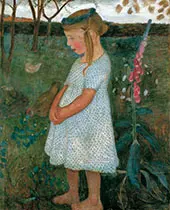
She established a small studio nearby, where she painted almost daily. Artworks from this period often featured children, notably Head of a Fair Girl (1901) and Elsbeth in the Brunjes Garden (1902).
When did Paula Modersohn-Becker move to Paris?
Becker found it challenging to concentrate on her art, so she and Otto returned to Paris in 1903. Here, she visited the artist Auguste Rodin and studied new Japonisme trends, rejuvenating her artistic passion.
After 1905, the two artists drifted apart, both creatively and romantically. Paula Modersohn Becker continued to create still life paintings and during the period 1905-1907 she painted almost fifty still-life artworks.
During this period, she also developed portrait painting, mainly focusing on depictions of mothers and children. Reclining Mother and Child 1906 is one of her best-known creations.
In 1906, Becker wrote to her husband asking him to "try to get used to" the thought that their lives could go "separate ways." Despite her family's intense concern, Becker returned to Paris to pursue her art alone.
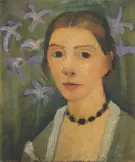
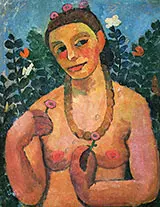
Oil paintings from this period include Becker's famous nude self-portrait paintings, such as Self Portrait with Amber Necklace Detail. These famous nude paintings are candid and brave. They unconventionally represent a real woman with an intense personal life, painted in a thick impasto style.
Becker loved her newfound freedom to focus on her art. She wrote to her sister, Milly Rohland-Becker, that it was the most intensively happy period of her entire life.
Who was the first woman to make nude self-portraits?
Paula Modersohn Becker was the first woman to create a nude self-portrait. In 1906, she also painted a portrait of her sixth wedding anniversary, the first nude and pregnant self-portrait.
This oil painting depicts Becker, pregnant with Otto Modersohn's child. Despite their separation in previous years, the couple stayed in contact and maintained a relationship. However, Becker was unsure about motherhood and concerned it would impact her ability to paint.
Nonetheless, the couple was delighted with the pregnancy. On 2 November 1907, their daughter, Mathilde Modersohn, arrived. However, Becker complained of severe leg pain soon after delivery, and on the advice of her doctor, she stayed in bed.
20 November, Becker rose from her bed and asked her baby. Complaining again of leg pain and with her daughter in her arms, Becker passed away. Her last words were, "What a pity".
Paul Modersohn Becker died from deep vein thrombosis in her leg, a common side-effect of keeping women in bed for long periods after delivery.
Otto Modersohn arranged for Becker's burial in Worpswede Cemetery, outside their artist's colony home.
Paula Modersohn Becker Expressionist Paintings: fine art reproductions
Paula Modersohn Becker is one of the most famous female artists of the 19th and 20th centuries. Her pioneering Expressionist paintings revolutionized portraiture, and her nude oil paintings changed views on femininity.
Discover expressionist paintings by famous artists Gabriele Munter and Max Beckmann.
If you love paintings by famous women artists, enjoy our extensive collection of replica art. Fine art reproductions are 100% hand-painted by professional artists.





Enter Your Private Gallery
Log in with your gallery ID here
Track Your Order
Type your order number here




Cannot Find What You Are Looking For?
Reproduction Gallery Information
Customer Service

(Send Us A Message)

Tel: (302) 513 3464