




Caravaggio Oil Painting Reproductions
Caravaggio replica paintings on Canvas for sale
Who is Caravaggio?
Michelangelo Merisi da Caravaggio, best known simply as Caravaggio. He is famous for Baroque period art and Renaissance oil paintings. His Religious Art can be seen in churches and chapels throughout Rome.
Born in Milan, Italy, in 1571, he lived a short, chaotic, and troubled life. Throughout the 1570s, the Bubonic Plague ravaged many Italian cities. Consequently, the family relocated to the town of Caravaggio in 1576. The artist's grandparents died from the plague when he was just six years old, and his mother died from the disease when he was 10. Caravaggio’s artistic talents were evident from an early age. Aged 12, he commenced an artistic apprenticeship in the studio of Simone Peterzano. After four years of working as an apprentice, he moved to Rome. In the late 1580s, a surge in the construction of Italian church buildings led to a strong demand for high-caliber artists to create religious paintings.
Michelangelo Merisi da Caravaggio Religious Art
At the start of his career, the Catholic Church sought oil paintings offering an alternative to the Mannerism paintings of the past. They also hoped to counter the Protestant Reformation with a new, naturalistic style of communicating religion to the masses. Caravaggio's paintings, with their distinctive style of realistic yet vivid chiaroscuro and dramatic juxtapositions of light and dark, were ideally suited for this purpose. Boy Peeling a Fruit, Boy with Basket of Fruit, and Young Sick Bacchus c1593 reflect this early, intensely dramatic style.
During this period, Caravaggio met influential artists and earned the patronage of notable figures, including the architect Onorio Longhini and the painter Prospero Orsi, who introduced him to wealthy Roman society. His religious paintings initially focused on scenes from the New Testament. However, he was a true innovator, prioritizing the mundane, everyday aspects of biblical narratives and transforming them into new heights. Controversially, the artist often used street people as models for figures such as Mary and the Apostles. Enhanced by theatrical lighting and shallow pictorial space, this approach marked the beginning of a new age of realism in religious art.
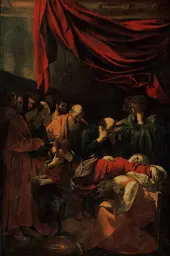
Due to their shocking nature, the church rejected many of Caravaggio's early paintings. Indeed, rumors abounded that in his oil painting Death of the Virgin 1601, Mary was based on the body of a dead prostitute who had drowned in the Tiber. Interestingly, the painting was later purchased by the Duke of Mantua at the recommendation of the artist Peter Paul Rubens, famous for his painting "The Conversion of St. Paul."
Why are Caravaggio's Paintings Famous?
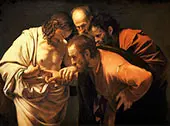
Caravaggio's fame and reputation quickly grew despite or perhaps because of the scandals surrounding him. Known for their dramatic lighting, his paintings contain a rich, jewel-toned palette of color. His oil paintings harmonize theatrical compositions with biblical narratives as part of the Catholic counter-reformation. Famous paintings such as Judith Beheading Holofernes (1599) and The Incredulity of St. Thomas (1602) exemplify the intense skill and drama that make his Renaissance paintings among the most famous 16th-century artworks. Indeed, every composition tells a story understood by believers of all social echelons.
Caravaggio also frequently created Greek mythological paintings, exemplified in oil paintings such as Bacchus c1596. Early oil paintings, such as The Cardsharps 1594 and The Fortune Teller 1598, represent everyday scenes. With their fantastic detail and rich psychological insight, Caravaggio's paintings impressed a prominent collector, Francesco Cardinal Del Monte. The Cardinal was one of the artist's first patrons, providing him with lodgings and many beneficial introductions to Roman society.
What are Caravaggio's Masterpiece Religious Paintings?
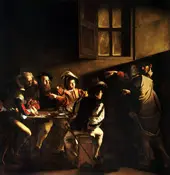
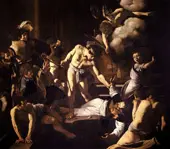
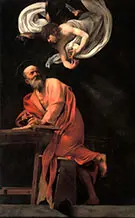
These social connections, provided by Cardinal Del Monte, led to Caravaggio’s most important commissions: two paintings for the Contarelli Chapel in Rome. Today, they are shining masterpieces of Baroque Art and Renaissance paintings. These are The Calling of Saint Matthew and The Martyrdom of Saint Matthew. Painted between 1599 and 1600, they remain in the Church of San Luigi dei Francesi. Caravaggios's paintings were an immediate success and greatly admired; he never struggled for commissions again.
Representing stories from the Gospel of Matthew, the artist boldly places Jesus Christ and the saints in tawdry, dark settings. This realistic presentation contrasts the shining light of faith with worldly attire, mundane interiors, and everyday activities. Even today, his religious paintings retain their emotional power. Pope Francis frequently spoke of visits to The Calling of Saint Matthew, simply commenting, “This is me.” Yet, even the Pope saw himself in Caravaggio’s art as a “sinner on whom the Lord has turned his gaze.”
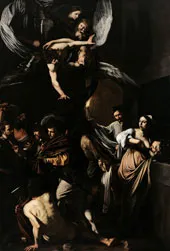
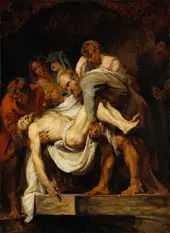
In addition to the paintings in the Contarelli Chapel, the Betrayal of Christ, Entombment of Christ, and The Seven Works of Mercy are recognized as important religious paintings.
Are Michelangelo and Caravaggio the same person?
As a frequently asked question, it is worthwhile noting that Caravaggio’s real name was Michelangelo Merisi. However, he is not the artist Michelangelo Buonarroti, known simply as Michelangelo. The great Michelangelo lived from 1475 to 1564 and died before Caravaggio’s birth in 1571.
While Michelangelo largely avoided public scandal, Caravaggio was known for his quick temper, many lovers, and frequent brawls. He committed many minor crimes, such as swearing at a constable, cutting a hole in his landlord’s ceiling to allow light for painting, and carrying a sword without a license. More serious crimes include scarring a guard during a fight and throwing a plate directly in the face of a waiter. The incident occurred because he believed his undercooked artichokes were an insult to his culinary skills.
Why was Caravaggio Exiled?
Ultimately, his fiery temper was his downfall. He killed Ranuccio Tomassoni in a duel after Tomassoni insulted a prostitute Caravaggio particularly admired. Scholars speculate the two men also had gambling debts. However, rather than risking execution for the crime, his exile served as punishment for Tomassoni’s murder.
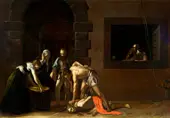
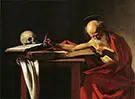
He consequently fled Rome heading for Naples. While in exile, he hid with multiple noble families and patrons, including the Sforzas and the House of Colonna. During this period, he continued to work and painted several masterpieces, including "The Beheading of Saint John the Baptist" and "Saint Jerome Writing," the only painting Caravaggio signed.
Despite this, Caravaggio fled Malta after yet another fight. On this occasion, he seriously wounded a high-ranking knight and again escaped prison. He traveled to Sicily under the protection of an old artist friend, Mario Minniti, and painted the Adoration of the Shepherds on the picturesque Italian island. Nonetheless, the artist lived in a state of constant fear and paranoia. His suspicion proved well-founded after a group of men attacked him in possible retaliation for the attack on the Maltese knight. This time his face was permanently disfigured.
Why was Caravaggio killed?
It is unknown whether Caravaggio died of natural causes or if he was murdered. We know that he died at some point in July 1610 while still attempting to obtain a Papal pardon for the murder of Ranuccio Tomassoni. However, this most famous Baroque and Italian Renaissance artist probably died from syphilis, malaria, or brucellosis. Nonetheless, some art historians speculate that he was killed in retribution for the death of either Tomassoni or the Knight, whom he had attacked in Malta.
A 2010 discovery identified bones likely to be those of Caravaggio. They reveal toxic lead levels, perhaps absorbed from the paints he used. His painting style was incredibly physical and erratic, and supported this theory. Furthermore, unpredictable and violent behavior is also a common symptom of lead poisoning. Whatever the cause of death, Caravaggio died at the age of 38 in Spain. He was en route to the Pope after hearing a pardon was due.
What was Caravaggio's influence?
Caravaggio's paintings had a profound influence on late Renaissance Art and the Baroque movement. In the words of the art historian Bernard Berenson, “no other Italian painter has exercised so great an influence” on European art.
Even artists of the time referred to themselves as “Caravaggisti.” Indeed, leading painters such as Bartolomeo Manfredi, Carlo Saraceni, Battistello Caracciolo, and Artemisia Gentileschi began to follow his pioneering techniques, which included heightened naturalism and dramatic compositions. Furthermore, Peter Paul Rubens, Diego Velázquez, and Rembrandt van Rijn admired Caravaggio paintings. His use of tenebrism, a painting style characterized by dark tones with contrasting light effects, is particularly evident in many of Rembrandt’s famous paintings.
Buy Caravaggio Oil Paintings Reproductions.
If you love stunning Renaissance paintings, explore our collection of museum-quality oil paintings on canvas.
Buy fine art reproductions of Caravaggio paintings. Discover replica paintings of Renaissance paintings from Leonardo da Vinci, Raphael, or Titian. We have been creating hand-painted oil on canvas art since 1996. Our Money Back Guarantee covers standard catalog paintings; INTERNATIONAL SHIPPING IS FREE wherever you are.




Testimonial from Cristian B, Waterloo, Ontario

Enter Your Private Gallery
Log in with your gallery ID here
Track Your Order
Type your order number here




Cannot Find What You Are Looking For?
Reproduction Gallery Information
Customer Service

(Send Us A Message)

Tel: (302) 513 3464