




Vincent van Gogh Oil Painting Reproductions
Vincent van Gogh replica paintings on Canvas for sale
Famous Paintings by Vincent van Gogh: An Artistic Biography
Born on March 30, 1853, Vincent Van Gogh is one of the most famous artists in the history of art. His striking colors, energetic brushwork, and beautiful compositions profoundly influenced a generation of artists to follow.
Given his worldwide renown and artistic significance, we delve into the artist's captivating personal life through famous Post Impressionist paintings. Here are some of the most frequently asked questions about Van Gogh’s paintings and their fascinating stories.
Where was Van Gogh born?
Born in Groot-Zundert (the Netherlands), he traveled across Europe as a young man. He journeyed through Belgium, France, and England before settling in London for three years.
Finding inspiration in London’s extensive public art galleries, Van Gogh’s brother, Theo, who worked in an art gallery, also introduced him to the latest styles and ideas.
Van Gogh only decided to work as an artist at the age of 27. Before this, he worked as a shop assistant, teacher, and Christian lay minister
What was Van Gogh's most famous painting?
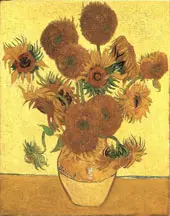
In terms of famous paintings by Vincent van Gogh, "Sunflowers" (1889) is one of his most famous paintings. He created five separate versions of this painting, each with varying colors and arrangements.
After seeing Impressionist art in Paris, particularly the paintings of Claude Monet and Camille Pissarro, he introduced brighter colors into his work. The result is increasingly extreme color contrasts in his later sunflower paintings.
Indeed, Van Gogh’s early paintings, such as The Potato Eaters or Still Life with Bible (1885), employed incredibly dark palettes and reflect his study of Dutch painters, including Rembrandt van Rijn and Frans Hals.
He also used these famous sunflowers to decorate Gauguin’s room in Arles. Vincent Van Gogh invited Paul Gauguin to stay with him in the hope that they could set up an artist’s colony. Arriving in October 1888, Gauguin stayed for only 63 days after a series of explosive arguments.
What is the story behind The Starry Night painting?
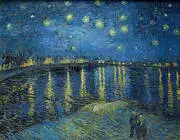
Vincent Van Gogh's Starry Night painting is one of the world's most recognizable paintings. Writing to his brother Theo in June 1889, the artist describes a “new study of a starry sky.”
In other letters, he describes the “huge” morning star and the “wheat fields” visible from his bedroom window. This window was in his room at the asylum in Saint-Rémy-de-Provence, where Van Gogh was a patient.
He spent days and nights simply gazing out of this east-facing window at the asylum. Despite lengthy periods observing the landscape, much of Starry Night is imaginary. Indeed, the dream-like village, the moon, and the cypress trees were all variations of reality.
What are Van Gogh's most famous paintings?
In addition to Sunflowers and Starry Night, famous paintings by Vincent van Gogh include works such as Irises and The Night Cafe.
Paintings such as Night Café 1888 demonstrate his evolving style. Writing to his brother, Van Gogh described how he tried to express the “terrible passions of humanity” with the “blood red” walls and green billiard table.
Vincent van Gogh’s Irises (1899) is one of his most beautiful and valuable paintings. It sold for $54 million at Sotheby's in New York on November 11, 1987. Scholars believe this is the first painting he created after his mental health breakdown and entering the Saint-Paul de Mausole asylum. The breakdown resulted in Van Gogh severing his ear before voluntarily committing to the institution.
In addition to his striking landscapes, still-life paintings, and townscapes, he is also well-known for his portrait paintings. While he created several notable portraits of sitters, such as Père Tanguy and The Postman Joseph Roulin, Van Gogh’s self-portraits are among his most recognizable and famous paintings.
He once said portraits were the “only thing in painting” that “moves me deeply.” Indeed, Van Gogh’s self-portraits give a fascinating insight into his evolving painterly style and mental state. His Self Portrait with Bandaged Ear (painted shortly after his breakdown in Arles) is a truly iconic work.
What is van Gogh's Most Expensive Painting?
Van Gogh’s Portrait of Dr. Paul Gachet is one of his most expensive artworks. It set an impressive precedent for the artist, selling for $83 million on May 15, 1990. Indeed, in today’s money, this equals $180 million.
The painting holds particular interest, as Dr. Gachet was a significant figure in Van Gogh’s life. He cared for the artist after he shot himself in Auvers-sur-Oise, making Gachet one of the last people in Van Gogh’s company. Purchased by a Tokyo buyer (the businessman Ryoei Saito), it also demonstrates the deep Japanese appreciation for Impressionist and Post-Impressionist art.
What are five interesting facts about Vincent van Gogh?
Here are five lesser-known facts about this artist’s fascinating life and work.
- Van Gogh liked a joke. There’s a Van Gogh skeleton painting depicting a skull with a burning cigarette. He painted it as a juvenile joke while studying at Antwerp's prestigious art academy. While drawing skeletons formed part of the curriculum, painting them (with cigarettes) did not.
- Van Gogh only sold one painting. Surprisingly, Van Gogh only sold one painting in his lifetime: Red Vineyard at Arles (sold for 400 Francs).
Van Gogh lived most of his life in poverty. As a young man, he worked as a religious missionary in Belgium, giving away all his possessions. It was only after his dismissal by church authorities (for causing scandals with his literal interpretations of Jesus’s life) that Van Gogh started painting seriously. - Van Gogh’s nickname was the “Redheaded Madman.” It is common knowledge that Van Gogh suffered from mental health issues throughout his life. In addition, he experienced frequent poverty and malnutrition. As a result, he often experienced hallucinations, earning his nickname “le fou roux” amongst his neighbors in Arles.
- Van Gogh produced 43 self-portraits. Van Gogh rarely had enough money to pay for models. He also had a limited social circle, often falling out with his few friends. Consequently, Van Gogh painted over 40 stunning self-portraits, using himself as the only model available.
- Van Gogh painted over his art. In 2022, art historians discovered a Van Gogh self-portrait hidden behind another painting, Head of a Peasant Woman.
As staggering as this discovery was, this was a regular cost-saving trick used by Van Gogh. He often painted over artworks instead of buying new canvases.
How many paintings did Van Gogh create in his lifetime?
Although Van Gogh died at 37, he produced hundreds of oil paintings during his brief career. He created almost 900 oil paintings and around 1,100 works on paper. Given that Van Gogh only took up painting at the age of 27. It is a truly astounding amount.
Van Gogh shot himself on 27 July 1890. He died from the infected wound two days later. Van Gogh’s poignant last words to his brother were, “The sadness will last forever.”
Van Gogh’s Wheat Field with Crows (1890) was one of the last paintings created before his death. With ominous black birds circling over the jagged yellow corn, it is a fittingly intense final work.
How many of Van Gogh's Famous Paintings Still Exist?
While Van Gogh produced around 2,000 artworks during his lifetime, approximately 85 are currently “missing” or in an “unknown location.”
The fact that so few artworks are missing (despite the turmoil of two world wars) is down to his own family’s care. Van Gogh left most of his paintings to his brother Theo. After his death, Jo (Theo’s wife) sold several of Vincent's paintings. However, she kept many of them, forming the basis of the Amsterdam Van Gogh museum’s collection.
What made Van Gogh a Famous Artist?
Sadly, he never found artistic fame during his lifetime. Arguably, it wasn’t even his paintings that earned his fame. Instead, Theo’s widow published the brothers’ letters in 1914. Then, after Theo died in 1891, she spent many years carefully compiling and sorting these touching family notes. They fostered an interest in the little-known artist by offering a fascinating insight into his life. After this date, Van Gogh’s reputation continued to grow.
Why is Van Gogh Important?
He is important for his vivid imagination, bright colors, and skillful yet spontaneous brushwork. Unfortunately, in recent years, he’s also become a quintessential tortured artist stereotype. His famous art features in prestigious galleries and museums around the world. For instance, the MoMA collection includes paintings such as van Gogh's Starry Night and The Olive Trees.
Van Gogh also influenced a generation of later artists, particularly inspiring Expressionist artists, as well as Fauvist and early abstract painters.
Fine Art Reproductions of Famous Paintings.
If you love the colorful creativity of Vincent van Gogh’s artwork, explore our extensive collection of Post Impressionist reproduction oil paintings. From Irises to Sunflowers, The Night Café, and Starry Night, you’ll find Van Gogh art reproductions on canvas to enrich your life and your walls.




Testimonial from JV, Houston, Texas

Enter Your Private Gallery
Log in with your gallery ID here
Track Your Order
Type your order number here



Cannot Find What You Are Looking For?
Reproduction Gallery Information
Customer Service

(Send Us A Message)

Tel: (302) 513 3464