




Famous Nude Paintings: A Brief Introduction
Buy your oil painting reproductions of famous nudes here.
What Are Famous Nude Paintings?
Famous nude paintings are major works of Western art in which the unclothed human figure is used to explore anatomy, mythology, beauty, desire, religion, realism, psychology, and modern identity. From Botticelli and Titian to Manet, Picasso, and Modigliani, these paintings reveal how artists redefined the body across changing periods of art history.
During the Renaissance, artists such as Leonardo da Vinci and Michelangelo studied the body obsessively through anatomy, sculpture, and life drawing. Renaissance painters often searched for ideal proportion and harmony, while later artists used the nude very differently, exploring sensuality, realism, vulnerability, alienation, and emotional instability.
The graceful linear rhythms of Sandro Botticelli feel worlds away from the fractured bodies of Pablo Picasso or the confrontational realism of Édouard Manet. You can often trace the history of Western painting simply by looking at how artists treated the human body.
Why Nude Paintings Became Central to Western Art
Interest in the nude expanded dramatically during the Renaissance as Italian artists and scholars rediscovered the art and philosophy of ancient Greece and Rome. Classical sculpture presented the human body as something ordered, balanced, and idealized rather than purely symbolic or religious. For many Renaissance thinkers, physical beauty reflected harmony and intelligence within the natural world itself.
Mythological subjects also gave painters greater freedom to depict the unclothed figure outside strictly religious settings. Patrons connected to powerful courts in Florence, Venice, and Rome increasingly commissioned paintings inspired by Classical literature, poetry, and ancient history. The depiction of the human body increasingly reflected artistic ambition, education, and cultural refinement.
Over time, artists used the nude in very different ways. Baroque painters introduced greater sensuality and theatrical drama, while 19th century artists pushed the figure toward realism and modern life. By the 20th century, painters such as Pablo Picasso and Édouard Manet no longer sought ideal beauty at all. The body often appeared psychologically tense, confrontational, and at times deliberately unsettling.
H2: Renaissance Nude Paintings and Classical Influence
Renaissance painters returned repeatedly to subjects drawn from Classical mythology because ancient Greek and Roman art offered a very different way of thinking about the human body. Instead of treating figures purely as religious symbols, many Renaissance artists became interested in proportion, movement, beauty, and the relationship between physical form and intellectual harmony. Mythological subjects also gave painters greater freedom to depict the nude outside strictly religious art.
The Birth of Venus by Sandro Botticelli
Few paintings capture the atmosphere of Renaissance Florence more completely than The Birth of Venus. Painted around 1485–1486 for the House of Medici, the work presents Venus arriving on shore upon a shell while wind and drapery move rhythmically across the surface of the painting.
Now in the Uffizi Gallery collection, the large canvas measures approximately 172.5 x 278.9 cm (67.9 x 109.8 in). Precise anatomical realism was never Sandro Botticelli’s main concern. His figures are shaped more by flowing contour, rhythm, and elegance. The figure feels elongated, weightless, and almost unreal at times. What gives the painting its power is not physical accuracy, but flowing contour, decorative rhythm, and a sense of poetic elegance that still feels distinctive centuries later.
The painting also reflects the intellectual culture of Renaissance Florence, where beauty was sometimes connected to spiritual and philosophical ideas rather than simple physical appearance alone.
Venus of Urbino by Titian
When Titian painted the Venus of Urbino in 1538, he pushed the tradition of the nude in a much more intimate direction. Earlier mythological figures often feel distant or symbolic. Titian’s Venus does not. She occupies a quiet domestic interior filled with warm color, soft fabric, and carefully observed texture, while meeting the viewer’s gaze directly.
The painting remains one of the best-known works in the Uffizi Gallery and measures approximately 119 x 165 cm (46.8 x 65 in). Venetian painters were famous for their handling of color and surface, and Titian used subtle shifts in flesh tone, fabric, and light to give the figure an unusual physical presence. Later artists, including Diego Velázquez, Francisco de Goya, and Édouard Manet, would reinterpret that direct relationship between the nude figure and the viewer in very different ways.
Rather than presenting the body as an abstract ideal, Titian helped move European painting toward something more personal, sensual, and psychologically immediate.
How Baroque and Romantic Artists Reimagined the Nude
By the 17th century, European painters were treating the nude very differently from earlier Renaissance artists. Baroque painters introduced deeper shadow, stronger emotional tension, richer atmosphere, and a greater sense of physical immediacy. Figures no longer appeared calm and perfectly balanced in the Renaissance manner. Paintings became more sensual, dramatic, and psychologically charged.
During the late 18th and early 19th centuries, Romantic artists pushed the nude further away from Classical idealism. Individual emotion, ambiguity, realism, and human vulnerability became increasingly important. Instead of presenting the body as a perfect ideal, many artists began treating it as something more personal, unstable, and emotionally complex.
The Rokeby Venus by Diego Velázquez
The Rokeby Venus feels unusually restrained for a Baroque nude painting. Painted by Diego Velázquez between about 1647 and 1651, the work avoids the heavy drama and elaborate symbolism common in much 17th century European art.
Instead, Velázquez created something quieter and more intimate. Venus reclines with her back turned toward the viewer while looking into a mirror held by Cupid. The softened shadows, muted color palette, and controlled lighting give the painting a calm, almost distant atmosphere rather than overt sensuality.
Today, the painting is held in the National Gallery, London. Many later figurative painters admired the work precisely because of its restraint. Velázquez allows mood, ambiguity, and reflection to carry much of the painting’s emotional weight.
La Maja Desnuda by Francisco de Goya
When Francisco de Goya painted La Maja Desnuda around 1797–1800, its directness was highly unusual. Earlier European nude paintings were often presented through mythology or allegory, but Goya removed that distance completely. The figure confronts the viewer openly and without apology.
The painting is now part of the collection of the Museo del Prado. Goya treated the body with a realism that felt very different from the polished idealization associated with much Renaissance and Academic painting. The figure appears individual, immediate, and psychologically present rather than symbolically perfect.
In many ways, La Maja Desnuda points toward the more confrontational realism that later emerged in 19th century modern art.
How Academic Artists Idealized the Human Figure
19th century Academic painters frequently pursued an ideal of technical refinement rooted in Renaissance art and Classical sculpture. Salon audiences often admired paintings with invisible brushwork, smooth surfaces, carefully modeled anatomy, and idealized beauty. The nude became one of the principal demonstrations of academic training because it required mastery of anatomy, tonal modeling, proportion, composition, and finish.
How Modern Art Transformed Nude Painting
Modern painters approached the nude very differently from earlier Renaissance and Academic artists. Ideal proportion and polished beauty became less important than realism, emotional tension, sexuality, and psychological complexity. Some artists focused on urban modern life, while others distorted or fragmented the body altogether to challenge traditional ideas about beauty and representation.
Visible brushwork, flattened space, abrupt tonal contrasts, and fractured forms increasingly replaced the smooth illusionism admired in Academic painting. Artists no longer treated the unclothed figure simply as classical perfection. Modern painters increasingly use the human figure to explore alienation, instability, and psychological tension.
Olympia by Édouard Manet
When Édouard Manet exhibited Olympia at the Paris Salon in 1865, many viewers reacted with hostility. Critics were unsettled not only by the subject itself but by the painting’s modern directness. Instead of presenting an idealized mythological figure, Manet showed a contemporary woman meeting the viewer’s gaze openly and without apology.
The painting is now one of the best-known works in the Musée d'Orsay and measures approximately 130.5 x 190 cm (51.4 x 74.8 in). The flattened space, abrupt tonal contrasts, and visible brushwork felt deliberately harsh compared with the polished surfaces associated with Academic painting. Olympia helped shift modern art away from perfected illusion and toward something more immediate, urban, and psychologically confrontational.
Les Demoiselles d’Avignon by Pablo Picasso
Few paintings disrupted the history of Western art more dramatically than Les Demoiselles d'Avignon. Painted in 1907, the work broke apart many of the visual rules that had shaped European painting since the Renaissance. Perspective becomes unstable, bodies fracture into sharp angular forms, and the figures feel aggressive rather than harmonious.
The monumental canvas, now held in the Museum of Modern Art, New York, measures approximately 243.9 x 233.7 cm (96 x 92 in). Pablo Picasso drew partly from Iberian sculpture and African art, although modern scholarship approaches these influences more carefully and critically than earlier art criticism often did. The painting became one of the foundations of Cubism and permanently changed how artists approached the human figure in modern art.
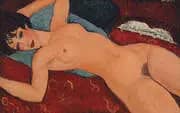
Reclining Nude 1917 by Amedeo Modigliani
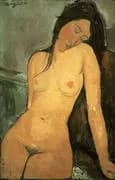
The reclining nude paintings created by Amedeo Modigliani between roughly 1916 and 1919 remain some of the most recognizable images in 20th century figurative art. Modigliani simplified the body into elongated curves, narrow faces, stretched proportions, and flowing contour lines that feel both sensual and emotionally distant at the same time.
Unlike the muscular anatomical precision admired during the Renaissance, Modigliani treated the figure more as an expressive arrangement of shape, rhythm, and surface. His paintings combine influences from Italian portrait tradition, African sculpture, and modernist simplification while still retaining a strong sense of intimacy and human presence.
Several important examples from the series are now held in major museum collections, including the Museum of Modern Art, while others remain in private collections.
Why Nude Painting Was Technically Difficult for Artists
For centuries, European art academies treated the nude figure as one of the hardest subjects a painter could attempt successfully. The human body is immediately recognizable, which means even small mistakes in anatomy, balance, proportion, or movement can make a figure feel awkward or unconvincing.
Artists trained for years through life drawing, anatomical study, and plaster casts before attempting large figurative paintings. Painters needed to understand how weight shifted through the body, how muscles stretched under tension, and how light moved across skin and curved surfaces. Flesh tones were especially difficult because subtle changes in temperature, shadow, and reflected light could quickly make a figure appear flat or artificial.
Large multi-figure compositions introduced even greater challenges. Maintaining believable anatomy across complicated poses, shifting light, and interacting bodies required extraordinary control over drawing, proportion, and spatial balance. Because of this, mastery of the nude became closely associated with artistic skill and professional ambition throughout the history of Western painting.
The Evolution of the Male Nude in Western Art
Although female figures became especially prominent in European nude painting, the male body remained equally important throughout the history of Western art. Renaissance artists often treated the male nude as a symbol of strength, heroism, and ideal proportion, inspired by ancient Greek and Roman sculpture.
Works associated with Michelangelo emphasized muscular tension, physical power, and monumental scale. In many Renaissance paintings and sculptures, the male figure represented discipline, intellect, spiritual authority, or heroic achievement as much as physical beauty.
Later artists approached the male body very differently. Romantic painters introduced greater emotional intensity and vulnerability, while modern artists increasingly explored identity, isolation, sexuality, athleticism, and psychological tension through depictions of the male figure. Over time, artists moved away from heroic beauty and explored the male figure with greater emotional and psychological complexity.
How Nude Paintings Shaped Modern Art
Many of the most important developments in Western painting emerged directly from artists attempting to reinterpret the human figure. Renaissance anatomy studies, Baroque sensuality, Academic idealization, Impressionist realism, Cubist fragmentation, and modern abstraction all reshaped how the body could be represented visually.
Because of this, famous nude paintings continue to occupy a central place within museums, art history scholarship, academic study, and contemporary collecting. Artwork associated with institutions such as the Uffizi Gallery, Musée d'Orsay, Museo del Prado, and the Museum of Modern Art remains among the most studied and widely reproduced paintings in the history of art.
Their influence extends far beyond traditional painting into photography, cinema, fashion, advertising, contemporary figurative art, and modern visual culture itself.
Collecting Reproductions of Famous Nude Paintings
Collectors continue to commission reproductions of famous nude paintings not only because of their historical importance, but because many of these works still feel visually powerful in contemporary interiors. Renaissance mythological scenes, Baroque figurative paintings, and modernist nudes all bring very different moods, textures, and atmospheres into a space.
At Reproduction Gallery, every painting is created entirely by hand using traditional oil-on-canvas techniques rather than prints or giclée reproductions. The family-owned studio has specialized in museum-quality oil painting reproductions since 1996, with artists working carefully to preserve original proportions, color relationships, and overall character of the original composition.
Large figurative paintings can be especially difficult to reproduce successfully because even small distortions in anatomy or proportion become immediately noticeable at scale. Custom commissions are available up to 225 cm (89"} on the shortest side while maintaining the original aspect ratio of the artwork. Paintings associated with museums such as the Uffizi Gallery and Musée d'Orsay can therefore be recreated for private collections using traditional hand-painted oil techniques.







Enter Your Private Gallery
Log in with your gallery ID here
Track Your Order
Type your order number here
Most Popular Artists