




Famous Angel replica paintings on Canvas for sale
Buy famous angel reproduction oil paintings
What is the History of Famous Angel Paintings?
Famous Angel paintings were first discovered from the 3rd Century onwards. From this moment, angels in paintings have remained enduringly popular, gracing art and the popular imagination with their ethereal presence.
While angels are usually depicted as beautiful and serene, they can also range from awe-inspiring and frightening creatures to cute cherubim with chubby cheeks and innocent faces. Some of the greatest paintings in history depict angels. From the Italian Renaissance art movement through to the Dutch Golden Age era of painting and then the Modern Art Movement, the topic of Angels in Art has enthralled artists and the art-loving public alike.
To commemorate this unique art historical phenomenon, please enjoy our guide to some of the most famous angel paintings ever created.
What is the Timeline of Most Famous Angel Paintings?
Artistic depictions of angels have incredibly early origins. As well as appearing in Medieval Illuminated manuscripts and Byzantine art, some of the earliest angels in paintings were found in the “Catacomb of Priscilla”. A Christian burial site dating back to the 3rd century in Rome, this unique archaeological site features numerous religious frescoes that narrate biblical passages.
This rich tradition continued through the centuries, with Renaissance angel paintings becoming some of the most recognizable images in the history of religious art. Unlike medieval portrayals, however, Renaissance angels began to appear in more humanized and realistic forms. This progression coincided with the concurrent shift towards naturalism during the High Renaissance, as evidenced in the art of great masters such as Raphael, Leonardo da Vinci, and Caravaggio.
To provide a brief introduction to famous angel paintings, we’ve compiled a timeline of some of our most popular paintings of angel art reproductions.
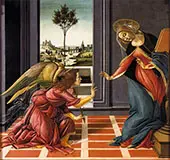
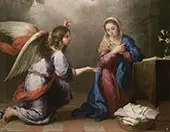
- Sandro Botticelli, The Angel of the Annunciation (1481). In this early Renaissance painting of angels, the Annunciation (referencing Angel Gabriel’s announcement to the Virgin Mary of her impending motherhood) is set within a contemporary Italian Renaissance palace. As well as a beautiful example of religious art in its own right, Botticelli’s famous painting offers fascinating glimpses into popular furnishings. For instance, Mary kneels on an incredible and intricate carpet. It is also full of symbolism, with elements such as the walled garden symbolizing Mary’s purity. The heavenly realm on the right (full of worldly possessions) further contrasts with the angelic, serene messenger on the left.
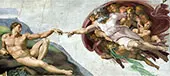
- Michelangelo, The Creation of Adam (c1512). Part of the Sistine Chapel ceiling, Michelangelo’s "The Creation of Adam" illustrates the biblical account of creation. God thus breathes life into Adam, surrounded by a whole host of angelic forms. Despite the straightforward narrative, debates persist regarding the identity of these twelve figures. Some argue they represent Eve and the entirety of the human race. Conversely, others believe the Virgin Mary appears beside God. Yet more alternative interpretations posit a group of heavenly beings. Perhaps it’s an art historical debate destined to remain a mystery.
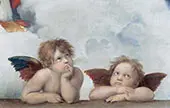
- Raphael, The Sistine Madonna (c1513). Among Renaissance cherub paintings, Raphael’s curious putti paintings are among the most recognizable images of angels of all time. Commissioned by Pope Julius II, Raphael's angels represent the Virgin Mary cradling the baby Jesus. Underneath, however, are two innocent yet intriguing putti. Represented as roughly the same age as Jesus, the cherubs have tousled hair, feathered wings, and adorable chubby physiques. Although their identity remains a mystery, they could be the children of Raphael’s model for the Virgin Mary.
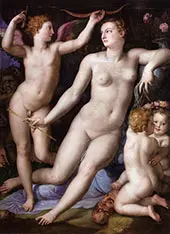
- Agnolo Bronzino, Venus, Cupid and Envy (1548). As one of Bronzino’s most enigmatic and complex cupid art, this “angel” painting represents the goddess Venus. She gazes provocatively towards her son (Cupid) with both figures presented in full frontal nudity. To the right of the painting, however, are two cherub figures, innocent and cherubic. Harking back to Raphael’s iconic Renaissance cherub paintings, they remain uninvolved in the rest of the scene. Despite the association with angels, the two masks at Venus’s feet suggest she and Cupid exploit lust in a thoroughly un-angelic and deceptive manner.
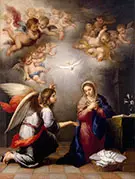
- El Greco, The Annunciation (c1596). Drawing on the same theme as Sandro Botticelli, but completely modernizing the approach, El Greco’s Annunciation painting is a rare and distinctive example of angels in art. In vertical format, this Spanish Renaissance painting of angels is a swirling composition, and ghostly light enhances the otherworldly aspect of the angelic characters. Painted with highly expressive features and intensely contrasting tones, it’s a perfect example of El Greco’s highly individual style in the latter stages of his artistic career.
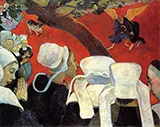
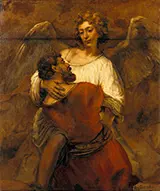
- Rembrandt van Rijn, Jacob Wrestling with the Angel (1659). Jacob Wrestling with the Angel is a theme frequently explored by various artists. Rembrandt's painting is one of the most famous and best-loved examples of Rembrandt's Angel art. His painting emphasizes the strength and power of the female angel in contrast to Jacob and humanity. Her white clothing and serene expression shine with a heavenly light against Jacob’s darker tunic and pained expression. Many Christian interpretations treat the story as a man wrestling with God himself. The theme was also notably represented by Paul Gauguin in Jacob Wrestling the Angel, The Vision.
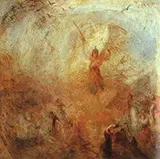
- Joseph M. W. Turner, The Angel Standing in the Sun (1846). A highly unusual and expressive painting of angels, Turner's art (created late in Turner’s career) depicts a scene from the Old Testament. In Turner's oil painting, the Archangel Michael brandishes his flaming sword with scenes of betrayal and murder in the foreground. This includes Adam and Eve mourning Abel and Judith with the headless body of Holofernes. Painted in the latter stages of Turner’s life, it references his concerns. Importantly, these worries centered around how Turner’s own life and actions would be judged in the afterlife. Indeed, the artist exhibited the painting with the ominous and enigmatic description: “the feast of vultures when the day is done”.
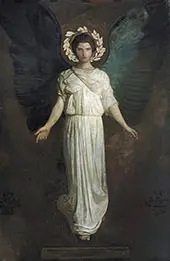
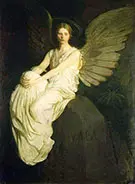
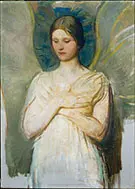
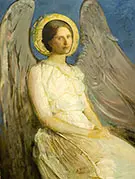
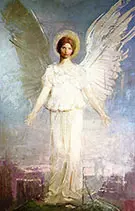
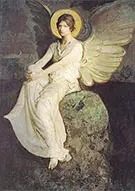
- Abbott Handerson Thayer, Winged Figure (1889). Currently on display at the Art Institute of Chicago, Thayer’s Winged Figure is the last painting on our timeline. Moving forward to the present day, it represents an angelic individual in a truly serene and peaceful manner. Speaking of his many angel wing paintings, Thayer commented he put wings on figures to “symbolize an exalted atmosphere”. For Abbott HandersonThayer, this negated the need to explain their actions. His otherworldly idealism is tempered by a sense of mass and gravity in this portrait, however. The artist’s extremely naturalistic investigation of the female form demonstrates his technical skill as well as astounding imagination.
- Paintings of Nymphs and Angels: William Adolphe Bouguereau. In this introduction to famous angel paintings, we couldn’t fail to mention Bouguereau paintings. As a French painter inspired by Classical art and mythology, Bouguereau’s paintings of nymphs and angels define the modern angelic imagination. Famous paintings such as "The Assault" (1898), "Abduction of Psyche" (1895), and "Le Printemps" or "The Return of Spring" (1886) all display an astoundingly lifelike portrayal of human and angelic forms in Bouguereau's art. His exploration of the theme continues with numerous paintings of cherubs, most famously First Kiss, L’Amour et Psyché, Enfants (1890), and the beautiful yet troubling Wet Cupid. Whilst you may recognize the imagery, William Adolphe Bouguereau’s name isn’t that well-known today. Despite this, he won high praise from contemporary impressionist artists such as Edgar Degas and Claude Monet. These legendary figures particularly admired his astounding technical proficiency and the sheer beauty of his works. With an approach steeped in academic painterly skill and classical art, Bouguereau’s angel paintings remain true masterpieces of heaven.
Did 20th Century artists create Angel Paintings?
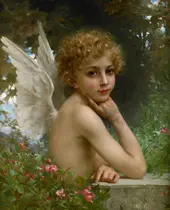
Angel paintings on canvas did not stop with the turn of the 20th century. It is a theme artists have continually returned to, right up to the present day. Indeed, whether it is graffiti artists such as Keith Haring, Anselm Kiefer's neo-expressionist Angel series, or Jeff Koons’ kitsch creations, angels are continuously reimagined and repurposed by modern artists. This ranges from traditional figurative depictions, such as Jules-Cyrille Cave’s The Thoughtful Angel (1903), to surreal expressionist masterpieces, such as Poor Angel (1939) by Paul Klee.
To conclude this overview, however, no introduction to angels in art would be complete without mentioning Marc Chagall. In 20th-century oil paintings, such as "Jacob Wrestling the Angel" and "Jacob’s Ladder," Chagall created some of the most iconic and imaginative portrayals of angels ever seen.
In these paintings, his colorful, joyful, and acrobatic angels dance around dream-like compositions. They consequently present the deep connection between earth and heaven, good and evil, reality and the artistic imagination, providing a fitting culmination to this endlessly fascinating theme.
If you’re looking for beautiful angel paintings on canvas, explore our hand-crafted collection of replica art today.
We have an unparalleled selection of art reproductions on canvas for sale. So, whether you’re searching for Religious art, Renaissance masterpieces, or modern abstract paintings, enjoy discovering museum quality oil painting reproductions to enrich your life and your walls.

Enter Your Private Gallery
Log in with your gallery ID here
Track Your Order
Type your order number here




Cannot Find What You Are Looking For?
Reproduction Gallery Information
Customer Service

(Send Us A Message)

Tel: (302) 513 3464