




Popular Oil Painting Reproductions on Canvas
Every painting is a hand painted reproduction oil painting, created by a talented artist and comes with a 100% Money Back Guarantee and free shipping worldwide.
Most Popular Paintings and Hand-Painted Oil Reproductions
Art history is filled with important works that remain relatively unknown outside academic circles. Only a small number enter broader public consciousness and become woven into everyday visual culture.
Sometimes a painting survives because it introduced a radically new approach to light, color, or composition. In other cases, its emotional atmosphere continues resonating long after the historical circumstances surrounding its creation have faded. Certain images seem capable of adapting endlessly to changing generations without losing their original force.
Institutional visibility has profoundly shaped which paintings remain culturally dominant over time. Paintings exhibited continuously inside internationally recognized collections accumulate authority through scholarship, conservation, tourism, education, and repeated reproduction over centuries. Eventually, the image stops functioning solely as an artwork and begins operating as part of shared cultural memory.
Why Some Paintings Become Permanently Recognizable
Art history contains countless remarkable works that rarely enter wider public awareness. A much smaller group crosses into collective consciousness and becomes almost impossible to separate from the broader history of visual culture itself.
In some cases, artistic innovation permanently altered the direction of painting itself. Sometimes it is emotional power. Occasionally, a painting becomes unforgettable because of a single expression, atmosphere, gesture, or visual idea that permanently embeds itself within public imagination.
Museum visibility also shapes reputation over time. Paintings exhibited continuously inside internationally recognized institutions accumulate cultural weight through tourism, education, conservation, publishing, and repeated reproduction across generations.
Eventually, the image stops functioning merely as a painting and begins operating as a cultural symbol.
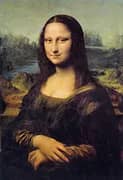
Mona Lisa by Leonardo da Vinci
Leonardo da Vinci’s Mona Lisa (c. 1503–1506) has been reproduced so frequently that many people arrive at the original painting expecting familiarity.
Leonardo da Vinci avoided the rigid formality common to many Renaissance portraits. The expression appears to fluctuate subtly depending on distance and light. Her gaze feels attentive yet emotionally unreachable. Even the landscape behind her seems unstable, dissolving into rivers, winding roads, and geological formations softened through Leonardo’s delicate sfumato technique.
The original painting hangs in the Louvre Museum in Paris and measures only 77 x 53 cm (30 x 21 in), far smaller than many visitors anticipate on first encounter.
Yet its physical modesty intensifies the experience rather than diminishing it. Leonardo creates intimacy instead of spectacle.
Unlike portraits intended primarily to communicate wealth or status, the Mona Lisa feels psychologically unresolved. The painting never settles into a fixed emotional state. More than five centuries later, viewers still project new interpretations onto the painting’s unresolved expression.
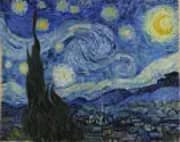
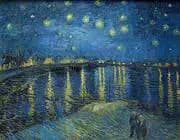
The Starry Night by Vincent van Gogh
The sky in The Starry Night appears to move under emotional pressure.
During his stay at the asylum in Saint-Rémy-de-Provence in 1889, Vincent van Gogh transformed the landscape into a field of unstable energy.
Rather than pursuing naturalistic observation, Van Gogh constructed the painting through rhythm, texture, and movement. Thick impasto and directional brushwork create a surface that changes constantly as light moves across it. The painting feels physically built rather than smoothly rendered.
The painting is preserved today at the Museum of Modern Art in New York, with dimensions of 73.7 x 92.1 cm (29 x 36¼ in).
Yet its emotional scale feels much larger in person because of the extraordinary energy compressed into the composition.
Its lasting power emerges from the uneasy balance between turbulence and structure. Beneath the turbulent sky, the village remains silent and structured. Van Gogh allows emotional unrest to remain visible without permitting the painting to collapse entirely into chaos.
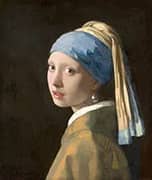
Girl with a Pearl Earring by Johannes Vermeer
Johannes Vermeer approached painting with extraordinary restraint.
Dating from around 1665 during the Dutch Golden Age and housed today in the Mauritshuis in The Hague, Girl with a Pearl Earring contains remarkably little narrative information compared to many Baroque paintings of its period.
There is no elaborate architectural setting, no mythological subject, and no dramatic theatrical gesture directing interpretation. The figure simply emerges from darkness.
Prolonged viewing only deepens the sense of ambiguity surrounding the figure. Light rests briefly on the lips before dissolving into shadow. The pearl reflects a cool point of illumination. The expression feels suspended somewhere between recognition and distance.
Only around thirty-five Vermeer paintings are generally accepted as authentic today, which contributes partly to the extraordinary fascination surrounding his work. At just 44.5 x 39 cm (17½ x 15⅜ in), Girl with a Pearl Earring achieves an intimacy that many monumental paintings struggle to match.
Its emotional power comes largely from what remains unresolved. The girl never fully explains herself to the viewer.
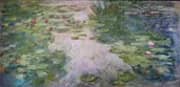
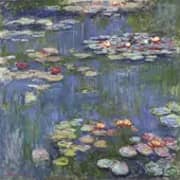
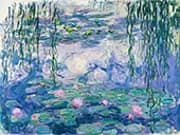
Water Lilies by Claude Monet
By the final decades of his career, French artist Claude Monet had largely abandoned traditional landscape structure.
Developed between c. 1897 and 1926, the Water Lilies series dissolves many of the visual conventions that had shaped European painting for centuries.
Horizons disappear almost entirely. Reflections merge with water and sky. Space fragments into shifting color, atmosphere, and light.
Monet returned repeatedly to the ponds at Giverny between the 1890s and 1926, eventually producing roughly 250 paintings connected to the series. What began within Impressionism gradually evolved toward something increasingly immersive and abstract.
Monet’s deteriorating eyesight also influenced many later works. Cataracts altered his perception of color and softened visual clarity, contributing to the diffuse atmosphere visible throughout the paintings.
The monumental panoramic panels installed inside the Musée de l’Orangerie in Paris intensify this immersive effect physically, with certain works extending to approximately 200 x 600 cm (79 x 236 in). These panoramic works surround viewers with drifting reflections and chromatic movement rather than conventional perspective.
Despite their scale, however, Monet’s paintings rarely feel overwhelming. Their softened tonal relationships allow them to expand gently through interior space, which helps explain why Impressionist reproductions and paintings by famous French artists remain especially popular within contemporary homes and quieter architectural interiors.
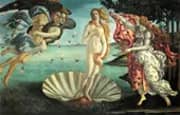
The Birth of Venus by Sandro Botticelli
Sandro Botticelli treated mythology less as historical narrative and more as visual poetry.
Created during the height of Renaissance Florence between 1484 and 1486, The Birth of Venus now hangs in the Uffizi Gallery and spans 172.5 x 278.9 cm (67⅞ x 109⅝ in).
Hair moves unnaturally through the air. Drapery twists rhythmically across the composition. The figures seem governed by elegance and choreography rather than anatomical weight.
Botticelli transformed classical mythology into something decorative, lyrical, and idealized. The painting exists somewhere between fantasy, court culture, and theatrical invention.
Centuries later, its influence remains visible throughout fashion photography, luxury branding, cinema, and decorative arts. Few Renaissance paintings have maintained such continuous visibility within contemporary visual culture.
Nighthawks by Edward Hopper
Edward Hopper painted urban loneliness with remarkable precision.
Completed in 1942, Nighthawks presents a brightly illuminated diner isolated within nearly empty nighttime streets and harsh artificial light.
On display at the Art Institute of Chicago, the scene initially appears ordinary, though the atmosphere becomes increasingly uneasy over time.
The figures occupy the same space without genuinely connecting. Large areas of empty sidewalk, reflective glass, and harsh electric light create emotional distance rather than comfort.
Hopper shared certain interests with the earlier Ashcan School painters, particularly their attention to modern American city life outside idealized academic subjects. Yet where Ashcan artists often emphasized movement, crowds, and working-class energy, Hopper reduced the city to stillness and psychological isolation.
The composition later influenced film noir cinematography, photography, advertising, and countless cinematic depictions of urban alienation. Its silence remains one of its most unsettling qualities.
The Fighting Temeraire by J.M.W. Turner
J.M.W. Turner transformed landscape painting into atmosphere decades before abstraction emerged formally within modern art.
Turner completed The Fighting Temeraire in 1839, and the painting now remains one of the defining works in the National Gallery, London.
The Fighting Temeraire depicts a once-celebrated British warship being pulled toward dismantling by a modern steam tug. The historical symbolism is clear, though Turner places greater emphasis on light, color, and atmosphere than narrative detail.
Smoke dissolves into glowing sunset haze. Reflections spread softly across the water. Large areas of the painting hover between structure and dissolution.
Although relatively modest in scale at 90.7 x 121.6 cm (35.7 x 47.8 in), it derives much of its emotional force from atmosphere rather than sheer monumentality. Turner presents industrial progress not triumphantly, but elegiacally.
Many later artists would recognize in Turner’s dissolving forms an early movement toward abstraction and modern atmospheric art.
Why These Paintings Continue to Be Reproduced
The lasting popularity of these works extends beyond simple recognition. Their compositions, tonal relationships, and emotional atmosphere continue functioning naturally inside contemporary interiors despite changing decorative trends.
Some paintings introduce calmness through softened color and diffused light. Others create tension, movement, theatricality, or psychological complexity. Renaissance works often bring symmetry and order, while Impressionist and Post-Impressionist art tends to introduce fluidity and chromatic movement.
Collectors are not responding only to historical importance. They are responding to visual experience itself.
This continued adaptability allows centuries-old paintings to remain visually convincing within modern architectural and interior environments.
The Lasting Appeal of Hand-Painted Oil Reproductions
Original masterpieces housed inside major museum collections remain inaccessible to most collectors because they are permanently institutionalized or valued far beyond private ownership.
Hand-painted oil reproductions preserve many of the physical qualities that define traditional painting in ways digital printing often cannot fully replicate, including:
- visible brush movement
- layered pigment
- tonal depth
- textured surfaces
- changing interaction with natural light
Surface movement and layered pigment are particularly significant when reproducing artists such as Vincent van Gogh, Claude Monet, and J.M.W. Turner, whose paintings depend heavily upon impasto, glazing, atmospheric color transitions, and painterly surface movement.
A carefully executed oil reproduction can preserve much of the visual richness that makes these works compelling when viewed directly.
Why Famous Paintings Continue to Feel Relevant
Decorative fashions change constantly. Historically important artworks tend to survive those cycles because they communicate experiences that remain recognizable across generations.
Some paintings feel psychologically mysterious. Others feel meditative, unstable, theatrical, melancholic, transcendent, or emotionally immersive. The response changes from work to work, though the strongest masterpieces continue rewarding repeated viewing long after their historical moment has passed.
That enduring ability to retain emotional and visual force ultimately separates permanent works of art from temporarily fashionable images.













































Enter Your Private Gallery
Log in with your gallery ID here
Track Your Order
Type your order number here




Cannot Find What You Are Looking For?
Reproduction Gallery Information
Customer Service

(Send Us A Message)

Tel: (302) 513 3464